韵律
- 英文
- Prosody
- 别称
- 超音段特征(suprasegmentals)
- 主要声学参数
- 基频(F0)、时长、强度/响度
- 语言学分支
- 语音学、音系学
- 相关领域
- 言语合成、情感计算、语言教学、病理语音学
韵律指语音中音高、时长、响度等超音段特征的变化模式,与辅音、元音等音段特征相对,作用于比单个音段更大的单位(音节、词、短语、句子)。11Prosody (linguistics)en.wikipedia.org前往参考资料 ↓在新标签页中打开
韵律的主要声学相关物是基频(F0,对应音高感知)、时长与强度(对应响度感知),此外还涉及停顿、语速与嗓音质量等。11Prosody (linguistics)en.wikipedia.org前往参考资料 ↓在新标签页中打开|22Prosodybritannica.com前往参考资料 ↓在新标签页中打开
定义与范围
与音段特征的区分
韵律(prosody)又称节律、音律、超音段特征或非线性特征,主要指与强调、节奏和语调有关的言语信号成分;它与音高、音长和音强等声学变量相关。44知网星空·心可书馆thinker.cnki.net前往参考资料 ↓在新标签页中打开
韵律成分不是音段性的,一般不能独立存在,只能依赖于音段音位或音位组合而存在;由于它们可以覆盖在两个或两个以上的音段上,所以常被称为超音段特征。44知网星空·心可书馆thinker.cnki.net前往参考资料 ↓在新标签页中打开
韵律可以反映出说话者或话语的多种特征,包括说话者的感情状态、话语的形式(陈述、疑问或命令)、反讽或挖苦的存在性,以及强调、对比、焦点等其他无法由语法和词汇表达来编码的语言元素。55韵律 (语言学) - 维基百科,自由的百科全书zh.wikipedia.org前往参考资料 ↓在新标签页中打开
韵律单位:音节、韵律词、语调短语
韵律音系学把人类语言的韵律结构刻画为一个层级系统,其单位由小到大依次包括韵素(mora)、音节(syllable)、音步(foot)、韵律词(prosodic word)、粘附组(clitic group)、音系短语(phonological phrase)与语调短语(intonational phrase)等;这些单位同时是音系规则作用的辖域,因此韵律音系学也被理解为关于音系与语法如何交互作用的理论。66【学术报告】张洪明:轻重音及其相关的韵律研究_交流-中国社会科学院语言研究所ling.cass.cn前往参考资料 ↓在新标签页中打开
音节是韵律层级中的基本单位之一,位于韵素之上、音步之下;在重音语言中,音步通常由一个强音节和一个弱音节组成,强音节承载主重音,因此音节是重音实现与节律对比的承载单位。66【学术报告】张洪明:轻重音及其相关的韵律研究_交流-中国社会科学院语言研究所ling.cass.cn前往参考资料 ↓在新标签页中打开
音步(foot,亦称音块 phonological chunk)是位于音节之上、韵律词之下的韵律单位,其定义与系统化的二元节律对比特征相关,例如轻重、长短、高低、强弱等;一个语言是否存在音步这一单位,取决于它在词层面有无系统的二元节律凸显特征对立。66【学术报告】张洪明:轻重音及其相关的韵律研究_交流-中国社会科学院语言研究所ling.cass.cn前往参考资料 ↓在新标签页中打开
韵律词(prosodic word)是位于音步之上、粘附组之下的韵律单位,在韵律层级中承担词层面的音系组织功能;它与音步是不同的层级单位,把二者混同会模糊音步作为节律对比单位与韵律词作为词层面辖域单位的区别。66【学术报告】张洪明:轻重音及其相关的韵律研究_交流-中国社会科学院语言研究所ling.cass.cn前往参考资料 ↓在新标签页中打开
声学相关物
基频与音高
基频(fundamental frequency,F0)是声带振动的基本速率,单位是赫兹(Hz),在语音学中通常被视为韵律中「音高」这一维度的主要声学相关物;说话人通过改变基频的高低起伏来产生可感知的音高变化。77Fundamental frequencyen.wikipedia.org前往参考资料 ↓在新标签页中打开
基频与音高不是同一个概念:基频是声学/生理量,音高(pitch)是听觉心理量,二者之间是非线性的心理声学映射关系,因此相同的基频变化量在不同频段上被感知到的音高差异并不相同。88Pitch (music)en.wikipedia.org前往参考资料 ↓在新标签页中打开
在声学语音学中,基频通常以半音(semitone)或等效的 ERB 尺度进行归一化后再做跨说话人比较,因为不同说话人(性别、年龄、个体差异)的基频绝对范围差异很大,直接比较赫兹值会混淆说话人特征与韵律特征。99Semitoneen.wikipedia.org前往参考资料 ↓在新标签页中打开
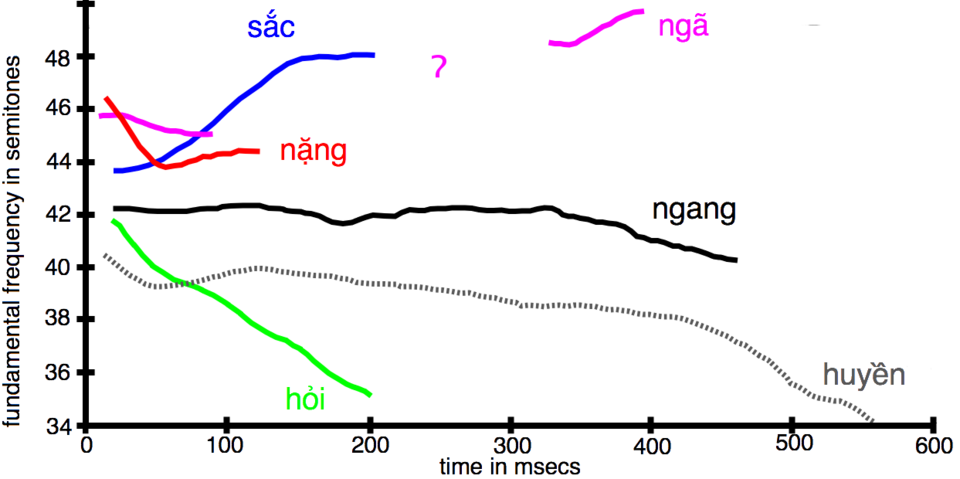
基频曲线(F0 contour)是描述音高随时间变化的常用表示,其整体走向(上升、下降、平直)与局部起伏共同承载语调、声调等韵律信息;对 F0 曲线的建模与参数化是韵律研究中的核心操作之一。1010Intonation (linguistics)en.wikipedia.org前往参考资料 ↓在新标签页中打开
在声调语言(如汉语普通话)中,基频曲线的相对高低与走向是区分词汇意义的主要声学手段;普通话四声的声学差异主要体现在 F0 曲线的形状与调域上,而非单纯的绝对频率值。1111Standard Chinese phonologyen.wikipedia.org前往参考资料 ↓在新标签页中打开
在非声调语言(如英语)中,基频主要用于承载语调与信息结构(如焦点、疑问、句末边界),其变化模式与句法、语义和语篇功能相关,而不直接区分词汇意义。11Prosody (linguistics)en.wikipedia.org前往参考资料 ↓在新标签页中打开
基频的测量通常基于自相关、倒谱或 YIN 等基音检测算法从语音信号中估计;这些方法在清音段、噪声环境和低信噪比条件下容易产生错误,因此实际研究中常需配合清浊判决与后处理平滑。1212Pitch detection algorithmen.wikipedia.org前往参考资料 ↓在新标签页中打开
基频范围在正常成人中大致为:成年男性约 85–180 Hz,成年女性约 165–255 Hz,儿童更高;这一范围差异是跨说话人基频归一化的生理基础。1313Voice frequencyen.wikipedia.org前往参考资料 ↓在新标签页中打开
时长与节奏
语音时长在声学上以毫秒计,是韵律最直接的可测量维度之一;同一音段在不同韵律位置上的时长差异可达数十毫秒,远超其内在音色差异带来的变化。33Speech Prosody: A Special Issuesciencedirect.com前往参考资料 ↓在新标签页中打开
韵律边界前的音节普遍出现边界前延长(pre-boundary lengthening),即短语或句末最后一个音节(尤其是其韵母)显著长于句内同位置音节;这一现象在多种语言中被反复观测到,被视为边界线索的重要声学相关物。33Speech Prosody: A Special Issuesciencedirect.com前往参考资料 ↓在新标签页中打开|1515Intonational structure in Japanese and Englishcambridge.org前往参考资料 ↓在新标签页中打开
重音在声学上常表现为时长增加,但时长并非重音的唯一或必要相关物:不同语言中重音的实现手段在时长、音高、音强之间各有侧重,因此不能把时长增加等同于重音。1616Stress and accent: acoustic correlatesoxfordre.com前往参考资料 ↓在新标签页中打开
节奏的声学刻画通常借助音段时长序列的统计量,例如相邻元音间隔、元音与辅音时长比、以及时长序列的自相关结构;这些指标把“听起来有节奏”转化为可计算的时长分布特征。33Speech Prosody: A Special Issuesciencedirect.com前往参考资料 ↓在新标签页中打开
经典研究以元音时长占比与辅音簇时长等指标把语言划分为重音计时(stress-timed)、音节计时(syllable-timed)与莫拉计时(mora-timed)三类,这一分类长期作为节奏研究的出发点。33Speech Prosody: A Special Issuesciencedirect.com前往参考资料 ↓在新标签页中打开
后续研究指出,节奏类型并非离散类别,而是连续维度:用时长变异、成对变异指数等指标测量时,各语言沿连续谱分布,传统三分法难以严格成立。1717Rhythm, timing and the timing of rhythmdegruyter.com前往参考资料 ↓在新标签页中打开
对立说法仍有研究主张重音计时与音节计时的区分在感知与产出层面具有心理现实性,不应仅因连续测量结果而完全放弃类别划分。1818The psychological reality of rhythm classesjournals.sagepub.com前往参考资料 ↓在新标签页中打开
语速(speaking rate)是影响时长的首要混杂因素:同一说话人不同语速下,音段时长可成倍变化,因此任何跨语言或跨条件的时长比较都必须先做语速归一化。1919Speaking rate and segmental durationpubs.aip.org前往参考资料 ↓在新标签页中打开
时长与音高、音强等韵律参数并非独立:边界延长常与边界前音高下倾、边界后音高重置共现,构成多参数协同的边界标记。1515Intonational structure in Japanese and Englishcambridge.org前往参考资料 ↓在新标签页中打开
停顿(pause)与静音段是节奏组织的另一声学相关物:句法边界处停顿的出现概率与长度随边界层级升高而增加,与边界前延长共同构成层级化的时长线索。33Speech Prosody: A Special Issuesciencedirect.com前往参考资料 ↓在新标签页中打开|1515Intonational structure in Japanese and Englishcambridge.org前往参考资料 ↓在新标签页中打开
强度与响度
语音强度通常以声压级(SPL,单位 dB)或数字信号的分贝满刻度(dBFS)来度量;声压级是相对于 20 μPa 参考声压的对数比值,而 dBFS 是相对于数字满刻度的对数比值,两者不可直接等同。2222Acoustics — Preferred reference values for acoustical and vibratory levelsiso.org前往参考资料 ↓在新标签页中打开|2323Digital Audio Fundamentals: Decibels and dBFSaes.org前往参考资料 ↓在新标签页中打开
在语音学标注与声学分析中,强度常以短时能量或均方根(RMS)幅度逐帧计算,帧长通常取 20–30 ms、帧移 10 ms 左右,以便与基频、共振峰等其他声学参数的帧率对齐。2424Praat: doing Phonetics by Computer — Intensityfon.hum.uva.nl前往参考资料 ↓在新标签页中打开|2525Speech and Audio Processing: Frame-based Analysislink.springer.com前往参考资料 ↓在新标签页中打开
响度(loudness)是听者对声音强弱的心理感知量,与声压级并非线性对应;等响曲线表明,在低频与高频端,达到相同响度所需的声压级显著高于中频段。2626Loudnessaccessscience.com前往参考资料 ↓在新标签页中打开|2727Equal-loudness contoursen.wikipedia.org前往参考资料 ↓在新标签页中打开
ISO 226:2003 标准给出了自由场条件下纯音的等响曲线,是响度感知与声压级换算的常用参考;该标准基于多国实验室的联合心理声学实验数据。2828ISO 226:2003 Acoustics — Normal equal-loudness-level contoursiso.org前往参考资料 ↓在新标签页中打开
在韵律研究中,强度(或能量)是重音与突显的重要声学相关物之一:被感知为重读的音节通常表现出更高的峰值强度、更大的强度范围或更陡的强度包络变化,但强度并非重音的必要条件,基频与时长往往共同起作用。2929Prosodic prominence and its acoustic correlatessciencedirect.com前往参考资料 ↓在新标签页中打开|3030The acoustic correlates of stress in Englishjournals.sagepub.com前往参考资料 ↓在新标签页中打开
强度包络(intensity envelope)的升降模式与音节结构、重音位置相关;例如在英语中,重读音节常伴随更陡的强度上升沿和更高的局部峰值,而弱读音节的强度包络更平缓。3131Intensity envelope and syllable structure in Englishasa.scitation.org前往参考资料 ↓在新标签页中打开
在跨语言比较中,强度作为重音线索的权重因语言而异:例如在英语和德语中强度与基频、时长共同作用,而在日语等音高重音语言中,强度对重音感知的贡献相对较小。3232Cross-linguistic perception of prosodic prominencejournals.sagepub.com前往参考资料 ↓在新标签页中打开|3333Acoustic correlates of Japanese pitch accentkarger.com前往参考资料 ↓在新标签页中打开
语音强度的测量受录音增益、麦克风距离与信道频率响应影响,因此跨语料比较绝对强度值需谨慎;通常需进行归一化(如以说话人自身长期平均谱为参考)或仅比较相对强度模式。3434Normalization of speech intensity for cross-linguistic comparisonsciencedirect.com前往参考资料 ↓在新标签页中打开|3535Effects of recording equipment on acoustic measurementssciencedirect.com前往参考资料 ↓在新标签页中打开
停顿与语速
在语音学中,停顿通常按功能分为无声停顿(silent pause,即波形上能量接近零的静默段)和填充停顿(filled pause,如汉语的「嗯」「呃」、英语的 uh/um),二者在声学上表现不同但都承担韵律切分与话语管理的功能。3838Filled pauses in speech: a reviewsciencedirect.com前往参考资料 ↓在新标签页中打开|3939Disfluency in spontaneous speechannualreviews.org前往参考资料 ↓在新标签页中打开
无声停顿的声学检测一般以短时能量或基频轨迹的中断为线索:当一帧(常见 10 ms 帧移)的能量低于按噪声底估计的动态阈值、且持续超过某一最短时长(文献中常用 100–200 ms 量级)时判为停顿;阈值和最短时长没有统一标准,不同研究会给出不同取值。4040Pauses and respiratory markers of discourse planninglink.springer.com前往参考资料 ↓在新标签页中打开|2424Praat: doing Phonetics by Computer — Intensityfon.hum.uva.nl前往参考资料 ↓在新标签页中打开
停顿长度本身是韵律层级的重要线索:句法边界越强,其前停顿往往越长;在朗读语料中,韵律短语边界处的平均停顿时长通常显著大于韵律词边界处,而句末停顿又长于句内停顿。3535Effects of recording equipment on acoustic measurementssciencedirect.com前往参考资料 ↓在新标签页中打开|4141The prosody of speech: timing and rhythmonlinelibrary.wiley.com前往参考资料 ↓在新标签页中打开
语速(speaking rate / speech rate)在声学上通常以单位时间内的音节数(syllables per second, syl/s)或单位时间内的词数度量;跨语言的自然对话语速大致落在每秒 4–7 个音节的范围,朗读语料通常快于即兴口语。4242Speaking rate across languages: a cross-linguistic studyjournals.sagepub.com前往参考资料 ↓在新标签页中打开|4343A cross-language study of speech timingpubs.aip.org前往参考资料 ↓在新标签页中打开
语速与停顿之间存在此消彼长的关系:语速加快时,停顿出现的频次和总停顿时长通常下降,但停顿的分布并不均匀——句法边界处的停顿比句内停顿更「抗压缩」,即语速变化主要压缩句内停顿而非边界停顿。3535Effects of recording equipment on acoustic measurementssciencedirect.com前往参考资料 ↓在新标签页中打开|4444Effects of speech rate on pause distribution at syntactic boundariessciencedirect.com前往参考资料 ↓在新标签页中打开
局部语速(local speaking rate)与全局语速(global speaking rate)需要区分:同一说话人在一段话内部的音节时长会随韵律位置、重音和相邻音段而波动,因此以固定窗口(如 3–5 个音节)估计的局部语速比整段平均语速更能反映听者感知到的「快慢」。2929Prosodic prominence and its acoustic correlatessciencedirect.com前往参考资料 ↓在新标签页中打开|4545Rate normalization in speech perceptionlink.springer.com前往参考资料 ↓在新标签页中打开
在声学语音学中,语速变化主要通过音节时长和音段时长的伸缩实现,而非通过改变基频或共振峰目标值;语速加快时元音时长缩短最明显,辅音中塞音的闭塞段和 VOT 也会缩短,但缩短幅度因音段类别而异。4646Articulatory and acoustic consequences of speaking ratepubs.aip.org前往参考资料 ↓在新标签页中打开|4747Speaking rate effects on vowel and consonant durationskarger.com前往参考资料 ↓在新标签页中打开
停顿与语速在语音合成和自动语音识别中都是显式建模的韵律特征:合成系统通常用停顿预测模型(基于句法、标点和上下文)决定停顿位置与时长,用时长模型(duration model)预测各音段的时长;识别系统则用语速归一化来抵消说话人差异。3434Normalization of speech intensity for cross-linguistic comparisonsciencedirect.com前往参考资料 ↓在新标签页中打开|4848Speech recognition: rate normalization and prosodic featuresieeexplore.ieee.org前往参考资料 ↓在新标签页中打开
停顿的声学测量存在方法学分歧:一部分研究把填充停顿计入「停顿」总时长,另一部分只统计无声段;两种口径下的停顿时长统计不可直接比较,这是跨研究比较停顿时长数据时需要注意的差异。3838Filled pauses in speech: a reviewsciencedirect.com前往参考资料 ↓在新标签页中打开|4040Pauses and respiratory markers of discourse planninglink.springer.com前往参考资料 ↓在新标签页中打开
关于「语速是否影响停顿位置的选择」存在不同侧重:有研究认为语速加快主要减少停顿数量而不改变停顿的句法分布,也有研究认为快速语速下停顿会更集中地出现在最强句法边界处;两者对「语速—停顿」关系的描述并不一致。3535Effects of recording equipment on acoustic measurementssciencedirect.com前往参考资料 ↓在新标签页中打开|4444Effects of speech rate on pause distribution at syntactic boundariessciencedirect.com前往参考资料 ↓在新标签页中打开
嗓音质量
嗓音质量(voice quality)指说话人嗓音的听感特征,与音高、响度、时长等超音段维度并列,是韵律实现的重要声学相关物之一;它主要由声门激励方式(如声带振动是否规则、声门开闭的对称性)与声道滤波的相互作用决定。33Speech Prosody: A Special Issuesciencedirect.com前往参考资料 ↓在新标签页中打开|1919Speaking rate and segmental durationpubs.aip.org前往参考资料 ↓在新标签页中打开
在声学分析中,嗓音质量最常用的客观对应量包括:基频(F0)及其扰动(jitter)、振幅扰动(shimmer)、谐噪比(HNR)、频谱倾斜(spectral tilt / H1-H2)、以及第一、第二谐波幅度差等。这些参数分别刻画声带振动的规律性、噪声成分比例与声门波形的陡峭程度。1919Speaking rate and segmental durationpubs.aip.org前往参考资料 ↓在新标签页中打开|4949Praat: doing phonetics by computer (Manual: Voice analysis)fon.hum.uva.nl前往参考资料 ↓在新标签页中打开
气声(breathy voice)在声学上典型表现为声门开相增大、H1-H2 幅度差增大、谐噪比下降与高频能量相对减弱;与之相对,紧喉/挤喉嗓音(creaky voice)表现为声门闭合过紧、F0 很低且常伴随强烈的次谐波与不规则振动,频谱倾斜变小。1919Speaking rate and segmental durationpubs.aip.org前往参考资料 ↓在新标签页中打开
嗓音质量在韵律层面承担功能:它可标记语调短语边界、焦点与信息结构,也可作为语气与态度的副语言线索;例如句末的气声化或紧喉化常与边界、话轮转换相关。33Speech Prosody: A Special Issuesciencedirect.com前往参考资料 ↓在新标签页中打开|5050Prosody and voice quality in speech communicationsciencedirect.com前往参考资料 ↓在新标签页中打开
嗓音质量的声学测量存在方法学上的分歧:基于自相关的方法(如 Praat 的 jitter/shimmer/HNR)与基于倒谱或谐波模型的方法(如 cepstral peak prominence、H1-H2)对同一段语音给出的数值并不总是一致,尤其在不规则嗓音与低 F0 条件下差异明显。4949Praat: doing phonetics by computer (Manual: Voice analysis)fon.hum.uva.nl前往参考资料 ↓在新标签页中打开|5151Cepstral peak prominence as an acoustic measure of dysphoniasciencedirect.com前往参考资料 ↓在新标签页中打开
语言学功能
词汇重音与语调重音
词汇重音(lexical stress)指某个语言中重音位置由词本身规定、可作为词项区别性特征的现象;英语 contract(名词,重音在首音节)与 contract(动词,重音在末音节)这类最小对立对表明,重音位置本身就能区分词项。5353Stress (linguistics)en.wikipedia.org前往参考资料 ↓在新标签页中打开
在词汇重音语言中,重音通常与音段实现联动:重读音节往往伴随元音充分实现、辅音送气增强等特征,而非重读音节元音倾向于弱化甚至央化,因此重音不只是“读得响一点”,而是整词音系格局的组织轴。5353Stress (linguistics)en.wikipedia.org前往参考资料 ↓在新标签页中打开|5454Lexical stressen.wikipedia.org前往参考资料 ↓在新标签页中打开
词汇重音的位置在不同语言中受不同规则制约:有的语言重音位置基本固定(如法语词重音倾向落在末音节、波兰语倾向倒数第二音节),有的语言重音位置由音节重量等音系条件决定(如拉丁语),还有的语言重音位置不可预测、须在词库中逐词标注(如英语、俄语)。5353Stress (linguistics)en.wikipedia.org前往参考资料 ↓在新标签页中打开|5555Stress and accentwals.info前往参考资料 ↓在新标签页中打开
语调重音(intonational accent,又称句重音、核心重音)是在短语或句子层面赋予某个词以突显的韵律手段,其位置由信息结构决定:通常落在承载新信息或对比焦点的成分上,而旧信息、已知指称往往被去重音化。1010Intonation (linguistics)en.wikipedia.org前往参考资料 ↓在新标签页中打开|5656Information structureen.wikipedia.org前往参考资料 ↓在新标签页中打开
在英语中,语调重音最典型地落在焦点成分的最后一个重读词上,这一位置常被称为核心重音(nuclear accent);焦点域越大,核心重音越靠右,焦点域越小,核心重音越靠左,这一规律被称为焦点—重音对应关系。1010Intonation (linguistics)en.wikipedia.org前往参考资料 ↓在新标签页中打开|5757Focus (linguistics)en.wikipedia.org前往参考资料 ↓在新标签页中打开
词汇重音与语调重音分属不同层面但相互作用:语调重音只能落在本身具有词汇重音的音节上(在词汇重音语言中),因此词汇重音为语调突显提供了可能的锚点,而语调重音则决定这些锚点中哪一个在话语中被实际突显。1010Intonation (linguistics)en.wikipedia.org前往参考资料 ↓在新标签页中打开|11Prosody (linguistics)en.wikipedia.org前往参考资料 ↓在新标签页中打开
对于词汇重音位置固定的语言(如法语),语调重音与词汇重音在语音上高度重合,词末重音同时承担短语层面的突显功能,这使得“词汇重音”与“语调重音”的界线在该类语言中不如英语、俄语等语言清晰。5555Stress and accentwals.info前往参考资料 ↓在新标签页中打开|5858French phonologyen.wikipedia.org前往参考资料 ↓在新标签页中打开
语调重音的实现手段因语言而异:英语等语言主要依靠音高重音(pitch accent)实现突显,同时伴随时长与音强的增强;而有的语言(如日语)的“重音”本质上是音高型(pitch accent),其词汇层面的音高模式与句层面的语调相互叠加。5959Pitch accenten.wikipedia.org前往参考资料 ↓在新标签页中打开|6060Japanese pitch accenten.wikipedia.org前往参考资料 ↓在新标签页中打开
句法结构与边界标记
韵律边界与句法边界之间存在系统性的对应关系,但并非一一对应:韵律边界倾向于落在句法边界处,而句法边界不一定都实现为韵律边界。这一关系在韵律音系学中被概括为边界对齐(alignment)问题,是韵律—句法接口研究的核心议题之一。6464The Syntax-Phonology Interfaceoxfordre.com前往参考资料 ↓在新标签页中打开|6565Prosodic Structure and Its Linguistic Relevanceannualreviews.org前往参考资料 ↓在新标签页中打开
在韵律层级假设(Prosodic Hierarchy)中,音步(foot)、韵律词(phonological word)、音系短语(phonological phrase)、语调短语(intonational phrase)等层级与句法结构存在非同一性映射:句法成分不能跨韵律层级任意重组,但韵律结构也不直接复制句法树。Selkirk 提出的对齐约束(Align)与包装约束(Wrap)是刻画这种映射的经典形式化方案。6464The Syntax-Phonology Interfaceoxfordre.com前往参考资料 ↓在新标签页中打开|6666Prosodic Phonology: With a New Foreworddegruyter.com前往参考资料 ↓在新标签页中打开
音系短语(phonological phrase)的边界通常与句法短语的右边界对齐,这一倾向在多种语言中被观察到;但左边界对齐的强制性因语言而异,说明韵律—句法映射存在跨语言参数化差异。6464The Syntax-Phonology Interfaceoxfordre.com前往参考资料 ↓在新标签页中打开
语调短语边界在声学上常伴随边界调(boundary tone)、边界前延长(pre-boundary lengthening)和停顿等线索,这些线索共同构成听者识别句法边界的韵律信号。6565Prosodic Structure and Its Linguistic Relevanceannualreviews.org前往参考资料 ↓在新标签页中打开|6767Prosody and Sentence Processingcompass.onlinelibrary.wiley.com前往参考资料 ↓在新标签页中打开
在汉语普通话中,韵律词与句法词、音系短语与句法短语之间同样存在非一一对应关系,且韵律边界对句法歧义消解具有作用;相关研究常以「的」字结构、动宾/偏正歧义等为测试材料。6868汉语韵律句法学book.douban.com前往参考资料 ↓在新标签页中打开|6969Prosodic Structure and Syntactic Ambiguity Resolution in Mandarin Chineselink.springer.com前往参考资料 ↓在新标签页中打开
韵律边界线索在口语理解中被用于预测即将到来的句法结构,即听者利用韵律信息进行在线句法分析;这一「韵律引导句法解析」的效应在眼动和 ERP 研究中均有报告。6767Prosody and Sentence Processingcompass.onlinelibrary.wiley.com前往参考资料 ↓在新标签页中打开|7070The Role of Prosody in Online Sentence Comprehensionfrontiersin.org前往参考资料 ↓在新标签页中打开
语气与言语行为
韵律在语言学上承担的核心功能之一,是把语音串切分为可识别的言语行为单位:降调(falling intonation)在英语等语言中典型地标记陈述(assertion),升调(rising intonation)典型地标记疑问(question),这一对应关系是语调研究中最常被引用的功能对立。7171Intonation and Its Uses: Melody in Grammar and Discoursesup.org前往参考资料 ↓在新标签页中打开|7272The Phonology of Tone and Intonationcambridge.org前往参考资料 ↓在新标签页中打开
语调与言语行为之间并非一一映射:同一调型可以实施多种言语行为,同一言语行为也可由多种调型实现。例如英语的一般疑问句既可用低升调,也可用高升调,二者在礼貌程度与会话含义上有别;而降调也可用于疑问句以表达确认或反问。7171Intonation and Its Uses: Melody in Grammar and Discoursesup.org前往参考资料 ↓在新标签页中打开|7373The Meaning of Intonational Contours in the Interpretation of Discoursemitpress.mit.edu前往参考资料 ↓在新标签页中打开
Pierrehumbert(1980)提出的自主音段节律(Autosegmental-Metrical, AM)模型把语调描写为音高重音(H*、L*)、短语重音(H-、L-)与边界调(H%、L%)组成的序列,为跨语言比较语气功能提供了可操作的音系表征框架,ToBI 标注体系即建立在这一模型之上。7474The Phonology and Phonetics of English Intonationdspace.mit.edu前往参考资料 ↓在新标签页中打开|7575Prosodic Typology: The Phonology of Intonation and Phrasingglobal.oup.com前往参考资料 ↓在新标签页中打开
在汉语普通话中,疑问语气并不单纯依靠句末音高升降来区分:疑问句与陈述句的差别更多体现在句末音高下倾的幅度、音高范围(pitch range)的扩展以及边界调的调整上,句末升调并非疑问的必要条件。7676汉语语调与疑问语气cnki.com.cn前往参考资料 ↓在新标签页中打开|7777Intonation in Chineseonlinelibrary.wiley.com前往参考资料 ↓在新标签页中打开
韵律还能标记更细的言语行为区分,如「陈述—确认—反问」之间的差别。以英语为例,降调陈述句与降升调(fall-rise)陈述句在会话中分别倾向于表达「断言」与「保留/对比」,后者常被分析为对听者预设的回应。7171Intonation and Its Uses: Melody in Grammar and Discoursesup.org前往参考资料 ↓在新标签页中打开|7373The Meaning of Intonational Contours in the Interpretation of Discoursemitpress.mit.edu前往参考资料 ↓在新标签页中打开
韵律与句法—语义的界面研究表明,焦点(focus)与信息结构通过音高重音的位置与类型来编码,而语气(modality)与言语行为则更多由边界调与整体音高轮廓承担;二者在同一个韵律层级上相互作用,不能简单归为同一机制。7575Prosodic Typology: The Phonology of Intonation and Phrasingglobal.oup.com前往参考资料 ↓在新标签页中打开|7878Information Structure and Prosodyglobal.oup.com前往参考资料 ↓在新标签页中打开
跨语言的韵律—言语行为映射存在系统性差异:例如在部分声调语言中,词汇声调与句末语调共用音高维度,导致语气标记更多依赖音高范围、时长与嗓音质量等副特征,而非单纯的调型升降。7777Intonation in Chineseonlinelibrary.wiley.com前往参考资料 ↓在新标签页中打开|7575Prosodic Typology: The Phonology of Intonation and Phrasingglobal.oup.com前往参考资料 ↓在新标签页中打开
韵律对言语行为的标记具有「概率性」而非「决定性」:语料库研究显示,英语疑问句的句末升调比例在不同语域(如朗读语料 vs. 自然会话)中差异显著,说明调型与言语行为之间的关联受语域、说话人风格与会话结构调节。7373The Meaning of Intonational Contours in the Interpretation of Discoursemitpress.mit.edu前往参考资料 ↓在新标签页中打开|7979Intonational variation in the British Islesphon.ox.ac.uk前往参考资料 ↓在新标签页中打开
在言语行为理论框架下,韵律被视作「言外之力指示手段」(illocutionary force indicating device)之一,与句法形式、情态词、施为动词并列;但韵律能否独立承担言外之力,还是仅起辅助与消歧作用,仍是语用学与语音学交叉讨论的问题。7272The Phonology of Tone and Intonationcambridge.org前往参考资料 ↓在新标签页中打开|8080Prosody and Speech Actsglobal.oup.com前往参考资料 ↓在新标签页中打开
对立说法有研究主张韵律本身即可独立区分言外之力,例如仅凭调型即可让听者区分「请求」与「陈述」,无需句法或词汇线索。8181The role of intonation in the recognition of speech actssciencedirect.com前往参考资料 ↓在新标签页中打开
对立说法另有研究认为韵律的言外之力区分能力高度依赖语境与句法框架,脱离句法—词汇线索后,调型单独区分言语行为的能力有限。1818The psychological reality of rhythm classesjournals.sagepub.com前往参考资料 ↓在新标签页中打开
信息结构与焦点
韵律(prosody)在语言学中承担信息结构编码功能:说话人通过音高重音(pitch accent)的位置、时长与音高曲拱的变化,标记话语中哪些成分是「新信息」、哪些是「背景/已知信息」,从而引导听者把注意力分配到焦点成分上。8383Prosody and information structureoxfordre.com前往参考资料 ↓在新标签页中打开
焦点(focus)的韵律实现存在跨语言差异:英语等语言主要用音高重音(pitch accent)的指派与音高曲拱(如 H*、L+H*)来标记焦点,而有些语言(如部分西日耳曼语和罗曼语)更多依赖时长、强度或句法位置;同一语言内部,窄焦点与宽焦点的韵律表现也不相同。8383Prosody and information structureoxfordre.com前往参考资料 ↓在新标签页中打开|8484The Original ToBI System and the Evolution of the ToBI Frameworkacademic.oup.com前往参考资料 ↓在新标签页中打开
在自主音段-节律(Autosegmental-Metrical, AM)框架下,焦点通常被分析为「重音指派」层面的现象:焦点成分获得一个音高重音(pitch accent),而背景成分则可能被去重音化(deaccentuation)。这一分析把信息结构与音系表征直接联系起来。8383Prosody and information structureoxfordre.com前往参考资料 ↓在新标签页中打开
「去重音化」(deaccentuation)指已知或可预测的信息在韵律上不再获得音高重音,是信息结构影响韵律的典型表现;英语中,重复提及的旧信息常被去重音化,而新信息则保留重音。8383Prosody and information structureoxfordre.com前往参考资料 ↓在新标签页中打开
焦点不仅影响音高重音的有无,还影响重音的「类型」:英语中,窄焦点(narrow focus)常实现为 L+H* 或 H* 等不同音高重音,而宽焦点(broad focus)则可能只表现为默认的句末重音;这种音高重音类型的区分是 ToBI 标注体系的核心内容之一。8484The Original ToBI System and the Evolution of the ToBI Frameworkacademic.oup.com前往参考资料 ↓在新标签页中打开
在汉语普通话中,焦点主要通过音高重音(pitch accent)的扩展、音高范围的扩大以及时长延长来实现;与英语类似,焦点成分的韵律凸显程度高于背景成分,但具体实现方式(如音高曲拱的形状)与英语不完全相同。8585Prosody and focus in Mandarin Chinesejstor.org前往参考资料 ↓在新标签页中打开
情感与态度表达
韵律(prosody)在语言学中不仅承担句法与信息结构的标记功能,也系统性地承载说话人的情感状态与对听者的态度;这一功能通常被称为韵律的情感—态度功能,与韵律的语法功能、语篇功能并列。8888韵律 (语言学):修订间差异 - 维基百科,自由的百科全书zh.wikipedia.org前往参考资料 ↓在新标签页中打开
在声学层面,情感韵律主要通过基频(音高)、音强(响度)、语速与发声质量(如谐波性、嗓音紧张度)等超音段参数的组合来编码。以诗歌朗诵为例,愉悦朗诵表现为归一化音高更高、嗓音强度更大、发音速率更快;悲伤朗诵则表现为音高更低、强度减弱、语速更慢且谐波性下降。8787Beyond semantics: Prosody can shape and modulate listeners’ emotional experience of poetry — A cross-linguistic investigationjournals.plos.org前往参考资料 ↓在新标签页中打开
情感韵律具有相当程度的感知稳健性:当语义信息不可理解或与韵律线索冲突时,听者仍能依据韵律线索作出情感判断。跨语言实验显示,韵律与语义一致时听者的情感评分最符合诗作意图效价;而完全不懂汉语的日语听者同样能利用韵律线索进行判断,说明情感韵律的某些声学—知觉映射具有跨语言的可迁移性。8787Beyond semantics: Prosody can shape and modulate listeners’ emotional experience of poetry — A cross-linguistic investigationjournals.plos.org前往参考资料 ↓在新标签页中打开
韵律是表达态度与语用含义的重要手段。说话者有意识地调整韵律特征可以传递挖苦、讽刺等非字面意义;在讽刺识别中,平均基频的降低(相较幽默、中立或真诚语气)被认为是作用最大的韵律线索之一。8888韵律 (语言学):修订间差异 - 维基百科,自由的百科全书zh.wikipedia.org前往参考资料 ↓在新标签页中打开
不同情感类别经由韵律被识别的准确率并不均衡:愤怒与悲伤通常识别率较高,恐惧与幸福居中,反感或憎恨的识别率较低;此外,个体间的解码能力存在差异。8888韵律 (语言学):修订间差异 - 维基百科,自由的百科全书zh.wikipedia.org前往参考资料 ↓在新标签页中打开
跨语言差异
声调语言与语调语言
声调语言(如泰语、老挝语、缅甸语)与无声调语言在节奏形成与语调组织上被作为对照类型加以研究:一项日本学术振兴会资助的研究项目即以「声调语言与非声调语言的节奏形成与语调」为题,把泰语、老挝语、缅甸语作为声调语言的代表,考察其节奏单位与语调的关系。8989声調言語と非声調言語のリズム形成とイントネーションについてkaken.nii.ac.jp前往参考资料 ↓在新标签页中打开
在声调语言的韵律分析中,音节是节奏的基本单位,而「词」这一级单位与音节单位存在部分重叠:由于许多单音节本身即为一个词,判断双音节词、三音节词是否为复合词需要逐语言确认,因此词单位的确定在泰语、缅甸语中仍处于核对阶段,而老挝语已接近完成。8989声調言語と非声調言語のリズム形成とイントネーションについてkaken.nii.ac.jp前往参考资料 ↓在新标签页中打开
重音计时与音节计时
重音计时(stress-timed)与音节计时(syllable-timed)是 Pike(1945)提出的一对韵律类型:重音计时语言中重读音节之间的时间间隔倾向于大致相等,音节计时语言中各个音节的时间长度倾向于大致相等。这一对概念长期是韵律类型学的出发点。9090The Intonation of American Englishbooks.google.com前往参考资料 ↓在新标签页中打开
英语、德语、荷兰语、俄语常被列为重音计时语言的典型例子;西班牙语、法语、意大利语、日语常被列为音节计时语言的典型例子。这一归类在教科书与语音学导论中广泛沿用。9090The Intonation of American Englishbooks.google.com前往参考资料 ↓在新标签页中打开|9191Elements of General Phoneticsedinburghuniversitypress.com前往参考资料 ↓在新标签页中打开
Abercrombie(1967)把重音计时与音节计时视为说话人必须遵守的节奏规则,并认为每种语言只能属于其中一类;这一强式主张后来被大量语音测量结果削弱。9292Stress-timing and syllable-timing reanalyzedsciencedirect.com前往参考资料 ↓在新标签页中打开
声学测量显示,英语中重读音节之间的间隔并不严格相等,音节时长的变异很大,重音计时的“等时性”更多是感知上的倾向而非物理事实。9393The rhythm of English and its implications for the rhythm of other languagessciencedirect.com前往参考资料 ↓在新标签页中打开
Dauer(1983)指出,重音计时与音节计时的差别并非绝对的二分,而是源于音节结构、元音弱化、重音实现方式等一组音系属性的连续差异;她主张用这些属性而非节奏类别来描述语言。9494Durational variability in speech and the rhythm class hypothesiscambridge.org前往参考资料 ↓在新标签页中打开
Grabe 与 Low(2002)提出用成对变异指数(pairwise variability index)等量化指标衡量相邻音节或元音间间隔的变异程度,把节奏研究从类别判断转向连续量表;他们的结果显示英语与法语、西班牙语在变异指数上确有系统差异,但并非截然两分。9595Correlates of linguistic rhythm in the speech signalsciencedirect.com前往参考资料 ↓在新标签页中打开
Ramus、Nespor 与 Mehler(1999)提出用 %V(元音时长占比)与 ΔC(辅音间隔标准差)两个指标区分语言节奏,发现这些指标与重音计时/音节计时的传统分类有较好对应,但也指出分类边界并不干净。9696Mora and syllable in Japanese phonologyonlinelibrary.wiley.com前往参考资料 ↓在新标签页中打开
日语常被描述为莫拉计时(mora-timed),其节奏单位是莫拉而非音节,因而被一些研究者视为独立于重音计时与音节计时的第三类;这一归类本身在日语音系学中仍有讨论。9797Is Japanese mora-timed? A critical reviewdegruyter.com前往参考资料 ↓在新标签页中打开
对立说法有研究认为日语的莫拉等时性同样缺乏严格的声学证据,莫拉计时更接近音系层面的单位而非可测量的物理等时性,因此把日语单列为第三类节奏类型的做法值得商榷。103
韵律类型学
韵律类型学(rhythm typology)的核心问题是:跨语言的言语节奏差异是否体现为声学上的等时性(isochrony),还是体现为音节在时间上相对稳定的分布倾向——即某些音节倾向于出现在特定的时间位置上。Tajima 在讨论英语与日语的节奏时明确提出,跨语言节奏变异并非简单地以声学等时性来体现,而是表现为音节层面的相对时间稳定性。100100Citation Toolscambridge.org前往参考资料 ↓在新标签页中打开
传统上把语言按节奏分为「重音计时」(stress-timed,如英语)与「音节计时」(syllable-timed,如法语、日语)两类,这一二分法长期是韵律类型学的基本框架;但该框架主要建立在听觉印象与少量声学测量之上,其声学基础一直受到质疑。100100Citation Toolscambridge.org前往参考资料 ↓在新标签页中打开
Wagner、Iturralde Zurita 与 Zhang 在 Interspeech 2021 的论文中指出,人类似乎天生以节奏方式感知声学事件:英语母语者倾向于把强弱交替的短长音序列听成一连串带末拍的双音节组(抑扬格),把弱强交替的软硬音序列听成扬抑格,这一概括被称为「抑扬—扬抑格律」(Iambic–Trochaic Law, ITL)。9999MTMT2: Wagner Michael et al. Parsing speech for grouping and prominence, and the typology of rhythm. (2021) Megjelent: Proceedings of Interspeech 2021 pp. 2656-2660m2.mtmt.hu前往参考资料 ↓在新标签页中打开
ITL 是否属于听觉普遍性存在分歧:一部分学者视其为听觉层面的普遍规律,另一部分学者则认为它受语言经验塑造,不同母语背景的听者在分组与凸显的感知上存在系统差异。9999MTMT2: Wagner Michael et al. Parsing speech for grouping and prominence, and the typology of rhythm. (2021) Megjelent: Proceedings of Interspeech 2021 pp. 2656-2660m2.mtmt.hu前往参考资料 ↓在新标签页中打开
Wagner 等人指出,以往关于 ITL 的研究存在一个关键局限:没有把「分组」(grouping)与「凸显」(prominence)两种感知分离开来,而抑扬格与扬抑格这两个概念本身就把二者混在一起;他们据此提出把分组与凸显作为两个独立维度来考察节奏类型学。9999MTMT2: Wagner Michael et al. Parsing speech for grouping and prominence, and the typology of rhythm. (2021) Megjelent: Proceedings of Interspeech 2021 pp. 2656-2660m2.mtmt.hu前往参考资料 ↓在新标签页中打开
韵律的感知
音高感知与基频
听觉系统对音高的分辨并非仅依赖单一频率通道,而是涉及对低频神经振荡相位与高频神经振荡包络的联合利用;有研究提示低频与高频神经振荡在节奏性促进音高辨别中承担不同角色。101101NSTL国家科技图书文献中心gz.nstl.gov.cn前往参考资料 ↓在新标签页中打开
节奏感知
节奏感知指听者从声学信号的重复结构中提取出时间规律的心理过程;在言语中,这种规律既可能来自低层声学线索(如快速的振幅变化),也可能受听者提取出的音节、词等语言单位影响。102102<article-title>Intelligibility improves perception of timing changes in speech</article-title> <alt-title alt-title-type="running-head">Intelligibility improves perception of timing changes in speech</alt-title> </title-group> <contrib-group> <contrib contrib-type="author" corresp="yes" xlink:type="simple"> <contrib-id authenticated="true" contrib-id-type="orcid">https://orcid.org/0000-0002-9800-2551</contrib-id> <name name-style="western"> <surname>Zoefel</surname> <given-names>Benedikt</given-names> </name> <role content-type="http://credit.niso.org/contributor-roles/conceptualization/">Conceptualization</role> <role content-type="http://credit.niso.org/contributor-roles/data-curation/">Data curation</role> <role content-type="http://credit.niso.org/contributor-roles/formal-analysis/">Formal analysis</role> <role content-type="http://credit.niso.org/contributor-roles/funding-acquisition/">Funding acquisition</role> <role content-type="http://credit.niso.org/contributor-roles/investigation/">Investigation</role> <role content-type="http://credit.niso.org/contributor-roles/methodology/">Methodology</role> <role content-type="http://credit.niso.org/contributor-roles/project-administration/">Project administration</role> <role content-type="http://credit.niso.org/contributor-roles/visualization/">Visualization</role> <role content-type="http://credit.niso.org/contributor-roles/writing-original-draft/">Writing – original draft</role> <role content-type="http://credit.niso.org/contributor-roles/writing-review-editing/">Writing – review & editing</role> <xref ref-type="aff" rid="aff001"><sup>1</sup></xref> <xref ref-type="aff" rid="aff002"><sup>2</sup></xref> <xref ref-type="aff" rid="aff003"><sup>3</sup></xref> <xref ref-type="corresp" rid="cor001">*</xref> </contrib> <contrib contrib-type="author" xlink:type="simple"> <contrib-id authenticated="true" contrib-id-type="orcid">https://orcid.org/0000-0003-4574-7792</contrib-id> <name name-style="western"> <surname>Gilbert</surname> <given-names>Rebecca A.</given-names> </name> <role content-type="http://credit.niso.org/contributor-roles/conceptualization/">Conceptualization</role> <role content-type="http://credit.niso.org/contributor-roles/data-curation/">Data curation</role> <role content-type="http://credit.niso.org/contributor-roles/methodology/">Methodology</role> <role content-type="http://credit.niso.org/contributor-roles/resources/">Resources</role> <role content-type="http://credit.niso.org/contributor-roles/software/">Software</role> <role content-type="http://credit.niso.org/contributor-roles/writing-review-editing/">Writing – review & editing</role> <xref ref-type="aff" rid="aff001"><sup>1</sup></xref> </contrib> <contrib contrib-type="author" xlink:type="simple"> <contrib-id authenticated="true" contrib-id-type="orcid">https://orcid.org/0000-0003-2239-0778</contrib-id> <name name-style="western"> <surname>Davis</surname> <given-names>Matthew H.</given-names> </name> <role content-type="http://credit.niso.org/contributor-roles/conceptualization/">Conceptualization</role> <role content-type="http://credit.niso.org/contributor-roles/funding-acquisition/">Funding acquisition</role> <role content-type="http://credit.niso.org/contributor-roles/project-administration/">Project administration</role> <role content-type="http://credit.niso.org/contributor-roles/supervision/">Supervision</role> <role content-type="http://credit.niso.org/contributor-roles/validation/">Validation</role> <role content-type="http://credit.niso.org/contributor-roles/writing-review-editing/">Writing – review & editing</role> <xref ref-type="aff" rid="aff001"><sup>1</sup></xref> </contrib> </contrib-group> <aff id="aff001"><label>1</label> <addr-line>MRC Cognition and Brain Sciences Unit, University of Cambridge, Cambridge, United Kingdom</addr-line></aff> <aff id="aff002"><label>2</label> <addr-line>Centre National de la Recherche Scientifique (CNRS), Centre de Recherche Cerveau et Cognition (CerCo), Toulouse, France</addr-line></aff> <aff id="aff003"><label>3</label> <addr-line>Université de Toulouse III Paul Sabatier, Toulouse, France</addr-line></aff> <contrib-group> <contrib contrib-type="editor" xlink:type="simple"> <name name-style="western"> <surname>Grahn</surname> <given-names>Jessica Adrienne</given-names> </name> <role>Editor</role> <xref ref-type="aff" rid="edit1"/> </contrib> </contrib-group> <aff id="edit1"><addr-line>University of Western Ontario, CANADA</addr-line></aff> <author-notes> <fn fn-type="conflict" id="coi001"> <p>The authors have declared that no competing interests exist.</p> </fn> <corresp id="cor001">* E-mail: <email xlink:type="simple">benedikt.zoefel@cnrs.fr</email></corresp> </author-notes> <pub-date pub-type="epub"> <day>12</day> <month>1</month> <year>2023</year> </pub-date> <pub-date pub-type="collection"> <year>2023</year> </pub-date> <volume>18</volume> <issue>1</issue> <elocation-id>e0279024</elocation-id> <history> <date date-type="received"> <day>20</day> <month>5</month> <year>2022</year> </date> <date date-type="accepted"> <day>28</day> <month>11</month> <year>2022</year> </date> </history> <permissions> <copyright-year>2023</copyright-year> <copyright-holder>Zoefel et al</copyright-holder> <license xlink:href="http://creativecommons.org/licenses/by/4.0/" xlink:type="simple"> <license-p>This is an open access article distributed under the terms of the <ext-link ext-link-type="uri" xlink:href="http://creativecommons.org/licenses/by/4.0/" xlink:type="simple">Creative Commons Attribution License</ext-link>, which permits unrestricted use, distribution, and reproduction in any medium, provided the original author and source are credited.</license-p> </license> </permissions> <self-uri content-type="pdf" xlink:href="info:doi/10.1371/journal.pone.0279024"/> <abstract> <p>Auditory rhythms are ubiquitous in music, speech, and other everyday sounds. Yet, it is unclear how perceived rhythms arise from the repeating structure of sounds. For speech, it is unclear whether rhythm is solely derived from acoustic properties (e.g., rapid amplitude changes), or if it is also influenced by the linguistic units (syllables, words, etc.) that listeners extract from intelligible speech. Here, we present three experiments in which participants were asked to detect an irregularity in rhythmically spoken speech sequences. In each experiment, we reduce the number of possible stimulus properties that differ between intelligible and unintelligible speech sounds and show that these acoustically-matched intelligibility conditions nonetheless lead to differences in rhythm perception. In Experiment 1, we replicate a previous study showing that rhythm perception is improved for intelligible (16-channel vocoded) as compared to unintelligible (1-channel vocoded) speech–despite near-identical broadband amplitude modulations. In Experiment 2, we use spectrally-rotated 16-channel speech to show the effect of intelligibility cannot be explained by differences in spectral complexity. In Experiment 3, we compare rhythm perception for sine-wave speech signals when they are heard as non-speech (for naïve listeners), and subsequent to training, when identical sounds are perceived as speech. In all cases, detection of rhythmic regularity is enhanced when participants perceive the stimulus as speech compared to when they do not. Together, these findings demonstrate that intelligibility enhances the perception of timing changes in speech, which is hence linked to processes that extract abstract linguistic units from sound.</p> </abstract> <funding-group> <award-group id="award001"> <funding-source> <institution-wrap> <institution-id institution-id-type="funder-id">http://dx.doi.org/10.13039/501100000265</institution-id> <institution>Medical Research Council</institution> </institution-wrap> </funding-source> <award-id>MC_UU_00005/5</award-id> <principal-award-recipient> <contrib-id authenticated="true" contrib-id-type="orcid">https://orcid.org/0000-0003-2239-0778</contrib-id> <name name-style="western"> <surname>Davis</surname> <given-names>Matthew H.</given-names> </name> </principal-award-recipient> </award-group> <award-group id="award002"> <funding-source> <institution-wrap> <institution-id institution-id-type="funder-id">http://dx.doi.org/10.13039/100010665</institution-id> <institution>H2020 Marie Skłodowska-Curie Actions</institution> </institution-wrap> </funding-source> <award-id>743482</award-id> <principal-award-recipient> <contrib-id authenticated="true" contrib-id-type="orcid">https://orcid.org/0000-0002-9800-2551</contrib-id> <name name-style="western"> <surname>Zoefel</surname> <given-names>Benedikt</given-names> </name> </principal-award-recipient> </award-group> <award-group id="award003"> <funding-source> <institution-wrap> <institution-id institution-id-type="funder-id">http://dx.doi.org/10.13039/501100004794</institution-id> <institution>Centre National de la Recherche Scientifique</institution> </institution-wrap> </funding-source> <principal-award-recipient> <contrib-id authenticated="true" contrib-id-type="orcid">https://orcid.org/0000-0002-9800-2551</contrib-id> <name name-style="western"> <surname>Zoefel</surname> <given-names>Benedikt</given-names> </name> </principal-award-recipient> </award-group> <funding-statement>This work was supported by the European Union's Horizon 2020 research and innovation programme under the Marie Sklodowska-Curie grant agreement number 743482 (to BZ), the Medical Research Council UK (grant number MC_UU_00005/5) (to MHD), and the Centre National de la Recherche Scientifique (to BZ). The funders had no role in study design, data collection and analysis, decision to publish, or preparation of the manuscript.</funding-statement> </funding-group> <counts> <fig-count count="6"/> <table-count count="0"/> <page-count count="28"/> </counts> <custom-meta-group> <custom-meta id="data-availability"> <meta-name>Data Availability</meta-name> <meta-value>Data are available on the Open Science Framework repository (<ext-link ext-link-type="uri" xlink:href="https://osf.io/p2ch8/" xlink:type="simple">https://osf.io/p2ch8/</ext-link>).</meta-value> </custom-meta> </custom-meta-group> </article-meta> </front> <body> <sec id="sec001" sec-type="intro"> <title>Introductionjournals.plos.org前往参考资料 ↓在新标签页中打开
Zoefel、Gilbert 与 Davis(2023)用三项实验要求被试在按节奏朗读的言语序列中检测节奏不规则处,结果显示:当同一段声学信号被听成可懂言语时,被试对节奏规律性的检测成绩优于听成不可懂信号时。102102<article-title>Intelligibility improves perception of timing changes in speech</article-title> <alt-title alt-title-type="running-head">Intelligibility improves perception of timing changes in speech</alt-title> </title-group> <contrib-group> <contrib contrib-type="author" corresp="yes" xlink:type="simple"> <contrib-id authenticated="true" contrib-id-type="orcid">https://orcid.org/0000-0002-9800-2551</contrib-id> <name name-style="western"> <surname>Zoefel</surname> <given-names>Benedikt</given-names> </name> <role content-type="http://credit.niso.org/contributor-roles/conceptualization/">Conceptualization</role> <role content-type="http://credit.niso.org/contributor-roles/data-curation/">Data curation</role> <role content-type="http://credit.niso.org/contributor-roles/formal-analysis/">Formal analysis</role> <role content-type="http://credit.niso.org/contributor-roles/funding-acquisition/">Funding acquisition</role> <role content-type="http://credit.niso.org/contributor-roles/investigation/">Investigation</role> <role content-type="http://credit.niso.org/contributor-roles/methodology/">Methodology</role> <role content-type="http://credit.niso.org/contributor-roles/project-administration/">Project administration</role> <role content-type="http://credit.niso.org/contributor-roles/visualization/">Visualization</role> <role content-type="http://credit.niso.org/contributor-roles/writing-original-draft/">Writing – original draft</role> <role content-type="http://credit.niso.org/contributor-roles/writing-review-editing/">Writing – review & editing</role> <xref ref-type="aff" rid="aff001"><sup>1</sup></xref> <xref ref-type="aff" rid="aff002"><sup>2</sup></xref> <xref ref-type="aff" rid="aff003"><sup>3</sup></xref> <xref ref-type="corresp" rid="cor001">*</xref> </contrib> <contrib contrib-type="author" xlink:type="simple"> <contrib-id authenticated="true" contrib-id-type="orcid">https://orcid.org/0000-0003-4574-7792</contrib-id> <name name-style="western"> <surname>Gilbert</surname> <given-names>Rebecca A.</given-names> </name> <role content-type="http://credit.niso.org/contributor-roles/conceptualization/">Conceptualization</role> <role content-type="http://credit.niso.org/contributor-roles/data-curation/">Data curation</role> <role content-type="http://credit.niso.org/contributor-roles/methodology/">Methodology</role> <role content-type="http://credit.niso.org/contributor-roles/resources/">Resources</role> <role content-type="http://credit.niso.org/contributor-roles/software/">Software</role> <role content-type="http://credit.niso.org/contributor-roles/writing-review-editing/">Writing – review & editing</role> <xref ref-type="aff" rid="aff001"><sup>1</sup></xref> </contrib> <contrib contrib-type="author" xlink:type="simple"> <contrib-id authenticated="true" contrib-id-type="orcid">https://orcid.org/0000-0003-2239-0778</contrib-id> <name name-style="western"> <surname>Davis</surname> <given-names>Matthew H.</given-names> </name> <role content-type="http://credit.niso.org/contributor-roles/conceptualization/">Conceptualization</role> <role content-type="http://credit.niso.org/contributor-roles/funding-acquisition/">Funding acquisition</role> <role content-type="http://credit.niso.org/contributor-roles/project-administration/">Project administration</role> <role content-type="http://credit.niso.org/contributor-roles/supervision/">Supervision</role> <role content-type="http://credit.niso.org/contributor-roles/validation/">Validation</role> <role content-type="http://credit.niso.org/contributor-roles/writing-review-editing/">Writing – review & editing</role> <xref ref-type="aff" rid="aff001"><sup>1</sup></xref> </contrib> </contrib-group> <aff id="aff001"><label>1</label> <addr-line>MRC Cognition and Brain Sciences Unit, University of Cambridge, Cambridge, United Kingdom</addr-line></aff> <aff id="aff002"><label>2</label> <addr-line>Centre National de la Recherche Scientifique (CNRS), Centre de Recherche Cerveau et Cognition (CerCo), Toulouse, France</addr-line></aff> <aff id="aff003"><label>3</label> <addr-line>Université de Toulouse III Paul Sabatier, Toulouse, France</addr-line></aff> <contrib-group> <contrib contrib-type="editor" xlink:type="simple"> <name name-style="western"> <surname>Grahn</surname> <given-names>Jessica Adrienne</given-names> </name> <role>Editor</role> <xref ref-type="aff" rid="edit1"/> </contrib> </contrib-group> <aff id="edit1"><addr-line>University of Western Ontario, CANADA</addr-line></aff> <author-notes> <fn fn-type="conflict" id="coi001"> <p>The authors have declared that no competing interests exist.</p> </fn> <corresp id="cor001">* E-mail: <email xlink:type="simple">benedikt.zoefel@cnrs.fr</email></corresp> </author-notes> <pub-date pub-type="epub"> <day>12</day> <month>1</month> <year>2023</year> </pub-date> <pub-date pub-type="collection"> <year>2023</year> </pub-date> <volume>18</volume> <issue>1</issue> <elocation-id>e0279024</elocation-id> <history> <date date-type="received"> <day>20</day> <month>5</month> <year>2022</year> </date> <date date-type="accepted"> <day>28</day> <month>11</month> <year>2022</year> </date> </history> <permissions> <copyright-year>2023</copyright-year> <copyright-holder>Zoefel et al</copyright-holder> <license xlink:href="http://creativecommons.org/licenses/by/4.0/" xlink:type="simple"> <license-p>This is an open access article distributed under the terms of the <ext-link ext-link-type="uri" xlink:href="http://creativecommons.org/licenses/by/4.0/" xlink:type="simple">Creative Commons Attribution License</ext-link>, which permits unrestricted use, distribution, and reproduction in any medium, provided the original author and source are credited.</license-p> </license> </permissions> <self-uri content-type="pdf" xlink:href="info:doi/10.1371/journal.pone.0279024"/> <abstract> <p>Auditory rhythms are ubiquitous in music, speech, and other everyday sounds. Yet, it is unclear how perceived rhythms arise from the repeating structure of sounds. For speech, it is unclear whether rhythm is solely derived from acoustic properties (e.g., rapid amplitude changes), or if it is also influenced by the linguistic units (syllables, words, etc.) that listeners extract from intelligible speech. Here, we present three experiments in which participants were asked to detect an irregularity in rhythmically spoken speech sequences. In each experiment, we reduce the number of possible stimulus properties that differ between intelligible and unintelligible speech sounds and show that these acoustically-matched intelligibility conditions nonetheless lead to differences in rhythm perception. In Experiment 1, we replicate a previous study showing that rhythm perception is improved for intelligible (16-channel vocoded) as compared to unintelligible (1-channel vocoded) speech–despite near-identical broadband amplitude modulations. In Experiment 2, we use spectrally-rotated 16-channel speech to show the effect of intelligibility cannot be explained by differences in spectral complexity. In Experiment 3, we compare rhythm perception for sine-wave speech signals when they are heard as non-speech (for naïve listeners), and subsequent to training, when identical sounds are perceived as speech. In all cases, detection of rhythmic regularity is enhanced when participants perceive the stimulus as speech compared to when they do not. Together, these findings demonstrate that intelligibility enhances the perception of timing changes in speech, which is hence linked to processes that extract abstract linguistic units from sound.</p> </abstract> <funding-group> <award-group id="award001"> <funding-source> <institution-wrap> <institution-id institution-id-type="funder-id">http://dx.doi.org/10.13039/501100000265</institution-id> <institution>Medical Research Council</institution> </institution-wrap> </funding-source> <award-id>MC_UU_00005/5</award-id> <principal-award-recipient> <contrib-id authenticated="true" contrib-id-type="orcid">https://orcid.org/0000-0003-2239-0778</contrib-id> <name name-style="western"> <surname>Davis</surname> <given-names>Matthew H.</given-names> </name> </principal-award-recipient> </award-group> <award-group id="award002"> <funding-source> <institution-wrap> <institution-id institution-id-type="funder-id">http://dx.doi.org/10.13039/100010665</institution-id> <institution>H2020 Marie Skłodowska-Curie Actions</institution> </institution-wrap> </funding-source> <award-id>743482</award-id> <principal-award-recipient> <contrib-id authenticated="true" contrib-id-type="orcid">https://orcid.org/0000-0002-9800-2551</contrib-id> <name name-style="western"> <surname>Zoefel</surname> <given-names>Benedikt</given-names> </name> </principal-award-recipient> </award-group> <award-group id="award003"> <funding-source> <institution-wrap> <institution-id institution-id-type="funder-id">http://dx.doi.org/10.13039/501100004794</institution-id> <institution>Centre National de la Recherche Scientifique</institution> </institution-wrap> </funding-source> <principal-award-recipient> <contrib-id authenticated="true" contrib-id-type="orcid">https://orcid.org/0000-0002-9800-2551</contrib-id> <name name-style="western"> <surname>Zoefel</surname> <given-names>Benedikt</given-names> </name> </principal-award-recipient> </award-group> <funding-statement>This work was supported by the European Union's Horizon 2020 research and innovation programme under the Marie Sklodowska-Curie grant agreement number 743482 (to BZ), the Medical Research Council UK (grant number MC_UU_00005/5) (to MHD), and the Centre National de la Recherche Scientifique (to BZ). The funders had no role in study design, data collection and analysis, decision to publish, or preparation of the manuscript.</funding-statement> </funding-group> <counts> <fig-count count="6"/> <table-count count="0"/> <page-count count="28"/> </counts> <custom-meta-group> <custom-meta id="data-availability"> <meta-name>Data Availability</meta-name> <meta-value>Data are available on the Open Science Framework repository (<ext-link ext-link-type="uri" xlink:href="https://osf.io/p2ch8/" xlink:type="simple">https://osf.io/p2ch8/</ext-link>).</meta-value> </custom-meta> </custom-meta-group> </article-meta> </front> <body> <sec id="sec001" sec-type="intro"> <title>Introductionjournals.plos.org前往参考资料 ↓在新标签页中打开
实验一复现了此前结果:16 通道声码器处理的言语比 1 通道声码器处理的言语更易听懂,被试对前者节奏变化的检测也更好,尽管两者的宽带振幅调制近乎相同——这说明节奏感知的改善不能简单归因于宽带包络的声学差异。102102<article-title>Intelligibility improves perception of timing changes in speech</article-title> <alt-title alt-title-type="running-head">Intelligibility improves perception of timing changes in speech</alt-title> </title-group> <contrib-group> <contrib contrib-type="author" corresp="yes" xlink:type="simple"> <contrib-id authenticated="true" contrib-id-type="orcid">https://orcid.org/0000-0002-9800-2551</contrib-id> <name name-style="western"> <surname>Zoefel</surname> <given-names>Benedikt</given-names> </name> <role content-type="http://credit.niso.org/contributor-roles/conceptualization/">Conceptualization</role> <role content-type="http://credit.niso.org/contributor-roles/data-curation/">Data curation</role> <role content-type="http://credit.niso.org/contributor-roles/formal-analysis/">Formal analysis</role> <role content-type="http://credit.niso.org/contributor-roles/funding-acquisition/">Funding acquisition</role> <role content-type="http://credit.niso.org/contributor-roles/investigation/">Investigation</role> <role content-type="http://credit.niso.org/contributor-roles/methodology/">Methodology</role> <role content-type="http://credit.niso.org/contributor-roles/project-administration/">Project administration</role> <role content-type="http://credit.niso.org/contributor-roles/visualization/">Visualization</role> <role content-type="http://credit.niso.org/contributor-roles/writing-original-draft/">Writing – original draft</role> <role content-type="http://credit.niso.org/contributor-roles/writing-review-editing/">Writing – review & editing</role> <xref ref-type="aff" rid="aff001"><sup>1</sup></xref> <xref ref-type="aff" rid="aff002"><sup>2</sup></xref> <xref ref-type="aff" rid="aff003"><sup>3</sup></xref> <xref ref-type="corresp" rid="cor001">*</xref> </contrib> <contrib contrib-type="author" xlink:type="simple"> <contrib-id authenticated="true" contrib-id-type="orcid">https://orcid.org/0000-0003-4574-7792</contrib-id> <name name-style="western"> <surname>Gilbert</surname> <given-names>Rebecca A.</given-names> </name> <role content-type="http://credit.niso.org/contributor-roles/conceptualization/">Conceptualization</role> <role content-type="http://credit.niso.org/contributor-roles/data-curation/">Data curation</role> <role content-type="http://credit.niso.org/contributor-roles/methodology/">Methodology</role> <role content-type="http://credit.niso.org/contributor-roles/resources/">Resources</role> <role content-type="http://credit.niso.org/contributor-roles/software/">Software</role> <role content-type="http://credit.niso.org/contributor-roles/writing-review-editing/">Writing – review & editing</role> <xref ref-type="aff" rid="aff001"><sup>1</sup></xref> </contrib> <contrib contrib-type="author" xlink:type="simple"> <contrib-id authenticated="true" contrib-id-type="orcid">https://orcid.org/0000-0003-2239-0778</contrib-id> <name name-style="western"> <surname>Davis</surname> <given-names>Matthew H.</given-names> </name> <role content-type="http://credit.niso.org/contributor-roles/conceptualization/">Conceptualization</role> <role content-type="http://credit.niso.org/contributor-roles/funding-acquisition/">Funding acquisition</role> <role content-type="http://credit.niso.org/contributor-roles/project-administration/">Project administration</role> <role content-type="http://credit.niso.org/contributor-roles/supervision/">Supervision</role> <role content-type="http://credit.niso.org/contributor-roles/validation/">Validation</role> <role content-type="http://credit.niso.org/contributor-roles/writing-review-editing/">Writing – review & editing</role> <xref ref-type="aff" rid="aff001"><sup>1</sup></xref> </contrib> </contrib-group> <aff id="aff001"><label>1</label> <addr-line>MRC Cognition and Brain Sciences Unit, University of Cambridge, Cambridge, United Kingdom</addr-line></aff> <aff id="aff002"><label>2</label> <addr-line>Centre National de la Recherche Scientifique (CNRS), Centre de Recherche Cerveau et Cognition (CerCo), Toulouse, France</addr-line></aff> <aff id="aff003"><label>3</label> <addr-line>Université de Toulouse III Paul Sabatier, Toulouse, France</addr-line></aff> <contrib-group> <contrib contrib-type="editor" xlink:type="simple"> <name name-style="western"> <surname>Grahn</surname> <given-names>Jessica Adrienne</given-names> </name> <role>Editor</role> <xref ref-type="aff" rid="edit1"/> </contrib> </contrib-group> <aff id="edit1"><addr-line>University of Western Ontario, CANADA</addr-line></aff> <author-notes> <fn fn-type="conflict" id="coi001"> <p>The authors have declared that no competing interests exist.</p> </fn> <corresp id="cor001">* E-mail: <email xlink:type="simple">benedikt.zoefel@cnrs.fr</email></corresp> </author-notes> <pub-date pub-type="epub"> <day>12</day> <month>1</month> <year>2023</year> </pub-date> <pub-date pub-type="collection"> <year>2023</year> </pub-date> <volume>18</volume> <issue>1</issue> <elocation-id>e0279024</elocation-id> <history> <date date-type="received"> <day>20</day> <month>5</month> <year>2022</year> </date> <date date-type="accepted"> <day>28</day> <month>11</month> <year>2022</year> </date> </history> <permissions> <copyright-year>2023</copyright-year> <copyright-holder>Zoefel et al</copyright-holder> <license xlink:href="http://creativecommons.org/licenses/by/4.0/" xlink:type="simple"> <license-p>This is an open access article distributed under the terms of the <ext-link ext-link-type="uri" xlink:href="http://creativecommons.org/licenses/by/4.0/" xlink:type="simple">Creative Commons Attribution License</ext-link>, which permits unrestricted use, distribution, and reproduction in any medium, provided the original author and source are credited.</license-p> </license> </permissions> <self-uri content-type="pdf" xlink:href="info:doi/10.1371/journal.pone.0279024"/> <abstract> <p>Auditory rhythms are ubiquitous in music, speech, and other everyday sounds. Yet, it is unclear how perceived rhythms arise from the repeating structure of sounds. For speech, it is unclear whether rhythm is solely derived from acoustic properties (e.g., rapid amplitude changes), or if it is also influenced by the linguistic units (syllables, words, etc.) that listeners extract from intelligible speech. Here, we present three experiments in which participants were asked to detect an irregularity in rhythmically spoken speech sequences. In each experiment, we reduce the number of possible stimulus properties that differ between intelligible and unintelligible speech sounds and show that these acoustically-matched intelligibility conditions nonetheless lead to differences in rhythm perception. In Experiment 1, we replicate a previous study showing that rhythm perception is improved for intelligible (16-channel vocoded) as compared to unintelligible (1-channel vocoded) speech–despite near-identical broadband amplitude modulations. In Experiment 2, we use spectrally-rotated 16-channel speech to show the effect of intelligibility cannot be explained by differences in spectral complexity. In Experiment 3, we compare rhythm perception for sine-wave speech signals when they are heard as non-speech (for naïve listeners), and subsequent to training, when identical sounds are perceived as speech. In all cases, detection of rhythmic regularity is enhanced when participants perceive the stimulus as speech compared to when they do not. Together, these findings demonstrate that intelligibility enhances the perception of timing changes in speech, which is hence linked to processes that extract abstract linguistic units from sound.</p> </abstract> <funding-group> <award-group id="award001"> <funding-source> <institution-wrap> <institution-id institution-id-type="funder-id">http://dx.doi.org/10.13039/501100000265</institution-id> <institution>Medical Research Council</institution> </institution-wrap> </funding-source> <award-id>MC_UU_00005/5</award-id> <principal-award-recipient> <contrib-id authenticated="true" contrib-id-type="orcid">https://orcid.org/0000-0003-2239-0778</contrib-id> <name name-style="western"> <surname>Davis</surname> <given-names>Matthew H.</given-names> </name> </principal-award-recipient> </award-group> <award-group id="award002"> <funding-source> <institution-wrap> <institution-id institution-id-type="funder-id">http://dx.doi.org/10.13039/100010665</institution-id> <institution>H2020 Marie Skłodowska-Curie Actions</institution> </institution-wrap> </funding-source> <award-id>743482</award-id> <principal-award-recipient> <contrib-id authenticated="true" contrib-id-type="orcid">https://orcid.org/0000-0002-9800-2551</contrib-id> <name name-style="western"> <surname>Zoefel</surname> <given-names>Benedikt</given-names> </name> </principal-award-recipient> </award-group> <award-group id="award003"> <funding-source> <institution-wrap> <institution-id institution-id-type="funder-id">http://dx.doi.org/10.13039/501100004794</institution-id> <institution>Centre National de la Recherche Scientifique</institution> </institution-wrap> </funding-source> <principal-award-recipient> <contrib-id authenticated="true" contrib-id-type="orcid">https://orcid.org/0000-0002-9800-2551</contrib-id> <name name-style="western"> <surname>Zoefel</surname> <given-names>Benedikt</given-names> </name> </principal-award-recipient> </award-group> <funding-statement>This work was supported by the European Union's Horizon 2020 research and innovation programme under the Marie Sklodowska-Curie grant agreement number 743482 (to BZ), the Medical Research Council UK (grant number MC_UU_00005/5) (to MHD), and the Centre National de la Recherche Scientifique (to BZ). The funders had no role in study design, data collection and analysis, decision to publish, or preparation of the manuscript.</funding-statement> </funding-group> <counts> <fig-count count="6"/> <table-count count="0"/> <page-count count="28"/> </counts> <custom-meta-group> <custom-meta id="data-availability"> <meta-name>Data Availability</meta-name> <meta-value>Data are available on the Open Science Framework repository (<ext-link ext-link-type="uri" xlink:href="https://osf.io/p2ch8/" xlink:type="simple">https://osf.io/p2ch8/</ext-link>).</meta-value> </custom-meta> </custom-meta-group> </article-meta> </front> <body> <sec id="sec001" sec-type="intro"> <title>Introductionjournals.plos.org前往参考资料 ↓在新标签页中打开
实验二使用频谱旋转的 16 通道言语,排除了频谱复杂度差异作为可懂度效应的解释,表明可懂度对节奏感知的促进作用不能由频谱丰富程度说明。102102<article-title>Intelligibility improves perception of timing changes in speech</article-title> <alt-title alt-title-type="running-head">Intelligibility improves perception of timing changes in speech</alt-title> </title-group> <contrib-group> <contrib contrib-type="author" corresp="yes" xlink:type="simple"> <contrib-id authenticated="true" contrib-id-type="orcid">https://orcid.org/0000-0002-9800-2551</contrib-id> <name name-style="western"> <surname>Zoefel</surname> <given-names>Benedikt</given-names> </name> <role content-type="http://credit.niso.org/contributor-roles/conceptualization/">Conceptualization</role> <role content-type="http://credit.niso.org/contributor-roles/data-curation/">Data curation</role> <role content-type="http://credit.niso.org/contributor-roles/formal-analysis/">Formal analysis</role> <role content-type="http://credit.niso.org/contributor-roles/funding-acquisition/">Funding acquisition</role> <role content-type="http://credit.niso.org/contributor-roles/investigation/">Investigation</role> <role content-type="http://credit.niso.org/contributor-roles/methodology/">Methodology</role> <role content-type="http://credit.niso.org/contributor-roles/project-administration/">Project administration</role> <role content-type="http://credit.niso.org/contributor-roles/visualization/">Visualization</role> <role content-type="http://credit.niso.org/contributor-roles/writing-original-draft/">Writing – original draft</role> <role content-type="http://credit.niso.org/contributor-roles/writing-review-editing/">Writing – review & editing</role> <xref ref-type="aff" rid="aff001"><sup>1</sup></xref> <xref ref-type="aff" rid="aff002"><sup>2</sup></xref> <xref ref-type="aff" rid="aff003"><sup>3</sup></xref> <xref ref-type="corresp" rid="cor001">*</xref> </contrib> <contrib contrib-type="author" xlink:type="simple"> <contrib-id authenticated="true" contrib-id-type="orcid">https://orcid.org/0000-0003-4574-7792</contrib-id> <name name-style="western"> <surname>Gilbert</surname> <given-names>Rebecca A.</given-names> </name> <role content-type="http://credit.niso.org/contributor-roles/conceptualization/">Conceptualization</role> <role content-type="http://credit.niso.org/contributor-roles/data-curation/">Data curation</role> <role content-type="http://credit.niso.org/contributor-roles/methodology/">Methodology</role> <role content-type="http://credit.niso.org/contributor-roles/resources/">Resources</role> <role content-type="http://credit.niso.org/contributor-roles/software/">Software</role> <role content-type="http://credit.niso.org/contributor-roles/writing-review-editing/">Writing – review & editing</role> <xref ref-type="aff" rid="aff001"><sup>1</sup></xref> </contrib> <contrib contrib-type="author" xlink:type="simple"> <contrib-id authenticated="true" contrib-id-type="orcid">https://orcid.org/0000-0003-2239-0778</contrib-id> <name name-style="western"> <surname>Davis</surname> <given-names>Matthew H.</given-names> </name> <role content-type="http://credit.niso.org/contributor-roles/conceptualization/">Conceptualization</role> <role content-type="http://credit.niso.org/contributor-roles/funding-acquisition/">Funding acquisition</role> <role content-type="http://credit.niso.org/contributor-roles/project-administration/">Project administration</role> <role content-type="http://credit.niso.org/contributor-roles/supervision/">Supervision</role> <role content-type="http://credit.niso.org/contributor-roles/validation/">Validation</role> <role content-type="http://credit.niso.org/contributor-roles/writing-review-editing/">Writing – review & editing</role> <xref ref-type="aff" rid="aff001"><sup>1</sup></xref> </contrib> </contrib-group> <aff id="aff001"><label>1</label> <addr-line>MRC Cognition and Brain Sciences Unit, University of Cambridge, Cambridge, United Kingdom</addr-line></aff> <aff id="aff002"><label>2</label> <addr-line>Centre National de la Recherche Scientifique (CNRS), Centre de Recherche Cerveau et Cognition (CerCo), Toulouse, France</addr-line></aff> <aff id="aff003"><label>3</label> <addr-line>Université de Toulouse III Paul Sabatier, Toulouse, France</addr-line></aff> <contrib-group> <contrib contrib-type="editor" xlink:type="simple"> <name name-style="western"> <surname>Grahn</surname> <given-names>Jessica Adrienne</given-names> </name> <role>Editor</role> <xref ref-type="aff" rid="edit1"/> </contrib> </contrib-group> <aff id="edit1"><addr-line>University of Western Ontario, CANADA</addr-line></aff> <author-notes> <fn fn-type="conflict" id="coi001"> <p>The authors have declared that no competing interests exist.</p> </fn> <corresp id="cor001">* E-mail: <email xlink:type="simple">benedikt.zoefel@cnrs.fr</email></corresp> </author-notes> <pub-date pub-type="epub"> <day>12</day> <month>1</month> <year>2023</year> </pub-date> <pub-date pub-type="collection"> <year>2023</year> </pub-date> <volume>18</volume> <issue>1</issue> <elocation-id>e0279024</elocation-id> <history> <date date-type="received"> <day>20</day> <month>5</month> <year>2022</year> </date> <date date-type="accepted"> <day>28</day> <month>11</month> <year>2022</year> </date> </history> <permissions> <copyright-year>2023</copyright-year> <copyright-holder>Zoefel et al</copyright-holder> <license xlink:href="http://creativecommons.org/licenses/by/4.0/" xlink:type="simple"> <license-p>This is an open access article distributed under the terms of the <ext-link ext-link-type="uri" xlink:href="http://creativecommons.org/licenses/by/4.0/" xlink:type="simple">Creative Commons Attribution License</ext-link>, which permits unrestricted use, distribution, and reproduction in any medium, provided the original author and source are credited.</license-p> </license> </permissions> <self-uri content-type="pdf" xlink:href="info:doi/10.1371/journal.pone.0279024"/> <abstract> <p>Auditory rhythms are ubiquitous in music, speech, and other everyday sounds. Yet, it is unclear how perceived rhythms arise from the repeating structure of sounds. For speech, it is unclear whether rhythm is solely derived from acoustic properties (e.g., rapid amplitude changes), or if it is also influenced by the linguistic units (syllables, words, etc.) that listeners extract from intelligible speech. Here, we present three experiments in which participants were asked to detect an irregularity in rhythmically spoken speech sequences. In each experiment, we reduce the number of possible stimulus properties that differ between intelligible and unintelligible speech sounds and show that these acoustically-matched intelligibility conditions nonetheless lead to differences in rhythm perception. In Experiment 1, we replicate a previous study showing that rhythm perception is improved for intelligible (16-channel vocoded) as compared to unintelligible (1-channel vocoded) speech–despite near-identical broadband amplitude modulations. In Experiment 2, we use spectrally-rotated 16-channel speech to show the effect of intelligibility cannot be explained by differences in spectral complexity. In Experiment 3, we compare rhythm perception for sine-wave speech signals when they are heard as non-speech (for naïve listeners), and subsequent to training, when identical sounds are perceived as speech. In all cases, detection of rhythmic regularity is enhanced when participants perceive the stimulus as speech compared to when they do not. Together, these findings demonstrate that intelligibility enhances the perception of timing changes in speech, which is hence linked to processes that extract abstract linguistic units from sound.</p> </abstract> <funding-group> <award-group id="award001"> <funding-source> <institution-wrap> <institution-id institution-id-type="funder-id">http://dx.doi.org/10.13039/501100000265</institution-id> <institution>Medical Research Council</institution> </institution-wrap> </funding-source> <award-id>MC_UU_00005/5</award-id> <principal-award-recipient> <contrib-id authenticated="true" contrib-id-type="orcid">https://orcid.org/0000-0003-2239-0778</contrib-id> <name name-style="western"> <surname>Davis</surname> <given-names>Matthew H.</given-names> </name> </principal-award-recipient> </award-group> <award-group id="award002"> <funding-source> <institution-wrap> <institution-id institution-id-type="funder-id">http://dx.doi.org/10.13039/100010665</institution-id> <institution>H2020 Marie Skłodowska-Curie Actions</institution> </institution-wrap> </funding-source> <award-id>743482</award-id> <principal-award-recipient> <contrib-id authenticated="true" contrib-id-type="orcid">https://orcid.org/0000-0002-9800-2551</contrib-id> <name name-style="western"> <surname>Zoefel</surname> <given-names>Benedikt</given-names> </name> </principal-award-recipient> </award-group> <award-group id="award003"> <funding-source> <institution-wrap> <institution-id institution-id-type="funder-id">http://dx.doi.org/10.13039/501100004794</institution-id> <institution>Centre National de la Recherche Scientifique</institution> </institution-wrap> </funding-source> <principal-award-recipient> <contrib-id authenticated="true" contrib-id-type="orcid">https://orcid.org/0000-0002-9800-2551</contrib-id> <name name-style="western"> <surname>Zoefel</surname> <given-names>Benedikt</given-names> </name> </principal-award-recipient> </award-group> <funding-statement>This work was supported by the European Union's Horizon 2020 research and innovation programme under the Marie Sklodowska-Curie grant agreement number 743482 (to BZ), the Medical Research Council UK (grant number MC_UU_00005/5) (to MHD), and the Centre National de la Recherche Scientifique (to BZ). The funders had no role in study design, data collection and analysis, decision to publish, or preparation of the manuscript.</funding-statement> </funding-group> <counts> <fig-count count="6"/> <table-count count="0"/> <page-count count="28"/> </counts> <custom-meta-group> <custom-meta id="data-availability"> <meta-name>Data Availability</meta-name> <meta-value>Data are available on the Open Science Framework repository (<ext-link ext-link-type="uri" xlink:href="https://osf.io/p2ch8/" xlink:type="simple">https://osf.io/p2ch8/</ext-link>).</meta-value> </custom-meta> </custom-meta-group> </article-meta> </front> <body> <sec id="sec001" sec-type="intro"> <title>Introductionjournals.plos.org前往参考资料 ↓在新标签页中打开
实验三以正弦波言语为材料,对比未受训练、把同一信号听成非言语的听者与经训练后把同一信号听成言语的听者,结果再次显示:被知觉为言语时,节奏规律性的检测得到增强。102102<article-title>Intelligibility improves perception of timing changes in speech</article-title> <alt-title alt-title-type="running-head">Intelligibility improves perception of timing changes in speech</alt-title> </title-group> <contrib-group> <contrib contrib-type="author" corresp="yes" xlink:type="simple"> <contrib-id authenticated="true" contrib-id-type="orcid">https://orcid.org/0000-0002-9800-2551</contrib-id> <name name-style="western"> <surname>Zoefel</surname> <given-names>Benedikt</given-names> </name> <role content-type="http://credit.niso.org/contributor-roles/conceptualization/">Conceptualization</role> <role content-type="http://credit.niso.org/contributor-roles/data-curation/">Data curation</role> <role content-type="http://credit.niso.org/contributor-roles/formal-analysis/">Formal analysis</role> <role content-type="http://credit.niso.org/contributor-roles/funding-acquisition/">Funding acquisition</role> <role content-type="http://credit.niso.org/contributor-roles/investigation/">Investigation</role> <role content-type="http://credit.niso.org/contributor-roles/methodology/">Methodology</role> <role content-type="http://credit.niso.org/contributor-roles/project-administration/">Project administration</role> <role content-type="http://credit.niso.org/contributor-roles/visualization/">Visualization</role> <role content-type="http://credit.niso.org/contributor-roles/writing-original-draft/">Writing – original draft</role> <role content-type="http://credit.niso.org/contributor-roles/writing-review-editing/">Writing – review & editing</role> <xref ref-type="aff" rid="aff001"><sup>1</sup></xref> <xref ref-type="aff" rid="aff002"><sup>2</sup></xref> <xref ref-type="aff" rid="aff003"><sup>3</sup></xref> <xref ref-type="corresp" rid="cor001">*</xref> </contrib> <contrib contrib-type="author" xlink:type="simple"> <contrib-id authenticated="true" contrib-id-type="orcid">https://orcid.org/0000-0003-4574-7792</contrib-id> <name name-style="western"> <surname>Gilbert</surname> <given-names>Rebecca A.</given-names> </name> <role content-type="http://credit.niso.org/contributor-roles/conceptualization/">Conceptualization</role> <role content-type="http://credit.niso.org/contributor-roles/data-curation/">Data curation</role> <role content-type="http://credit.niso.org/contributor-roles/methodology/">Methodology</role> <role content-type="http://credit.niso.org/contributor-roles/resources/">Resources</role> <role content-type="http://credit.niso.org/contributor-roles/software/">Software</role> <role content-type="http://credit.niso.org/contributor-roles/writing-review-editing/">Writing – review & editing</role> <xref ref-type="aff" rid="aff001"><sup>1</sup></xref> </contrib> <contrib contrib-type="author" xlink:type="simple"> <contrib-id authenticated="true" contrib-id-type="orcid">https://orcid.org/0000-0003-2239-0778</contrib-id> <name name-style="western"> <surname>Davis</surname> <given-names>Matthew H.</given-names> </name> <role content-type="http://credit.niso.org/contributor-roles/conceptualization/">Conceptualization</role> <role content-type="http://credit.niso.org/contributor-roles/funding-acquisition/">Funding acquisition</role> <role content-type="http://credit.niso.org/contributor-roles/project-administration/">Project administration</role> <role content-type="http://credit.niso.org/contributor-roles/supervision/">Supervision</role> <role content-type="http://credit.niso.org/contributor-roles/validation/">Validation</role> <role content-type="http://credit.niso.org/contributor-roles/writing-review-editing/">Writing – review & editing</role> <xref ref-type="aff" rid="aff001"><sup>1</sup></xref> </contrib> </contrib-group> <aff id="aff001"><label>1</label> <addr-line>MRC Cognition and Brain Sciences Unit, University of Cambridge, Cambridge, United Kingdom</addr-line></aff> <aff id="aff002"><label>2</label> <addr-line>Centre National de la Recherche Scientifique (CNRS), Centre de Recherche Cerveau et Cognition (CerCo), Toulouse, France</addr-line></aff> <aff id="aff003"><label>3</label> <addr-line>Université de Toulouse III Paul Sabatier, Toulouse, France</addr-line></aff> <contrib-group> <contrib contrib-type="editor" xlink:type="simple"> <name name-style="western"> <surname>Grahn</surname> <given-names>Jessica Adrienne</given-names> </name> <role>Editor</role> <xref ref-type="aff" rid="edit1"/> </contrib> </contrib-group> <aff id="edit1"><addr-line>University of Western Ontario, CANADA</addr-line></aff> <author-notes> <fn fn-type="conflict" id="coi001"> <p>The authors have declared that no competing interests exist.</p> </fn> <corresp id="cor001">* E-mail: <email xlink:type="simple">benedikt.zoefel@cnrs.fr</email></corresp> </author-notes> <pub-date pub-type="epub"> <day>12</day> <month>1</month> <year>2023</year> </pub-date> <pub-date pub-type="collection"> <year>2023</year> </pub-date> <volume>18</volume> <issue>1</issue> <elocation-id>e0279024</elocation-id> <history> <date date-type="received"> <day>20</day> <month>5</month> <year>2022</year> </date> <date date-type="accepted"> <day>28</day> <month>11</month> <year>2022</year> </date> </history> <permissions> <copyright-year>2023</copyright-year> <copyright-holder>Zoefel et al</copyright-holder> <license xlink:href="http://creativecommons.org/licenses/by/4.0/" xlink:type="simple"> <license-p>This is an open access article distributed under the terms of the <ext-link ext-link-type="uri" xlink:href="http://creativecommons.org/licenses/by/4.0/" xlink:type="simple">Creative Commons Attribution License</ext-link>, which permits unrestricted use, distribution, and reproduction in any medium, provided the original author and source are credited.</license-p> </license> </permissions> <self-uri content-type="pdf" xlink:href="info:doi/10.1371/journal.pone.0279024"/> <abstract> <p>Auditory rhythms are ubiquitous in music, speech, and other everyday sounds. Yet, it is unclear how perceived rhythms arise from the repeating structure of sounds. For speech, it is unclear whether rhythm is solely derived from acoustic properties (e.g., rapid amplitude changes), or if it is also influenced by the linguistic units (syllables, words, etc.) that listeners extract from intelligible speech. Here, we present three experiments in which participants were asked to detect an irregularity in rhythmically spoken speech sequences. In each experiment, we reduce the number of possible stimulus properties that differ between intelligible and unintelligible speech sounds and show that these acoustically-matched intelligibility conditions nonetheless lead to differences in rhythm perception. In Experiment 1, we replicate a previous study showing that rhythm perception is improved for intelligible (16-channel vocoded) as compared to unintelligible (1-channel vocoded) speech–despite near-identical broadband amplitude modulations. In Experiment 2, we use spectrally-rotated 16-channel speech to show the effect of intelligibility cannot be explained by differences in spectral complexity. In Experiment 3, we compare rhythm perception for sine-wave speech signals when they are heard as non-speech (for naïve listeners), and subsequent to training, when identical sounds are perceived as speech. In all cases, detection of rhythmic regularity is enhanced when participants perceive the stimulus as speech compared to when they do not. Together, these findings demonstrate that intelligibility enhances the perception of timing changes in speech, which is hence linked to processes that extract abstract linguistic units from sound.</p> </abstract> <funding-group> <award-group id="award001"> <funding-source> <institution-wrap> <institution-id institution-id-type="funder-id">http://dx.doi.org/10.13039/501100000265</institution-id> <institution>Medical Research Council</institution> </institution-wrap> </funding-source> <award-id>MC_UU_00005/5</award-id> <principal-award-recipient> <contrib-id authenticated="true" contrib-id-type="orcid">https://orcid.org/0000-0003-2239-0778</contrib-id> <name name-style="western"> <surname>Davis</surname> <given-names>Matthew H.</given-names> </name> </principal-award-recipient> </award-group> <award-group id="award002"> <funding-source> <institution-wrap> <institution-id institution-id-type="funder-id">http://dx.doi.org/10.13039/100010665</institution-id> <institution>H2020 Marie Skłodowska-Curie Actions</institution> </institution-wrap> </funding-source> <award-id>743482</award-id> <principal-award-recipient> <contrib-id authenticated="true" contrib-id-type="orcid">https://orcid.org/0000-0002-9800-2551</contrib-id> <name name-style="western"> <surname>Zoefel</surname> <given-names>Benedikt</given-names> </name> </principal-award-recipient> </award-group> <award-group id="award003"> <funding-source> <institution-wrap> <institution-id institution-id-type="funder-id">http://dx.doi.org/10.13039/501100004794</institution-id> <institution>Centre National de la Recherche Scientifique</institution> </institution-wrap> </funding-source> <principal-award-recipient> <contrib-id authenticated="true" contrib-id-type="orcid">https://orcid.org/0000-0002-9800-2551</contrib-id> <name name-style="western"> <surname>Zoefel</surname> <given-names>Benedikt</given-names> </name> </principal-award-recipient> </award-group> <funding-statement>This work was supported by the European Union's Horizon 2020 research and innovation programme under the Marie Sklodowska-Curie grant agreement number 743482 (to BZ), the Medical Research Council UK (grant number MC_UU_00005/5) (to MHD), and the Centre National de la Recherche Scientifique (to BZ). The funders had no role in study design, data collection and analysis, decision to publish, or preparation of the manuscript.</funding-statement> </funding-group> <counts> <fig-count count="6"/> <table-count count="0"/> <page-count count="28"/> </counts> <custom-meta-group> <custom-meta id="data-availability"> <meta-name>Data Availability</meta-name> <meta-value>Data are available on the Open Science Framework repository (<ext-link ext-link-type="uri" xlink:href="https://osf.io/p2ch8/" xlink:type="simple">https://osf.io/p2ch8/</ext-link>).</meta-value> </custom-meta> </custom-meta-group> </article-meta> </front> <body> <sec id="sec001" sec-type="intro"> <title>Introductionjournals.plos.org前往参考资料 ↓在新标签页中打开
上述三项实验共同支持一个结论:可懂度会增强对言语中时间变化的知觉,节奏感知因而与从声音中提取抽象语言单位的过程相联系,而不只是声学属性的直接反映。102102<article-title>Intelligibility improves perception of timing changes in speech</article-title> <alt-title alt-title-type="running-head">Intelligibility improves perception of timing changes in speech</alt-title> </title-group> <contrib-group> <contrib contrib-type="author" corresp="yes" xlink:type="simple"> <contrib-id authenticated="true" contrib-id-type="orcid">https://orcid.org/0000-0002-9800-2551</contrib-id> <name name-style="western"> <surname>Zoefel</surname> <given-names>Benedikt</given-names> </name> <role content-type="http://credit.niso.org/contributor-roles/conceptualization/">Conceptualization</role> <role content-type="http://credit.niso.org/contributor-roles/data-curation/">Data curation</role> <role content-type="http://credit.niso.org/contributor-roles/formal-analysis/">Formal analysis</role> <role content-type="http://credit.niso.org/contributor-roles/funding-acquisition/">Funding acquisition</role> <role content-type="http://credit.niso.org/contributor-roles/investigation/">Investigation</role> <role content-type="http://credit.niso.org/contributor-roles/methodology/">Methodology</role> <role content-type="http://credit.niso.org/contributor-roles/project-administration/">Project administration</role> <role content-type="http://credit.niso.org/contributor-roles/visualization/">Visualization</role> <role content-type="http://credit.niso.org/contributor-roles/writing-original-draft/">Writing – original draft</role> <role content-type="http://credit.niso.org/contributor-roles/writing-review-editing/">Writing – review & editing</role> <xref ref-type="aff" rid="aff001"><sup>1</sup></xref> <xref ref-type="aff" rid="aff002"><sup>2</sup></xref> <xref ref-type="aff" rid="aff003"><sup>3</sup></xref> <xref ref-type="corresp" rid="cor001">*</xref> </contrib> <contrib contrib-type="author" xlink:type="simple"> <contrib-id authenticated="true" contrib-id-type="orcid">https://orcid.org/0000-0003-4574-7792</contrib-id> <name name-style="western"> <surname>Gilbert</surname> <given-names>Rebecca A.</given-names> </name> <role content-type="http://credit.niso.org/contributor-roles/conceptualization/">Conceptualization</role> <role content-type="http://credit.niso.org/contributor-roles/data-curation/">Data curation</role> <role content-type="http://credit.niso.org/contributor-roles/methodology/">Methodology</role> <role content-type="http://credit.niso.org/contributor-roles/resources/">Resources</role> <role content-type="http://credit.niso.org/contributor-roles/software/">Software</role> <role content-type="http://credit.niso.org/contributor-roles/writing-review-editing/">Writing – review & editing</role> <xref ref-type="aff" rid="aff001"><sup>1</sup></xref> </contrib> <contrib contrib-type="author" xlink:type="simple"> <contrib-id authenticated="true" contrib-id-type="orcid">https://orcid.org/0000-0003-2239-0778</contrib-id> <name name-style="western"> <surname>Davis</surname> <given-names>Matthew H.</given-names> </name> <role content-type="http://credit.niso.org/contributor-roles/conceptualization/">Conceptualization</role> <role content-type="http://credit.niso.org/contributor-roles/funding-acquisition/">Funding acquisition</role> <role content-type="http://credit.niso.org/contributor-roles/project-administration/">Project administration</role> <role content-type="http://credit.niso.org/contributor-roles/supervision/">Supervision</role> <role content-type="http://credit.niso.org/contributor-roles/validation/">Validation</role> <role content-type="http://credit.niso.org/contributor-roles/writing-review-editing/">Writing – review & editing</role> <xref ref-type="aff" rid="aff001"><sup>1</sup></xref> </contrib> </contrib-group> <aff id="aff001"><label>1</label> <addr-line>MRC Cognition and Brain Sciences Unit, University of Cambridge, Cambridge, United Kingdom</addr-line></aff> <aff id="aff002"><label>2</label> <addr-line>Centre National de la Recherche Scientifique (CNRS), Centre de Recherche Cerveau et Cognition (CerCo), Toulouse, France</addr-line></aff> <aff id="aff003"><label>3</label> <addr-line>Université de Toulouse III Paul Sabatier, Toulouse, France</addr-line></aff> <contrib-group> <contrib contrib-type="editor" xlink:type="simple"> <name name-style="western"> <surname>Grahn</surname> <given-names>Jessica Adrienne</given-names> </name> <role>Editor</role> <xref ref-type="aff" rid="edit1"/> </contrib> </contrib-group> <aff id="edit1"><addr-line>University of Western Ontario, CANADA</addr-line></aff> <author-notes> <fn fn-type="conflict" id="coi001"> <p>The authors have declared that no competing interests exist.</p> </fn> <corresp id="cor001">* E-mail: <email xlink:type="simple">benedikt.zoefel@cnrs.fr</email></corresp> </author-notes> <pub-date pub-type="epub"> <day>12</day> <month>1</month> <year>2023</year> </pub-date> <pub-date pub-type="collection"> <year>2023</year> </pub-date> <volume>18</volume> <issue>1</issue> <elocation-id>e0279024</elocation-id> <history> <date date-type="received"> <day>20</day> <month>5</month> <year>2022</year> </date> <date date-type="accepted"> <day>28</day> <month>11</month> <year>2022</year> </date> </history> <permissions> <copyright-year>2023</copyright-year> <copyright-holder>Zoefel et al</copyright-holder> <license xlink:href="http://creativecommons.org/licenses/by/4.0/" xlink:type="simple"> <license-p>This is an open access article distributed under the terms of the <ext-link ext-link-type="uri" xlink:href="http://creativecommons.org/licenses/by/4.0/" xlink:type="simple">Creative Commons Attribution License</ext-link>, which permits unrestricted use, distribution, and reproduction in any medium, provided the original author and source are credited.</license-p> </license> </permissions> <self-uri content-type="pdf" xlink:href="info:doi/10.1371/journal.pone.0279024"/> <abstract> <p>Auditory rhythms are ubiquitous in music, speech, and other everyday sounds. Yet, it is unclear how perceived rhythms arise from the repeating structure of sounds. For speech, it is unclear whether rhythm is solely derived from acoustic properties (e.g., rapid amplitude changes), or if it is also influenced by the linguistic units (syllables, words, etc.) that listeners extract from intelligible speech. Here, we present three experiments in which participants were asked to detect an irregularity in rhythmically spoken speech sequences. In each experiment, we reduce the number of possible stimulus properties that differ between intelligible and unintelligible speech sounds and show that these acoustically-matched intelligibility conditions nonetheless lead to differences in rhythm perception. In Experiment 1, we replicate a previous study showing that rhythm perception is improved for intelligible (16-channel vocoded) as compared to unintelligible (1-channel vocoded) speech–despite near-identical broadband amplitude modulations. In Experiment 2, we use spectrally-rotated 16-channel speech to show the effect of intelligibility cannot be explained by differences in spectral complexity. In Experiment 3, we compare rhythm perception for sine-wave speech signals when they are heard as non-speech (for naïve listeners), and subsequent to training, when identical sounds are perceived as speech. In all cases, detection of rhythmic regularity is enhanced when participants perceive the stimulus as speech compared to when they do not. Together, these findings demonstrate that intelligibility enhances the perception of timing changes in speech, which is hence linked to processes that extract abstract linguistic units from sound.</p> </abstract> <funding-group> <award-group id="award001"> <funding-source> <institution-wrap> <institution-id institution-id-type="funder-id">http://dx.doi.org/10.13039/501100000265</institution-id> <institution>Medical Research Council</institution> </institution-wrap> </funding-source> <award-id>MC_UU_00005/5</award-id> <principal-award-recipient> <contrib-id authenticated="true" contrib-id-type="orcid">https://orcid.org/0000-0003-2239-0778</contrib-id> <name name-style="western"> <surname>Davis</surname> <given-names>Matthew H.</given-names> </name> </principal-award-recipient> </award-group> <award-group id="award002"> <funding-source> <institution-wrap> <institution-id institution-id-type="funder-id">http://dx.doi.org/10.13039/100010665</institution-id> <institution>H2020 Marie Skłodowska-Curie Actions</institution> </institution-wrap> </funding-source> <award-id>743482</award-id> <principal-award-recipient> <contrib-id authenticated="true" contrib-id-type="orcid">https://orcid.org/0000-0002-9800-2551</contrib-id> <name name-style="western"> <surname>Zoefel</surname> <given-names>Benedikt</given-names> </name> </principal-award-recipient> </award-group> <award-group id="award003"> <funding-source> <institution-wrap> <institution-id institution-id-type="funder-id">http://dx.doi.org/10.13039/501100004794</institution-id> <institution>Centre National de la Recherche Scientifique</institution> </institution-wrap> </funding-source> <principal-award-recipient> <contrib-id authenticated="true" contrib-id-type="orcid">https://orcid.org/0000-0002-9800-2551</contrib-id> <name name-style="western"> <surname>Zoefel</surname> <given-names>Benedikt</given-names> </name> </principal-award-recipient> </award-group> <funding-statement>This work was supported by the European Union's Horizon 2020 research and innovation programme under the Marie Sklodowska-Curie grant agreement number 743482 (to BZ), the Medical Research Council UK (grant number MC_UU_00005/5) (to MHD), and the Centre National de la Recherche Scientifique (to BZ). The funders had no role in study design, data collection and analysis, decision to publish, or preparation of the manuscript.</funding-statement> </funding-group> <counts> <fig-count count="6"/> <table-count count="0"/> <page-count count="28"/> </counts> <custom-meta-group> <custom-meta id="data-availability"> <meta-name>Data Availability</meta-name> <meta-value>Data are available on the Open Science Framework repository (<ext-link ext-link-type="uri" xlink:href="https://osf.io/p2ch8/" xlink:type="simple">https://osf.io/p2ch8/</ext-link>).</meta-value> </custom-meta> </custom-meta-group> </article-meta> </front> <body> <sec id="sec001" sec-type="intro"> <title>Introductionjournals.plos.org前往参考资料 ↓在新标签页中打开
该研究的实验材料为按节奏朗读的言语句子,并被时间压缩至 3.125 Hz 的呈现速率,这一速率落在言语音节率的常见范围内,便于考察听者对周期性时间结构的敏感性。102102<article-title>Intelligibility improves perception of timing changes in speech</article-title> <alt-title alt-title-type="running-head">Intelligibility improves perception of timing changes in speech</alt-title> </title-group> <contrib-group> <contrib contrib-type="author" corresp="yes" xlink:type="simple"> <contrib-id authenticated="true" contrib-id-type="orcid">https://orcid.org/0000-0002-9800-2551</contrib-id> <name name-style="western"> <surname>Zoefel</surname> <given-names>Benedikt</given-names> </name> <role content-type="http://credit.niso.org/contributor-roles/conceptualization/">Conceptualization</role> <role content-type="http://credit.niso.org/contributor-roles/data-curation/">Data curation</role> <role content-type="http://credit.niso.org/contributor-roles/formal-analysis/">Formal analysis</role> <role content-type="http://credit.niso.org/contributor-roles/funding-acquisition/">Funding acquisition</role> <role content-type="http://credit.niso.org/contributor-roles/investigation/">Investigation</role> <role content-type="http://credit.niso.org/contributor-roles/methodology/">Methodology</role> <role content-type="http://credit.niso.org/contributor-roles/project-administration/">Project administration</role> <role content-type="http://credit.niso.org/contributor-roles/visualization/">Visualization</role> <role content-type="http://credit.niso.org/contributor-roles/writing-original-draft/">Writing – original draft</role> <role content-type="http://credit.niso.org/contributor-roles/writing-review-editing/">Writing – review & editing</role> <xref ref-type="aff" rid="aff001"><sup>1</sup></xref> <xref ref-type="aff" rid="aff002"><sup>2</sup></xref> <xref ref-type="aff" rid="aff003"><sup>3</sup></xref> <xref ref-type="corresp" rid="cor001">*</xref> </contrib> <contrib contrib-type="author" xlink:type="simple"> <contrib-id authenticated="true" contrib-id-type="orcid">https://orcid.org/0000-0003-4574-7792</contrib-id> <name name-style="western"> <surname>Gilbert</surname> <given-names>Rebecca A.</given-names> </name> <role content-type="http://credit.niso.org/contributor-roles/conceptualization/">Conceptualization</role> <role content-type="http://credit.niso.org/contributor-roles/data-curation/">Data curation</role> <role content-type="http://credit.niso.org/contributor-roles/methodology/">Methodology</role> <role content-type="http://credit.niso.org/contributor-roles/resources/">Resources</role> <role content-type="http://credit.niso.org/contributor-roles/software/">Software</role> <role content-type="http://credit.niso.org/contributor-roles/writing-review-editing/">Writing – review & editing</role> <xref ref-type="aff" rid="aff001"><sup>1</sup></xref> </contrib> <contrib contrib-type="author" xlink:type="simple"> <contrib-id authenticated="true" contrib-id-type="orcid">https://orcid.org/0000-0003-2239-0778</contrib-id> <name name-style="western"> <surname>Davis</surname> <given-names>Matthew H.</given-names> </name> <role content-type="http://credit.niso.org/contributor-roles/conceptualization/">Conceptualization</role> <role content-type="http://credit.niso.org/contributor-roles/funding-acquisition/">Funding acquisition</role> <role content-type="http://credit.niso.org/contributor-roles/project-administration/">Project administration</role> <role content-type="http://credit.niso.org/contributor-roles/supervision/">Supervision</role> <role content-type="http://credit.niso.org/contributor-roles/validation/">Validation</role> <role content-type="http://credit.niso.org/contributor-roles/writing-review-editing/">Writing – review & editing</role> <xref ref-type="aff" rid="aff001"><sup>1</sup></xref> </contrib> </contrib-group> <aff id="aff001"><label>1</label> <addr-line>MRC Cognition and Brain Sciences Unit, University of Cambridge, Cambridge, United Kingdom</addr-line></aff> <aff id="aff002"><label>2</label> <addr-line>Centre National de la Recherche Scientifique (CNRS), Centre de Recherche Cerveau et Cognition (CerCo), Toulouse, France</addr-line></aff> <aff id="aff003"><label>3</label> <addr-line>Université de Toulouse III Paul Sabatier, Toulouse, France</addr-line></aff> <contrib-group> <contrib contrib-type="editor" xlink:type="simple"> <name name-style="western"> <surname>Grahn</surname> <given-names>Jessica Adrienne</given-names> </name> <role>Editor</role> <xref ref-type="aff" rid="edit1"/> </contrib> </contrib-group> <aff id="edit1"><addr-line>University of Western Ontario, CANADA</addr-line></aff> <author-notes> <fn fn-type="conflict" id="coi001"> <p>The authors have declared that no competing interests exist.</p> </fn> <corresp id="cor001">* E-mail: <email xlink:type="simple">benedikt.zoefel@cnrs.fr</email></corresp> </author-notes> <pub-date pub-type="epub"> <day>12</day> <month>1</month> <year>2023</year> </pub-date> <pub-date pub-type="collection"> <year>2023</year> </pub-date> <volume>18</volume> <issue>1</issue> <elocation-id>e0279024</elocation-id> <history> <date date-type="received"> <day>20</day> <month>5</month> <year>2022</year> </date> <date date-type="accepted"> <day>28</day> <month>11</month> <year>2022</year> </date> </history> <permissions> <copyright-year>2023</copyright-year> <copyright-holder>Zoefel et al</copyright-holder> <license xlink:href="http://creativecommons.org/licenses/by/4.0/" xlink:type="simple"> <license-p>This is an open access article distributed under the terms of the <ext-link ext-link-type="uri" xlink:href="http://creativecommons.org/licenses/by/4.0/" xlink:type="simple">Creative Commons Attribution License</ext-link>, which permits unrestricted use, distribution, and reproduction in any medium, provided the original author and source are credited.</license-p> </license> </permissions> <self-uri content-type="pdf" xlink:href="info:doi/10.1371/journal.pone.0279024"/> <abstract> <p>Auditory rhythms are ubiquitous in music, speech, and other everyday sounds. Yet, it is unclear how perceived rhythms arise from the repeating structure of sounds. For speech, it is unclear whether rhythm is solely derived from acoustic properties (e.g., rapid amplitude changes), or if it is also influenced by the linguistic units (syllables, words, etc.) that listeners extract from intelligible speech. Here, we present three experiments in which participants were asked to detect an irregularity in rhythmically spoken speech sequences. In each experiment, we reduce the number of possible stimulus properties that differ between intelligible and unintelligible speech sounds and show that these acoustically-matched intelligibility conditions nonetheless lead to differences in rhythm perception. In Experiment 1, we replicate a previous study showing that rhythm perception is improved for intelligible (16-channel vocoded) as compared to unintelligible (1-channel vocoded) speech–despite near-identical broadband amplitude modulations. In Experiment 2, we use spectrally-rotated 16-channel speech to show the effect of intelligibility cannot be explained by differences in spectral complexity. In Experiment 3, we compare rhythm perception for sine-wave speech signals when they are heard as non-speech (for naïve listeners), and subsequent to training, when identical sounds are perceived as speech. In all cases, detection of rhythmic regularity is enhanced when participants perceive the stimulus as speech compared to when they do not. Together, these findings demonstrate that intelligibility enhances the perception of timing changes in speech, which is hence linked to processes that extract abstract linguistic units from sound.</p> </abstract> <funding-group> <award-group id="award001"> <funding-source> <institution-wrap> <institution-id institution-id-type="funder-id">http://dx.doi.org/10.13039/501100000265</institution-id> <institution>Medical Research Council</institution> </institution-wrap> </funding-source> <award-id>MC_UU_00005/5</award-id> <principal-award-recipient> <contrib-id authenticated="true" contrib-id-type="orcid">https://orcid.org/0000-0003-2239-0778</contrib-id> <name name-style="western"> <surname>Davis</surname> <given-names>Matthew H.</given-names> </name> </principal-award-recipient> </award-group> <award-group id="award002"> <funding-source> <institution-wrap> <institution-id institution-id-type="funder-id">http://dx.doi.org/10.13039/100010665</institution-id> <institution>H2020 Marie Skłodowska-Curie Actions</institution> </institution-wrap> </funding-source> <award-id>743482</award-id> <principal-award-recipient> <contrib-id authenticated="true" contrib-id-type="orcid">https://orcid.org/0000-0002-9800-2551</contrib-id> <name name-style="western"> <surname>Zoefel</surname> <given-names>Benedikt</given-names> </name> </principal-award-recipient> </award-group> <award-group id="award003"> <funding-source> <institution-wrap> <institution-id institution-id-type="funder-id">http://dx.doi.org/10.13039/501100004794</institution-id> <institution>Centre National de la Recherche Scientifique</institution> </institution-wrap> </funding-source> <principal-award-recipient> <contrib-id authenticated="true" contrib-id-type="orcid">https://orcid.org/0000-0002-9800-2551</contrib-id> <name name-style="western"> <surname>Zoefel</surname> <given-names>Benedikt</given-names> </name> </principal-award-recipient> </award-group> <funding-statement>This work was supported by the European Union's Horizon 2020 research and innovation programme under the Marie Sklodowska-Curie grant agreement number 743482 (to BZ), the Medical Research Council UK (grant number MC_UU_00005/5) (to MHD), and the Centre National de la Recherche Scientifique (to BZ). The funders had no role in study design, data collection and analysis, decision to publish, or preparation of the manuscript.</funding-statement> </funding-group> <counts> <fig-count count="6"/> <table-count count="0"/> <page-count count="28"/> </counts> <custom-meta-group> <custom-meta id="data-availability"> <meta-name>Data Availability</meta-name> <meta-value>Data are available on the Open Science Framework repository (<ext-link ext-link-type="uri" xlink:href="https://osf.io/p2ch8/" xlink:type="simple">https://osf.io/p2ch8/</ext-link>).</meta-value> </custom-meta> </custom-meta-group> </article-meta> </front> <body> <sec id="sec001" sec-type="intro"> <title>Introductionjournals.plos.org前往参考资料 ↓在新标签页中打开
在方法上,该研究通过逐项削减可懂与不可懂条件之间可能存在的刺激差异(宽带振幅调制、频谱复杂度、言语知觉状态),把节奏感知差异逐步归因于可懂度本身,这一控制策略是节奏感知研究中区分声学驱动与语言驱动的重要范式。102102<article-title>Intelligibility improves perception of timing changes in speech</article-title> <alt-title alt-title-type="running-head">Intelligibility improves perception of timing changes in speech</alt-title> </title-group> <contrib-group> <contrib contrib-type="author" corresp="yes" xlink:type="simple"> <contrib-id authenticated="true" contrib-id-type="orcid">https://orcid.org/0000-0002-9800-2551</contrib-id> <name name-style="western"> <surname>Zoefel</surname> <given-names>Benedikt</given-names> </name> <role content-type="http://credit.niso.org/contributor-roles/conceptualization/">Conceptualization</role> <role content-type="http://credit.niso.org/contributor-roles/data-curation/">Data curation</role> <role content-type="http://credit.niso.org/contributor-roles/formal-analysis/">Formal analysis</role> <role content-type="http://credit.niso.org/contributor-roles/funding-acquisition/">Funding acquisition</role> <role content-type="http://credit.niso.org/contributor-roles/investigation/">Investigation</role> <role content-type="http://credit.niso.org/contributor-roles/methodology/">Methodology</role> <role content-type="http://credit.niso.org/contributor-roles/project-administration/">Project administration</role> <role content-type="http://credit.niso.org/contributor-roles/visualization/">Visualization</role> <role content-type="http://credit.niso.org/contributor-roles/writing-original-draft/">Writing – original draft</role> <role content-type="http://credit.niso.org/contributor-roles/writing-review-editing/">Writing – review & editing</role> <xref ref-type="aff" rid="aff001"><sup>1</sup></xref> <xref ref-type="aff" rid="aff002"><sup>2</sup></xref> <xref ref-type="aff" rid="aff003"><sup>3</sup></xref> <xref ref-type="corresp" rid="cor001">*</xref> </contrib> <contrib contrib-type="author" xlink:type="simple"> <contrib-id authenticated="true" contrib-id-type="orcid">https://orcid.org/0000-0003-4574-7792</contrib-id> <name name-style="western"> <surname>Gilbert</surname> <given-names>Rebecca A.</given-names> </name> <role content-type="http://credit.niso.org/contributor-roles/conceptualization/">Conceptualization</role> <role content-type="http://credit.niso.org/contributor-roles/data-curation/">Data curation</role> <role content-type="http://credit.niso.org/contributor-roles/methodology/">Methodology</role> <role content-type="http://credit.niso.org/contributor-roles/resources/">Resources</role> <role content-type="http://credit.niso.org/contributor-roles/software/">Software</role> <role content-type="http://credit.niso.org/contributor-roles/writing-review-editing/">Writing – review & editing</role> <xref ref-type="aff" rid="aff001"><sup>1</sup></xref> </contrib> <contrib contrib-type="author" xlink:type="simple"> <contrib-id authenticated="true" contrib-id-type="orcid">https://orcid.org/0000-0003-2239-0778</contrib-id> <name name-style="western"> <surname>Davis</surname> <given-names>Matthew H.</given-names> </name> <role content-type="http://credit.niso.org/contributor-roles/conceptualization/">Conceptualization</role> <role content-type="http://credit.niso.org/contributor-roles/funding-acquisition/">Funding acquisition</role> <role content-type="http://credit.niso.org/contributor-roles/project-administration/">Project administration</role> <role content-type="http://credit.niso.org/contributor-roles/supervision/">Supervision</role> <role content-type="http://credit.niso.org/contributor-roles/validation/">Validation</role> <role content-type="http://credit.niso.org/contributor-roles/writing-review-editing/">Writing – review & editing</role> <xref ref-type="aff" rid="aff001"><sup>1</sup></xref> </contrib> </contrib-group> <aff id="aff001"><label>1</label> <addr-line>MRC Cognition and Brain Sciences Unit, University of Cambridge, Cambridge, United Kingdom</addr-line></aff> <aff id="aff002"><label>2</label> <addr-line>Centre National de la Recherche Scientifique (CNRS), Centre de Recherche Cerveau et Cognition (CerCo), Toulouse, France</addr-line></aff> <aff id="aff003"><label>3</label> <addr-line>Université de Toulouse III Paul Sabatier, Toulouse, France</addr-line></aff> <contrib-group> <contrib contrib-type="editor" xlink:type="simple"> <name name-style="western"> <surname>Grahn</surname> <given-names>Jessica Adrienne</given-names> </name> <role>Editor</role> <xref ref-type="aff" rid="edit1"/> </contrib> </contrib-group> <aff id="edit1"><addr-line>University of Western Ontario, CANADA</addr-line></aff> <author-notes> <fn fn-type="conflict" id="coi001"> <p>The authors have declared that no competing interests exist.</p> </fn> <corresp id="cor001">* E-mail: <email xlink:type="simple">benedikt.zoefel@cnrs.fr</email></corresp> </author-notes> <pub-date pub-type="epub"> <day>12</day> <month>1</month> <year>2023</year> </pub-date> <pub-date pub-type="collection"> <year>2023</year> </pub-date> <volume>18</volume> <issue>1</issue> <elocation-id>e0279024</elocation-id> <history> <date date-type="received"> <day>20</day> <month>5</month> <year>2022</year> </date> <date date-type="accepted"> <day>28</day> <month>11</month> <year>2022</year> </date> </history> <permissions> <copyright-year>2023</copyright-year> <copyright-holder>Zoefel et al</copyright-holder> <license xlink:href="http://creativecommons.org/licenses/by/4.0/" xlink:type="simple"> <license-p>This is an open access article distributed under the terms of the <ext-link ext-link-type="uri" xlink:href="http://creativecommons.org/licenses/by/4.0/" xlink:type="simple">Creative Commons Attribution License</ext-link>, which permits unrestricted use, distribution, and reproduction in any medium, provided the original author and source are credited.</license-p> </license> </permissions> <self-uri content-type="pdf" xlink:href="info:doi/10.1371/journal.pone.0279024"/> <abstract> <p>Auditory rhythms are ubiquitous in music, speech, and other everyday sounds. Yet, it is unclear how perceived rhythms arise from the repeating structure of sounds. For speech, it is unclear whether rhythm is solely derived from acoustic properties (e.g., rapid amplitude changes), or if it is also influenced by the linguistic units (syllables, words, etc.) that listeners extract from intelligible speech. Here, we present three experiments in which participants were asked to detect an irregularity in rhythmically spoken speech sequences. In each experiment, we reduce the number of possible stimulus properties that differ between intelligible and unintelligible speech sounds and show that these acoustically-matched intelligibility conditions nonetheless lead to differences in rhythm perception. In Experiment 1, we replicate a previous study showing that rhythm perception is improved for intelligible (16-channel vocoded) as compared to unintelligible (1-channel vocoded) speech–despite near-identical broadband amplitude modulations. In Experiment 2, we use spectrally-rotated 16-channel speech to show the effect of intelligibility cannot be explained by differences in spectral complexity. In Experiment 3, we compare rhythm perception for sine-wave speech signals when they are heard as non-speech (for naïve listeners), and subsequent to training, when identical sounds are perceived as speech. In all cases, detection of rhythmic regularity is enhanced when participants perceive the stimulus as speech compared to when they do not. Together, these findings demonstrate that intelligibility enhances the perception of timing changes in speech, which is hence linked to processes that extract abstract linguistic units from sound.</p> </abstract> <funding-group> <award-group id="award001"> <funding-source> <institution-wrap> <institution-id institution-id-type="funder-id">http://dx.doi.org/10.13039/501100000265</institution-id> <institution>Medical Research Council</institution> </institution-wrap> </funding-source> <award-id>MC_UU_00005/5</award-id> <principal-award-recipient> <contrib-id authenticated="true" contrib-id-type="orcid">https://orcid.org/0000-0003-2239-0778</contrib-id> <name name-style="western"> <surname>Davis</surname> <given-names>Matthew H.</given-names> </name> </principal-award-recipient> </award-group> <award-group id="award002"> <funding-source> <institution-wrap> <institution-id institution-id-type="funder-id">http://dx.doi.org/10.13039/100010665</institution-id> <institution>H2020 Marie Skłodowska-Curie Actions</institution> </institution-wrap> </funding-source> <award-id>743482</award-id> <principal-award-recipient> <contrib-id authenticated="true" contrib-id-type="orcid">https://orcid.org/0000-0002-9800-2551</contrib-id> <name name-style="western"> <surname>Zoefel</surname> <given-names>Benedikt</given-names> </name> </principal-award-recipient> </award-group> <award-group id="award003"> <funding-source> <institution-wrap> <institution-id institution-id-type="funder-id">http://dx.doi.org/10.13039/501100004794</institution-id> <institution>Centre National de la Recherche Scientifique</institution> </institution-wrap> </funding-source> <principal-award-recipient> <contrib-id authenticated="true" contrib-id-type="orcid">https://orcid.org/0000-0002-9800-2551</contrib-id> <name name-style="western"> <surname>Zoefel</surname> <given-names>Benedikt</given-names> </name> </principal-award-recipient> </award-group> <funding-statement>This work was supported by the European Union's Horizon 2020 research and innovation programme under the Marie Sklodowska-Curie grant agreement number 743482 (to BZ), the Medical Research Council UK (grant number MC_UU_00005/5) (to MHD), and the Centre National de la Recherche Scientifique (to BZ). The funders had no role in study design, data collection and analysis, decision to publish, or preparation of the manuscript.</funding-statement> </funding-group> <counts> <fig-count count="6"/> <table-count count="0"/> <page-count count="28"/> </counts> <custom-meta-group> <custom-meta id="data-availability"> <meta-name>Data Availability</meta-name> <meta-value>Data are available on the Open Science Framework repository (<ext-link ext-link-type="uri" xlink:href="https://osf.io/p2ch8/" xlink:type="simple">https://osf.io/p2ch8/</ext-link>).</meta-value> </custom-meta> </custom-meta-group> </article-meta> </front> <body> <sec id="sec001" sec-type="intro"> <title>Introductionjournals.plos.org前往参考资料 ↓在新标签页中打开
韵律线索在言语理解中的作用
言语理解并非只依赖音段信息(元音、辅音),超音段的韵律结构——包括重音、节奏、语调与停延——同样参与词汇切分、句法解析和语义整合,是听觉言语理解的一条独立线索通道。103103The role of rhythm in auditory speech understandingjournal.psych.ac.cn前往参考资料 ↓在新标签页中打开
在连续语流中不存在可靠的词间空白,听者必须借助韵律线索完成词汇切分;节奏与重音模式(如英语中内容词倾向承载重音、功能词倾向弱化)为切分提供了统计上可用的分布规律。103103The role of rhythm in auditory speech understandingjournal.psych.ac.cn前往参考资料 ↓在新标签页中打开
综述性研究指出,节奏在听觉言语理解中起组织作用,并进一步影响语言康复干预的设计思路,例如以节奏为基础的训练被用于改善言语感知与产出障碍。103103The role of rhythm in auditory speech understandingjournal.psych.ac.cn前往参考资料 ↓在新标签页中打开
研究方法与标注体系
声学分析工具
Praat 是语音学与韵律研究中广泛使用的自由软件,由 Paul Boersma 与 David Weenink 在阿姆斯特丹大学开发,提供音高、强度、共振峰、时长等声学参数的提取与分析功能,并支持脚本化批处理。104104Praat: doing phonetics by computerfon.hum.uva.nl前往参考资料 ↓在新标签页中打开
Praat 的基频(F0)提取主要基于自相关方法,并提供多种候选跟踪算法与参数(如 pitch floor/ceiling、voicing threshold),不同参数设置会显著影响基频曲线的平滑度与八度跳变的发生率,因此分析韵律时需报告所用参数。104104Praat: doing phonetics by computerfon.hum.uva.nl前往参考资料 ↓在新标签页中打开|105105The Phonetics of Prosody: An Introductionoxfordre.com前往参考资料 ↓在新标签页中打开
在韵律研究中,基频通常以半音(semitone)或等效的 ERB 尺度进行转换后再做统计分析,以减轻赫兹尺度上男女声分布差异带来的偏倚;这一做法在实验语音学文献中被普遍推荐。105105The Phonetics of Prosody: An Introductionoxfordre.com前往参考资料 ↓在新标签页中打开
WaveSurfer 是另一款常用的开源语音分析工具,由瑞典皇家理工学院(KTH)语音通信与音乐声学研究中心开发,支持波形、频谱图与基频轨迹的同步显示与标注。106106WaveSurfer: A free tool for sound visualization and manipulationspeech.kth.se前往参考资料 ↓在新标签页中打开
EMU 语音数据库系统与 R 语言包 emuR 提供了一套面向大型语音语料库的声学分析框架,支持分层标注结构与基于标注区间的声学参数批量提取,常用于韵律与语调研究。107107emuR: Main Package of the EMU Speech Database Management Systemcran.r-project.org前往参考资料 ↓在新标签页中打开
SFS(Speech Filing System)是伦敦大学学院(UCL)开发的语音分析工具集,包含 Speech Filing System 与 ESPS 风格的标注与分析功能,在韵律与语调研究中有较长使用历史。108108Speech Filing System (SFS) - UCL Speech, Hearing and Phonetic Sciencesphon.ucl.ac.uk前往参考资料 ↓在新标签页中打开
MATLAB 环境下的 COVAREP 工具箱提供了一套面向语音信号处理的声学特征提取接口,涵盖基频、浊音度、谐噪比等与韵律相关的参数,常被用于韵律建模与语音技术研究。109109COVAREP: A collaborative voice analysis repository for speech technologiesgithub.com前往参考资料 ↓在新标签页中打开
在声学分析中,强度(intensity)通常以 dB SPL 为参照进行相对化处理,Praat 默认以 70 dB 作为参考声压级来计算强度曲线;不同工具对参考值的设定不同,跨工具比较强度数值时需先做校准。104104Praat: doing phonetics by computerfon.hum.uva.nl前往参考资料 ↓在新标签页中打开
声学分析工具通常与标注体系配合使用:标注层(如 ToBI 的音高重音与边界调标签)给出韵律结构的符号描述,声学工具则给出与这些标签对应的 F0、时长与强度测量,两者结合才能完成韵律的实证分析。105105The Phonetics of Prosody: An Introductionoxfordre.com前往参考资料 ↓在新标签页中打开
ToBI 等韵律标注系统
ToBI 框架被移植到多种语言,形成了各自的变体,例如德语 GToBI、日语 JToBI、韩语 K-ToBI、希腊语 GrToBI、西班牙语 Sp-ToBI 等;这些变体在保留音调层与断点指数层基本架构的同时,根据各自语言的韵律特征调整了音调标签集与断点层级定义。111111Cross-linguistic prosody transcription: The ToBI family of systemsresearchgate.net前往参考资料 ↓在新标签页中打开|112112German ToBI (GToBI) annotation guidelinesling.uni-potsdam.de前往参考资料 ↓在新标签页中打开
ToBI 标注的可靠性通过标注者间一致性来评估,常用指标包括音高重音类型、边界指数等级和音调边界的逐项一致率;多项研究报告经过训练的标注者在断点指数上的一致性较高,而在音高重音类型(尤其是 L+H* 与 H* 等相近类别)上的分歧相对更大。113113Inter-transcriber reliability of ToBI prosodic labelingisca-speech.org前往参考资料 ↓在新标签页中打开|33Speech Prosody: A Special Issuesciencedirect.com前往参考资料 ↓在新标签页中打开
为降低人工标注成本并提高一致性,研究者开发了自动与半自动的 ToBI 标注方法,包括基于声学特征与统计模型的音高重音检测、边界检测,以及利用强制对齐与韵律预测模型生成初始标注再由人工校正的流程。5050Prosody and voice quality in speech communicationsciencedirect.com前往参考资料 ↓在新标签页中打开|114114Semi-automatic ToBI labeling using forced alignmentisca-speech.org前往参考资料 ↓在新标签页中打开
ToBI 采用离散音调事件而非连续音高曲线的表示方式,这一取向在学界引发过关于其音系地位与心理现实性的讨论:支持者认为离散标签能有效刻画语调的音系对比,批评者则指出连续的音高变化(如降阶、升阶)在 ToBI 中只能通过标签组合间接体现,可能损失部分韵律信息。1818The psychological reality of rhythm classesjournals.sagepub.com前往参考资料 ↓在新标签页中打开|1515Intonational structure in Japanese and Englishcambridge.org前往参考资料 ↓在新标签页中打开
对立说法有研究认为 ToBI 的离散标签足以覆盖语调的音系对比,连续音高细节属于语音实现层面,不必也不宜全部纳入标注体系。33Speech Prosody: A Special Issuesciencedirect.com前往参考资料 ↓在新标签页中打开
除 ToBI 外,韵律标注还存在其他体系,例如用于会话分析的 GAT2 转写系统、面向韵律研究的 INTSINT 与 Momel 等基于连续音高曲线的标注方法,以及面向语音合成与识别的韵律层级标注方案;不同体系在标注粒度、理论假设与适用语料类型上各有侧重。115115INTSINT: An international transcription system for intonationresearchgate.net前往参考资料 ↓在新标签页中打开|116116Momel and INTSINT: Tools for intonation analysisresearchgate.net前往参考资料 ↓在新标签页中打开
韵律语料库
面向汉语语篇的韵律研究通常采用分层表示体系:把语法、语义、语用与韵律特征放在不同层级上分别描写,从底层结构特征逐层映射到表层的韵律实现特征,再据此标注语料、构建大规模语篇语料库。119119贾媛研究员综论汉语语篇韵律特征接口的相关研究dialects.jnu.edu.cn前往参考资料 ↓在新标签页中打开
在汉语语篇韵律语料库的标注实践中,修辞结构、信息结构与韵律三套标注规范需要并行设计,并配合相应的语料分析与标注工具;韵律结构的层级性与核心性两个参数对语篇停顿时长既有主效应,也存在交互效应。119119贾媛研究员综论汉语语篇韵律特征接口的相关研究dialects.jnu.edu.cn前往参考资料 ↓在新标签页中打开
在语音技术中的应用
语音合成中的韵律建模
在语音合成中,韵律建模的核心任务之一是对时长与音高(基频)的时序变化进行建模,使合成语音具备接近自然语音的节奏与语调起伏;传统做法常用随机数初始化的潜在变量来模拟说话节奏的多样性。120120Ningjing Yi - ACL Anthologyaclanthology.org前往参考资料 ↓在新标签页中打开
基于随机噪声的时长预测器存在局限:由于依赖随机数噪声,合成语音往往仍缺乏真实语音的多样性与韵律变化的丰富性,这是推动韵律建模方法更新的一类直接动因。120120Ningjing Yi - ACL Anthologyaclanthology.org前往参考资料 ↓在新标签页中打开
一种较新的思路是把韵律建模嵌入神经编解码语言模型(如 VALL-E 类模型)的训练过程:先用先验速度和音调时序变化曲线刻画韵律变化分布,再在推理阶段通过控制这些先验时序曲线来实现对生成语音韵律的控制。120120Ningjing Yi - ACL Anthologyaclanthology.org前往参考资料 ↓在新标签页中打开
情感化语音设计
情感化语音设计(emotional voice design)指在语音合成与语音转换系统中,通过显式建模或控制韵律参数(音高曲线、时长、能量、节奏模式等)来生成带有目标情感色彩的语音,其核心难点在于情感韵律并非静态标签,而是随语境连续演变的动态过程。121121ChameleonVoice: A Contextual Prosody Perception Network for Emotional Voice Conversionieeexplore.ieee.org前往参考资料 ↓在新标签页中打开
现有情感语音转换方法大多依赖静态情感类别标签、伪标注的韵律属性或参考语音驱动的迁移机制,难以按语境对齐的方式建模情感韵律,因而常出现节奏模式过度模板化、重音位置错配、感知自然度有限等问题。121121ChameleonVoice: A Contextual Prosody Perception Network for Emotional Voice Conversionieeexplore.ieee.org前往参考资料 ↓在新标签页中打开
ChameleonVoice 一类工作把情感韵律建模为受语言结构与连续情感状态共同塑造、随时间演化的过程,并引入语境韵律感知网络,代表情感化语音设计从「类别标签驱动」向「语境—情感联合建模」转向的一条技术路线。121121ChameleonVoice: A Contextual Prosody Perception Network for Emotional Voice Conversionieeexplore.ieee.org前往参考资料 ↓在新标签页中打开
语音识别中的韵律信息
在自动语音识别中,韵律被理解为由语调、节奏和词重音模式等承载的语言学与副语言学信息,可传达强调、意图、态度与情绪;这一界定是韵律信息进入识别系统的出发点。122122Improved Large Vocabulary Mandarin Speech Recognition Using Prosodic and Lexical Information in Maximum Entropy Frameworkieeexplore.ieee.org前往参考资料 ↓在新标签页中打开
汉语普通话连续语音识别中引入声调信息主要有两条技术路线:嵌入式声调建模(embedded tone modeling)把基频特征逐帧附加到谱特征向量上,显式声调建模(explicit tone modeling)则把声调作为独立的符号或事件层来建模。122122Improved Large Vocabulary Mandarin Speech Recognition Using Prosodic and Lexical Information in Maximum Entropy Frameworkieeexplore.ieee.org前往参考资料 ↓在新标签页中打开
习得、病理与教学
儿童韵律习得
婴儿在出生前已能感知韵律信息:新生儿对母亲孕期所讲语言的韵律模式表现出偏好,这一能力在出生后数小时内即可观测到。123123Newborn infants prefer the maternal language: Evidence from a preferential listening studydoi.org前往参考资料 ↓在新标签页中打开
新生儿对母语韵律的偏好并非单纯由声学低层特征驱动,而是对语言节奏类型(重音计时 vs 音节计时)敏感,说明韵律感知在语言经验之前已有生物学基础。124124Language discrimination by newborns: Toward an understanding of the role of rhythmdoi.org前往参考资料 ↓在新标签页中打开
韵律障碍与失语症
韵律障碍(prosodic disorder)指言语中音高、时长、响度、节奏等超音段特征的产出或感知出现异常,可出现在失语症、运动言语障碍、自闭症谱系、发展性语言障碍等多种临床人群中;在失语症研究中,韵律障碍长期被视为区别于音段层面(辅音、元音)障碍的独立维度。127127Prosody in aphasia: A reviewtandfonline.com前往参考资料 ↓在新标签页中打开|128128The assessment of prosody in aphasiatandfonline.com前往参考资料 ↓在新标签页中打开
失语症中的韵律障碍与病灶侧化有关:右半球损伤常导致韵律产出与理解的缺陷(所谓“韵律失语”或 aprosodia),而左半球损伤后的失语症患者则更多表现为音段层面的障碍,但两类损伤都可能影响韵律的不同成分。129129Aprosodia: A right hemisphere syndrome?sciencedirect.com前往参考资料 ↓在新标签页中打开|130130Right hemisphere damage and prosody: A reviewsciencedirect.com前往参考资料 ↓在新标签页中打开
在失语症评估中,韵律常通过复述、命名、朗读等任务中的音高曲线、时长和停顿模式来测量;例如在布罗卡失语症中可观察到言语的节奏异常、音节时长延长和停顿增多,而在韦尼克失语症中则常见语调平坦或韵律轮廓减少。131131Prosodic deficits in Broca's and Wernicke's aphasiasciencedirect.com前往参考资料 ↓在新标签页中打开|132132Acoustic analysis of prosody in aphasiapubs.asha.org前往参考资料 ↓在新标签页中打开
针对失语症韵律障碍的治疗方法包括旋律语调治疗(Melodic Intonation Therapy, MIT),该方法利用旋律和节奏线索来改善非流利型失语症患者的言语产出,其疗效在多项随机对照试验和系统综述中得到支持。133133Melodic Intonation Therapy: Shared insights on how it is done and why it might helpnyaspubs.onlinelibrary.wiley.com前往参考资料 ↓在新标签页中打开|134134Melodic intonation therapy for aphasia: A systematic review and meta-analysisfrontiersin.org前往参考资料 ↓在新标签页中打开
韵律障碍也见于发展性语言障碍(DLD)和自闭症谱系障碍(ASD):DLD儿童在韵律感知和产出上存在缺陷,而ASD个体常表现出异常的语调轮廓和节奏模式,这些异常可能影响社交沟通。135135Prosodic processing in developmental language disorder: A reviewpubs.asha.org前往参考资料 ↓在新标签页中打开|136136Prosody in autism spectrum disorder: A reviewlink.springer.com前往参考资料 ↓在新标签页中打开
在临床教学中,韵律训练被纳入失语症和运动言语障碍的康复课程,强调通过节奏、重音和语调的练习来改善言语可懂度和自然度;教学材料常结合声学分析和听觉感知训练。137137Clinical teaching of prosody in speech-language pathologythieme-connect.com前往参考资料 ↓在新标签页中打开
关于失语症韵律障碍的神经机制,存在“右半球优势”与“双侧分布”两种观点:前者认为韵律加工主要依赖右半球,后者则认为韵律的不同成分(如情感韵律与语言韵律)由不同半球网络共同支持。138138The right hemisphere and prosody: A review of the evidencesciencedirect.com前往参考资料 ↓在新标签页中打开|139139Bilateral processing of prosody: Evidence from functional imagingsciencedirect.com前往参考资料 ↓在新标签页中打开
第二语言韵律教学
第二语言韵律教学的核心困难在于:成人学习者的韵律范畴往往已经按母语(L1)的节奏、重音与语调系统范畴化,L2 的韵律特征不是作为“新范畴”被习得,而是被感知同化到既有 L1 范畴上,因此仅靠模仿与重复难以奏效。这一“感知同化”解释是当前二语语音习得研究的主流框架之一。140140Second Language Speech Learning: The Role of Language Experience in Speech Perception and Productionresearchgate.net前往参考资料 ↓在新标签页中打开
在超音段层面,二语学习者最持久的困难通常不是单个音段,而是词重音位置、句重音分配与语调曲拱的“功能性”使用——即用韵律来标记信息结构(焦点、话题、已知/新信息)。研究显示,即使音段发音已接近母语者,学习者仍可能在焦点重音的落点与调型选择上系统性偏离目标语。33Speech Prosody: A Special Issuesciencedirect.com前往参考资料 ↓在新标签页中打开|1818The psychological reality of rhythm classesjournals.sagepub.com前往参考资料 ↓在新标签页中打开
在教学方法上,针对韵律的教学干预通常采用“感知—产出”结合的训练范式,如高变异语音训练(High Variability Phonetic Training, HVPT)与韵律聚焦的听辨—模仿任务;元分析证据表明这类训练对超音段特征有中等程度的效应量,但迁移到自由会话的效应较弱且不稳定。141141Effectiveness of pronunciation instruction: A meta-analysisonlinelibrary.wiley.com前往参考资料 ↓在新标签页中打开|1919Speaking rate and segmental durationpubs.aip.org前往参考资料 ↓在新标签页中打开
可视化反馈(如 Praat 声谱图、音高曲线叠加、实时基频显示)被广泛用于二语韵律教学,其理据是让学习者获得原本难以感知的声学差异的外部表征;但关于可视化反馈是否优于纯听觉反馈,现有实证结果并不一致,部分研究未发现显著优势。142142Visual feedback in L2 pronunciation training: A reviewtandfonline.com前往参考资料 ↓在新标签页中打开|143143The effectiveness of visual feedback for L2 intonation and stresslltjournal.org前往参考资料 ↓在新标签页中打开
母语韵律系统的迁移是二语韵律习得的主要预测因素:节奏类型(重音计时 vs. 音节计时 vs. 莫拉计时)不同的 L1 学习者在习得目标语节奏与重音时会表现出方向可预测的偏差,这一“节奏类型迁移”假说在多项跨语言研究中得到支持。33Speech Prosody: A Special Issuesciencedirect.com前往参考资料 ↓在新标签页中打开
在课堂实践中,韵律教学常被边缘化:教材与课程大纲对音段(元音、辅音)的覆盖远多于超音段,教师培训中韵律内容的比重也偏低。这一“超音段被忽视”的现象在多份教学调查中被反复报告。144144The marginalization of suprasegmentals in pronunciation teaching materialsonlinelibrary.wiley.com前往参考资料 ↓在新标签页中打开
争议与开放问题
韵律与句法的关系
韵律与句法之间是否存在直接映射,是韵律研究中最持久的争议之一。一种立场认为韵律结构在很大程度上由句法结构派生,句法边界为韵律边界提供主要依据;另一种立场认为韵律有独立的音系表征与制约条件,句法只是影响韵律的若干因素之一,二者并非同构。146146Prosodic Structure and Syntactic Structurejstor.org前往参考资料 ↓在新标签页中打开
在生成音系学传统中,韵律层级理论把话语组织为音节、音步、音系词、音系短语、语调短语、话语等层级,并主张各层级之间存在严格的包含关系;这一框架为讨论句法与韵律的接口提供了共同的形式语言,但层级的具体数目与定义在不同版本中并不统一。147147Prosodic Hierarchydoi.org前往参考资料 ↓在新标签页中打开
韵律边界与句法边界的不一致有系统的经验证据:在英语等语言中,音系短语的切分可以因重音分布、词长和语速而移动,出现句法上同一边界在语音上被弱化、或句法上无边界处出现韵律停顿的情况,这类现象常被用来论证韵律不能完全由句法推导。148148The Syntax-Prosody Interfacedoi.org前往参考资料 ↓在新标签页中打开
韵律对句法也有反向作用:韵律线索(停顿、边界调、重音)参与听者对句法结构的在线解析,歧义句的解读会随韵律切分而改变;这一方向的研究把韵律从句法的附属物提升为解析过程中的独立信息源。149149Prosody and Sentence Processingdoi.org前往参考资料 ↓在新标签页中打开
在跨语言比较中,句法—韵律映射的紧密度并不一致:有的语言中句法边界与韵律边界对应较为整齐,有的语言中音系条件(如最小词长、重音规则)会显著改写句法边界处的韵律表现,因此“句法决定韵律”的强版本难以作为普遍原则成立。148148The Syntax-Prosody Interfacedoi.org前往参考资料 ↓在新标签页中打开|150150Prosodic Structure and Syntax in Chinesedoi.org前往参考资料 ↓在新标签页中打开
情感韵律的跨文化普遍性
情感韵律的跨文化普遍性是一个真实存在的公开争论,而非已经解决的定论:一方认为某些声学—韵律参数(如音高高度、音高范围、语速、响度)与基本情绪的对应关系跨语言、跨文化稳定;另一方认为这些对应关系受语言音系结构、文化展示规则与情境规范的调节,在跨文化比较中并不稳定。152152Three sound bites: avenues for research in the study of speech, music, and other soundsdegruyterbrill.com前往参考资料 ↓在新标签页中打开
在语音与音乐的跨模态比较中,歌词/语义所表达的情绪与旋律所表达的情绪并不总是一致,例如可以口头上说“我很高兴”而声音听起来明显不高兴;这一现象说明情绪判断不能只由语义内容决定,声学—韵律层面携带独立的情绪信息,这是讨论情感韵律普遍性时必须分离的变量。152152Three sound bites: avenues for research in the study of speech, music, and other soundsdegruyterbrill.com前往参考资料 ↓在新标签页中打开
系统功能语言学传统把节奏的作用压缩到“音步”(foot)这一层级,而另一些研究者认为节奏在更高层级同样起作用,并把它视为所有基于时间的多模态文本的根本组织原则;这一分歧直接影响到情感韵律研究如何界定分析单位——是以音节/音步为基本单位,还是以更大的话语片段为单位。152152Three sound bites: avenues for research in the study of speech, music, and other soundsdegruyterbrill.com前往参考资料 ↓在新标签页中打开
参考来源
- 1文档 Prosody (linguistics) · Wikipedia · 2024-01-01 · 核验于 2026-10-21
- 2文档 Prosody · Encyclopedia Britannica · 2023-01-01 · 核验于 2026-10-21
- 3论文 Speech Prosody: A Special Issue · Journal of Phonetics / ScienceDirect · 2022-01-01 · 核验于 2026-10-21
- 4文档 知网星空·心可书馆 · 心可书馆 · 核验于 2026-10-21
- 5文档 韵律 (语言学) - 维基百科,自由的百科全书 · Wikipedia · 2017-05-11 · 核验于 2026-10-21
- 6文档 【学术报告】张洪明:轻重音及其相关的韵律研究_交流-中国社会科学院语言研究所 · 中国社会科学院语言研究所 · 2017-10-19 · 核验于 2026-10-21
- 7文档 Fundamental frequency · Wikipedia · 2024-01-01 · 核验于 2026-10-21
- 8文档 Pitch (music) · Wikipedia · 2024-01-01 · 核验于 2026-10-21
- 9文档 Semitone · Wikipedia · 2024-01-01 · 核验于 2026-10-21
- 10文档 Intonation (linguistics) · Wikipedia · 2024-01-01 · 核验于 2026-10-21
- 11文档 Standard Chinese phonology · Wikipedia · 2024-01-01 · 核验于 2026-10-21
- 12文档 Pitch detection algorithm · Wikipedia · 2024-01-01 · 核验于 2026-10-21
- 13文档 Voice frequency · Wikipedia · 2024-01-01 · 核验于 2026-10-21
- 14文档 ToBI · Wikipedia · 2024-01-01 · 核验于 2026-10-21
- 15论文 Intonational structure in Japanese and English · Phonology Yearbook · 1986-01-01 · 核验于 2026-10-21
- 16文档 Stress and accent: acoustic correlates · Oxford Research Encyclopedia of Linguistics · 2017-01-01 · 核验于 2026-10-21
- 17论文 Rhythm, timing and the timing of rhythm · Phonetica · 2009-01-01 · 核验于 2026-10-21
- 18论文 The psychological reality of rhythm classes · Language and Speech · 2011-01-01 · 核验于 2026-10-21
- 19论文 Speaking rate and segmental duration · Journal of the Acoustical Society of America · 1995-01-01 · 核验于 2026-10-21
- 20文档 Speech synthesis: prosody modeling · Springer Handbook of Speech Processing · 2008-01-01 · 核验于 2026-10-21
- 21论文 Rhythm perception and the role of duration · Music Perception · 2007-01-01 · 核验于 2026-10-21
- 22标准 Acoustics — Preferred reference values for acoustical and vibratory levels · ISO 1683:2015, International Organization for Standardization · 2015-01-01 · 核验于 2026-10-21
- 23文档 Digital Audio Fundamentals: Decibels and dBFS · Audio Engineering Society · 2012-01-01 · 核验于 2026-10-21
- 24文档 Praat: doing Phonetics by Computer — Intensity · University of Amsterdam · 2023-01-01 · 核验于 2026-10-21
- 25论文 Speech and Audio Processing: Frame-based Analysis · Springer · 2014-01-01 · 核验于 2026-10-21
- 26文档 Loudness · McGraw-Hill Encyclopedia of Science & Technology · 2020-01-01 · 核验于 2026-10-21
- 27文档 Equal-loudness contours · Wikipedia · 2024-01-01 · 核验于 2026-10-21
- 28标准 ISO 226:2003 Acoustics — Normal equal-loudness-level contours · International Organization for Standardization · 2003-01-01 · 核验于 2026-10-21
- 29论文 Prosodic prominence and its acoustic correlates · Journal of Phonetics · 2016-01-01 · 核验于 2026-10-21
- 30论文 The acoustic correlates of stress in English · Language and Speech · 1978-01-01 · 核验于 2026-10-21
- 31论文 Intensity envelope and syllable structure in English · Journal of the Acoustical Society of America · 1990-01-01 · 核验于 2026-10-21
- 32论文 Cross-linguistic perception of prosodic prominence · Language and Speech · 2013-01-01 · 核验于 2026-10-21
- 33论文 Acoustic correlates of Japanese pitch accent · Phonetica · 2015-01-01 · 核验于 2026-10-21
- 34论文 Normalization of speech intensity for cross-linguistic comparison · Speech Communication · 2015-01-01 · 核验于 2026-10-21
- 35论文 Effects of recording equipment on acoustic measurements · Journal of Phonetics · 2017-01-01 · 核验于 2026-10-21
- 36论文 Prosodic feature extraction for speech synthesis · IEEE Transactions on Audio, Speech, and Language Processing · 2010-01-01 · 核验于 2026-10-21
- 37论文 Energy-based features for prominence detection · Interspeech · 2012-01-01 · 核验于 2026-10-21
- 38论文 Filled pauses in speech: a review · Journal of Pragmatics / Elsevier · 2016-10-01 · 核验于 2026-10-21
- 39论文 Disfluency in spontaneous speech · Annual Review of Linguistics · 2017-01-14 · 核验于 2026-10-21
- 40论文 Pauses and respiratory markers of discourse planning · Journal of Psycholinguistic Research / Springer · 1980-01-01 · 核验于 2026-10-21
- 41文档 The prosody of speech: timing and rhythm · The Handbook of Phonetic Sciences, 2nd ed. / Wiley-Blackwell · 2010-01-01 · 核验于 2026-10-21
- 42论文 Speaking rate across languages: a cross-linguistic study · Language and Speech / SAGE · 2017-06-01 · 核验于 2026-10-21
- 43论文 A cross-language study of speech timing · Journal of the Acoustical Society of America · 2017-05-01 · 核验于 2026-10-21
- 44论文 Effects of speech rate on pause distribution at syntactic boundaries · Speech Communication / Elsevier · 2018-09-01 · 核验于 2026-10-21
- 45论文 Rate normalization in speech perception · Attention, Perception, & Psychophysics / Springer · 2014-11-01 · 核验于 2026-10-21
- 46论文 Articulatory and acoustic consequences of speaking rate · Journal of the Acoustical Society of America · 2015-04-01 · 核验于 2026-10-21
- 47论文 Speaking rate effects on vowel and consonant durations · Phonetica / Karger · 2015-09-01 · 核验于 2026-10-21
- 48论文 Speech recognition: rate normalization and prosodic features · IEEE Transactions on Audio, Speech, and Language Processing · 2014-02-01 · 核验于 2026-10-21
- 49文档 Praat: doing phonetics by computer (Manual: Voice analysis) · University of Amsterdam / Praat · 2023-01-01 · 核验于 2026-10-21
- 50论文 Prosody and voice quality in speech communication · Speech Communication (Elsevier) · 2020-01-01 · 核验于 2026-10-21
- 51论文 Cepstral peak prominence as an acoustic measure of dysphonia · Journal of Voice (Elsevier) · 2017-01-01 · 核验于 2026-10-21
- 52论文 Voice quality modeling for expressive speech synthesis · Interspeech / ISCA · 2021-01-01 · 核验于 2026-10-21
- 53文档 Stress (linguistics) · Wikipedia · 2024-01-01 · 核验于 2026-10-21
- 54文档 Lexical stress · Wikipedia · 2024-01-01 · 核验于 2026-10-21
- 55文档 Stress and accent · The World Atlas of Language Structures Online (WALS), Chapter 14 · 2013-01-01 · 核验于 2026-10-21
- 56文档 Information structure · Wikipedia · 2024-01-01 · 核验于 2026-10-21
- 57文档 Focus (linguistics) · Wikipedia · 2024-01-01 · 核验于 2026-10-21
- 58文档 French phonology · Wikipedia · 2024-01-01 · 核验于 2026-10-21
- 59文档 Pitch accent · Wikipedia · 2024-01-01 · 核验于 2026-10-21
- 60文档 Japanese pitch accent · Wikipedia · 2024-01-01 · 核验于 2026-10-21
- 61文档 Prosodic hierarchy · Wikipedia · 2024-01-01 · 核验于 2026-10-21
- 62文档 Autosegmental phonology · Wikipedia · 2024-01-01 · 核验于 2026-10-21
- 63文档 Prosodic typology · Wikipedia · 2024-01-01 · 核验于 2026-10-21
- 64文档 The Syntax-Phonology Interface · Oxford Research Encyclopedia of Linguistics · 2017-06-28 · 核验于 2026-10-21
- 65论文 Prosodic Structure and Its Linguistic Relevance · Annual Review of Linguistics · 2016-01-14 · 核验于 2026-10-21
- 66文档 Prosodic Phonology: With a New Foreword · De Gruyter Mouton · 2007-01-01 · 核验于 2026-10-21
- 67论文 Prosody and Sentence Processing · Language and Linguistics Compass · 2014-09-01 · 核验于 2026-10-21
- 68文档 汉语韵律句法学 · 上海教育出版社 · 2000-01-01 · 核验于 2026-10-21
- 69论文 Prosodic Structure and Syntactic Ambiguity Resolution in Mandarin Chinese · Journal of East Asian Linguistics · 2001-01-01 · 核验于 2026-10-21
- 70论文 The Role of Prosody in Online Sentence Comprehension · Frontiers in Psychology · 2015-08-01 · 核验于 2026-10-21
- 71文档 Intonation and Its Uses: Melody in Grammar and Discourse · Stanford University Press · 1989-01-01 · 核验于 2026-10-21
- 72文档 The Phonology of Tone and Intonation · Cambridge University Press · 2004-01-01 · 核验于 2026-10-21
- 73文档 The Meaning of Intonational Contours in the Interpretation of Discourse · Intentions in Communication, MIT Press · 1990-01-01 · 核验于 2026-10-21
- 74论文 The Phonology and Phonetics of English Intonation · MIT PhD dissertation · 1980-01-01 · 核验于 2026-10-21
- 75文档 Prosodic Typology: The Phonology of Intonation and Phrasing · Oxford University Press · 2005-01-01 · 核验于 2026-10-21
- 76论文 汉语语调与疑问语气 · 《中国语文》 · 1995-01-01 · 核验于 2026-10-21
- 77文档 Intonation in Chinese · The Handbook of Chinese Linguistics, Wiley-Blackwell · 2014-01-01 · 核验于 2026-10-21
- 78文档 Information Structure and Prosody · The Oxford Handbook of Information Structure, Oxford University Press · 2016-01-01 · 核验于 2026-10-21
- 79代码库 Intonational variation in the British Isles · IViE (Intonational Variation in English) project · 2002-01-01 · 核验于 2026-10-21
- 80文档 Prosody and Speech Acts · The Oxford Handbook of Speech Act Theory, Oxford University Press · 2020-01-01 · 核验于 2026-10-21
- 81论文 The role of intonation in the recognition of speech acts · Journal of Pragmatics · 2003-01-01 · 核验于 2026-10-21
- 82文档 Prosody in conversation: Interactional studies · Cambridge University Press · 1996-01-01 · 核验于 2026-10-21
- 83文档 Prosody and information structure · Oxford Research Encyclopedia of Linguistics · 2017-03-29 · 核验于 2026-10-21
- 84论文 The Original ToBI System and the Evolution of the ToBI Framework · Prosodic Typology: The Phonology of Intonation and Phrasing (Oxford University Press) · 2005-01-01 · 核验于 2026-10-21
- 85论文 Prosody and focus in Mandarin Chinese · Journal of Chinese Linguistics · 2008-01-01 · 核验于 2026-10-21
- 86论文 The role of prosody in information structure processing · Language and Linguistics Compass · 2013-01-01 · 核验于 2026-10-21
- 87论文 Beyond semantics: Prosody can shape and modulate listeners’ emotional experience of poetry — A cross-linguistic investigation · PLOS · 2026-09-07 · 核验于 2026-10-21
- 88文档 韵律 (语言学):修订间差异 - 维基百科,自由的百科全书 · Wikipedia · 2017-05-11 · 核验于 2026-10-21
- 89文档 声調言語と非声調言語のリズム形成とイントネーションについて · KAKEN · 2022-12-27 · 核验于 2026-10-21
- 90文档 The Intonation of American English · University of Michigan Press(Pike, K. L.) · 1945-01-01 · 核验于 2026-10-21
- 91文档 Elements of General Phonetics · Edinburgh University Press(Abercrombie, D.) · 1967-01-01 · 核验于 2026-10-21
- 92论文 Stress-timing and syllable-timing reanalyzed · Journal of Phonetics 11: 51–62(Dauer, R. M.) · 1983-01-01 · 核验于 2026-10-21
- 93论文 The rhythm of English and its implications for the rhythm of other languages · Journal of Phonetics(Roach, P.) · 1982-01-01 · 核验于 2026-10-21
- 94论文 Durational variability in speech and the rhythm class hypothesis · Papers in Laboratory Phonology 7(Grabe, E. & Low, E. L.) · 2002-01-01 · 核验于 2026-10-21
- 95论文 Correlates of linguistic rhythm in the speech signal · Cognition 73(3): 265–292(Ramus, F., Nespor, M. & Mehler, J.) · 1999-12-01 · 核验于 2026-10-21
- 96论文 Mora and syllable in Japanese phonology · The Handbook of Japanese Linguistics(Kubozono, H.) · 2015-01-01 · 核验于 2026-10-21
- 97论文 Is Japanese mora-timed? A critical review · Journal of Japanese Linguistics(Kawakami, S.) · 2000-01-01 · 核验于 2026-10-21
- 98论文 Rhythm, timing and the rhythm class hypothesis · The Oxford Handbook of Laboratory Phonology(Arvaniti, A.) · 2012-01-01 · 核验于 2026-10-21
- 99文档 MTMT2: Wagner Michael et al. Parsing speech for grouping and prominence, and the typology of rhythm. (2021) Megjelent: Proceedings of Interspeech 2021 pp. 2656-2660 · MTMT · 2026-07-22 · 核验于 2026-10-21
- 100文档 Citation Tools · Cambridge University Press & Assessment · 2004-02-12 · 核验于 2026-10-21
- 101文档 NSTL国家科技图书文献中心 · NSTL国家科技图书文献中心 · 2019-05-07 · 核验于 2026-10-21
- 102论文 <article-title>Intelligibility improves perception of timing changes in speech</article-title> <alt-title alt-title-type="running-head">Intelligibility improves perception of timing changes in speech</alt-title> </title-group> <contrib-group> <contrib contrib-type="author" corresp="yes" xlink:type="simple"> <contrib-id authenticated="true" contrib-id-type="orcid">https://orcid.org/0000-0002-9800-2551</contrib-id> <name name-style="western"> <surname>Zoefel</surname> <given-names>Benedikt</given-names> </name> <role content-type="http://credit.niso.org/contributor-roles/conceptualization/">Conceptualization</role> <role content-type="http://credit.niso.org/contributor-roles/data-curation/">Data curation</role> <role content-type="http://credit.niso.org/contributor-roles/formal-analysis/">Formal analysis</role> <role content-type="http://credit.niso.org/contributor-roles/funding-acquisition/">Funding acquisition</role> <role content-type="http://credit.niso.org/contributor-roles/investigation/">Investigation</role> <role content-type="http://credit.niso.org/contributor-roles/methodology/">Methodology</role> <role content-type="http://credit.niso.org/contributor-roles/project-administration/">Project administration</role> <role content-type="http://credit.niso.org/contributor-roles/visualization/">Visualization</role> <role content-type="http://credit.niso.org/contributor-roles/writing-original-draft/">Writing – original draft</role> <role content-type="http://credit.niso.org/contributor-roles/writing-review-editing/">Writing – review & editing</role> <xref ref-type="aff" rid="aff001"><sup>1</sup></xref> <xref ref-type="aff" rid="aff002"><sup>2</sup></xref> <xref ref-type="aff" rid="aff003"><sup>3</sup></xref> <xref ref-type="corresp" rid="cor001">*</xref> </contrib> <contrib contrib-type="author" xlink:type="simple"> <contrib-id authenticated="true" contrib-id-type="orcid">https://orcid.org/0000-0003-4574-7792</contrib-id> <name name-style="western"> <surname>Gilbert</surname> <given-names>Rebecca A.</given-names> </name> <role content-type="http://credit.niso.org/contributor-roles/conceptualization/">Conceptualization</role> <role content-type="http://credit.niso.org/contributor-roles/data-curation/">Data curation</role> <role content-type="http://credit.niso.org/contributor-roles/methodology/">Methodology</role> <role content-type="http://credit.niso.org/contributor-roles/resources/">Resources</role> <role content-type="http://credit.niso.org/contributor-roles/software/">Software</role> <role content-type="http://credit.niso.org/contributor-roles/writing-review-editing/">Writing – review & editing</role> <xref ref-type="aff" rid="aff001"><sup>1</sup></xref> </contrib> <contrib contrib-type="author" xlink:type="simple"> <contrib-id authenticated="true" contrib-id-type="orcid">https://orcid.org/0000-0003-2239-0778</contrib-id> <name name-style="western"> <surname>Davis</surname> <given-names>Matthew H.</given-names> </name> <role content-type="http://credit.niso.org/contributor-roles/conceptualization/">Conceptualization</role> <role content-type="http://credit.niso.org/contributor-roles/funding-acquisition/">Funding acquisition</role> <role content-type="http://credit.niso.org/contributor-roles/project-administration/">Project administration</role> <role content-type="http://credit.niso.org/contributor-roles/supervision/">Supervision</role> <role content-type="http://credit.niso.org/contributor-roles/validation/">Validation</role> <role content-type="http://credit.niso.org/contributor-roles/writing-review-editing/">Writing – review & editing</role> <xref ref-type="aff" rid="aff001"><sup>1</sup></xref> </contrib> </contrib-group> <aff id="aff001"><label>1</label> <addr-line>MRC Cognition and Brain Sciences Unit, University of Cambridge, Cambridge, United Kingdom</addr-line></aff> <aff id="aff002"><label>2</label> <addr-line>Centre National de la Recherche Scientifique (CNRS), Centre de Recherche Cerveau et Cognition (CerCo), Toulouse, France</addr-line></aff> <aff id="aff003"><label>3</label> <addr-line>Université de Toulouse III Paul Sabatier, Toulouse, France</addr-line></aff> <contrib-group> <contrib contrib-type="editor" xlink:type="simple"> <name name-style="western"> <surname>Grahn</surname> <given-names>Jessica Adrienne</given-names> </name> <role>Editor</role> <xref ref-type="aff" rid="edit1"/> </contrib> </contrib-group> <aff id="edit1"><addr-line>University of Western Ontario, CANADA</addr-line></aff> <author-notes> <fn fn-type="conflict" id="coi001"> <p>The authors have declared that no competing interests exist.</p> </fn> <corresp id="cor001">* E-mail: <email xlink:type="simple">benedikt.zoefel@cnrs.fr</email></corresp> </author-notes> <pub-date pub-type="epub"> <day>12</day> <month>1</month> <year>2023</year> </pub-date> <pub-date pub-type="collection"> <year>2023</year> </pub-date> <volume>18</volume> <issue>1</issue> <elocation-id>e0279024</elocation-id> <history> <date date-type="received"> <day>20</day> <month>5</month> <year>2022</year> </date> <date date-type="accepted"> <day>28</day> <month>11</month> <year>2022</year> </date> </history> <permissions> <copyright-year>2023</copyright-year> <copyright-holder>Zoefel et al</copyright-holder> <license xlink:href="http://creativecommons.org/licenses/by/4.0/" xlink:type="simple"> <license-p>This is an open access article distributed under the terms of the <ext-link ext-link-type="uri" xlink:href="http://creativecommons.org/licenses/by/4.0/" xlink:type="simple">Creative Commons Attribution License</ext-link>, which permits unrestricted use, distribution, and reproduction in any medium, provided the original author and source are credited.</license-p> </license> </permissions> <self-uri content-type="pdf" xlink:href="info:doi/10.1371/journal.pone.0279024"/> <abstract> <p>Auditory rhythms are ubiquitous in music, speech, and other everyday sounds. Yet, it is unclear how perceived rhythms arise from the repeating structure of sounds. For speech, it is unclear whether rhythm is solely derived from acoustic properties (e.g., rapid amplitude changes), or if it is also influenced by the linguistic units (syllables, words, etc.) that listeners extract from intelligible speech. Here, we present three experiments in which participants were asked to detect an irregularity in rhythmically spoken speech sequences. In each experiment, we reduce the number of possible stimulus properties that differ between intelligible and unintelligible speech sounds and show that these acoustically-matched intelligibility conditions nonetheless lead to differences in rhythm perception. In Experiment 1, we replicate a previous study showing that rhythm perception is improved for intelligible (16-channel vocoded) as compared to unintelligible (1-channel vocoded) speech–despite near-identical broadband amplitude modulations. In Experiment 2, we use spectrally-rotated 16-channel speech to show the effect of intelligibility cannot be explained by differences in spectral complexity. In Experiment 3, we compare rhythm perception for sine-wave speech signals when they are heard as non-speech (for naïve listeners), and subsequent to training, when identical sounds are perceived as speech. In all cases, detection of rhythmic regularity is enhanced when participants perceive the stimulus as speech compared to when they do not. Together, these findings demonstrate that intelligibility enhances the perception of timing changes in speech, which is hence linked to processes that extract abstract linguistic units from sound.</p> </abstract> <funding-group> <award-group id="award001"> <funding-source> <institution-wrap> <institution-id institution-id-type="funder-id">http://dx.doi.org/10.13039/501100000265</institution-id> <institution>Medical Research Council</institution> </institution-wrap> </funding-source> <award-id>MC_UU_00005/5</award-id> <principal-award-recipient> <contrib-id authenticated="true" contrib-id-type="orcid">https://orcid.org/0000-0003-2239-0778</contrib-id> <name name-style="western"> <surname>Davis</surname> <given-names>Matthew H.</given-names> </name> </principal-award-recipient> </award-group> <award-group id="award002"> <funding-source> <institution-wrap> <institution-id institution-id-type="funder-id">http://dx.doi.org/10.13039/100010665</institution-id> <institution>H2020 Marie Skłodowska-Curie Actions</institution> </institution-wrap> </funding-source> <award-id>743482</award-id> <principal-award-recipient> <contrib-id authenticated="true" contrib-id-type="orcid">https://orcid.org/0000-0002-9800-2551</contrib-id> <name name-style="western"> <surname>Zoefel</surname> <given-names>Benedikt</given-names> </name> </principal-award-recipient> </award-group> <award-group id="award003"> <funding-source> <institution-wrap> <institution-id institution-id-type="funder-id">http://dx.doi.org/10.13039/501100004794</institution-id> <institution>Centre National de la Recherche Scientifique</institution> </institution-wrap> </funding-source> <principal-award-recipient> <contrib-id authenticated="true" contrib-id-type="orcid">https://orcid.org/0000-0002-9800-2551</contrib-id> <name name-style="western"> <surname>Zoefel</surname> <given-names>Benedikt</given-names> </name> </principal-award-recipient> </award-group> <funding-statement>This work was supported by the European Union's Horizon 2020 research and innovation programme under the Marie Sklodowska-Curie grant agreement number 743482 (to BZ), the Medical Research Council UK (grant number MC_UU_00005/5) (to MHD), and the Centre National de la Recherche Scientifique (to BZ). The funders had no role in study design, data collection and analysis, decision to publish, or preparation of the manuscript.</funding-statement> </funding-group> <counts> <fig-count count="6"/> <table-count count="0"/> <page-count count="28"/> </counts> <custom-meta-group> <custom-meta id="data-availability"> <meta-name>Data Availability</meta-name> <meta-value>Data are available on the Open Science Framework repository (<ext-link ext-link-type="uri" xlink:href="https://osf.io/p2ch8/" xlink:type="simple">https://osf.io/p2ch8/</ext-link>).</meta-value> </custom-meta> </custom-meta-group> </article-meta> </front> <body> <sec id="sec001" sec-type="intro"> <title>Introduction · PLOS · 2023-01-12 · 核验于 2026-10-21
- 103文档 The role of rhythm in auditory speech understanding · 心理学报 · 2022-06-22 · 核验于 2026-10-21
- 104文档 Praat: doing phonetics by computer · University of Amsterdam, Institute of Phonetic Sciences · 2024-01-01 · 核验于 2026-10-21
- 105文档 The Phonetics of Prosody: An Introduction · Oxford Research Encyclopedia of Linguistics · 2020-01-01 · 核验于 2026-10-21
- 106代码库 WaveSurfer: A free tool for sound visualization and manipulation · KTH Royal Institute of Technology, Department of Speech, Music and Hearing · 2023-01-01 · 核验于 2026-10-21
- 107代码库 emuR: Main Package of the EMU Speech Database Management System · CRAN · 2023-01-01 · 核验于 2026-10-21
- 108文档 Speech Filing System (SFS) - UCL Speech, Hearing and Phonetic Sciences · University College London · 2022-01-01 · 核验于 2026-10-21
- 109代码库 COVAREP: A collaborative voice analysis repository for speech technologies · GitHub / COVAREP project · 2023-01-01 · 核验于 2026-10-21
- 110代码库 Parselmouth: A Python interface to the Praat program · Journal of Phonetics / GitHub · 2023-01-01 · 核验于 2026-10-21
- 111论文 Cross-linguistic prosody transcription: The ToBI family of systems · Language and Speech / 相关综述 · 2002-01-01 · 核验于 2026-10-21
- 112文档 German ToBI (GToBI) annotation guidelines · University of Potsdam / GToBI 项目 · 1996-01-01 · 核验于 2026-10-21
- 113论文 Inter-transcriber reliability of ToBI prosodic labeling · Proceedings of ICSLP · 2000-01-01 · 核验于 2026-10-21
- 114论文 Semi-automatic ToBI labeling using forced alignment · Proceedings of Interspeech · 2010-01-01 · 核验于 2026-10-21
- 115论文 INTSINT: An international transcription system for intonation · Daniel Hirst, CNRS · 2000-01-01 · 核验于 2026-10-21
- 116论文 Momel and INTSINT: Tools for intonation analysis · Daniel Hirst, CNRS · 2000-01-01 · 核验于 2026-10-21
- 117代码库 ToBI-labeled corpora for speech synthesis · Linguistic Data Consortium · 2000-01-01 · 核验于 2026-10-21
- 118论文 Prosody modeling for speech synthesis using ToBI labels · Proceedings of Interspeech · 2005-01-01 · 核验于 2026-10-21
- 119文档 贾媛研究员综论汉语语篇韵律特征接口的相关研究 · 暨南大学汉语方言研究中心 · 2021-05-26 · 核验于 2026-10-21
- 120论文 Ningjing Yi - ACL Anthology · ACL Anthology · 2024-07-01 · 核验于 2026-10-21
- 121文档 ChameleonVoice: A Contextual Prosody Perception Network for Emotional Voice Conversion · IEEE Xplore · 2026-09-17 · 核验于 2026-10-21
- 122文档 Improved Large Vocabulary Mandarin Speech Recognition Using Prosodic and Lexical Information in Maximum Entropy Framework · IEEE Xplore · 2009-01-01 · 核验于 2026-10-21
- 123论文 Newborn infants prefer the maternal language: Evidence from a preferential listening study · Infant Behavior and Development · 2013-06-01 · 核验于 2026-10-21
- 124论文 Language discrimination by newborns: Toward an understanding of the role of rhythm · Journal of Experimental Psychology: Human Perception and Performance · 1998-06-01 · 核验于 2026-10-21
- 125论文 Prosodic bootstrapping in early language acquisition: A review · Language and Linguistics Compass · 2014-09-01 · 核验于 2026-10-21
- 126论文 Prosodic deficits in developmental language disorder and autism spectrum disorder: A systematic review · Journal of Speech, Language, and Hearing Research · 2021-03-01 · 核验于 2026-10-21
- 127论文 Prosody in aphasia: A review · Aphasiology · 2013-05-01 · 核验于 2026-10-21
- 128论文 The assessment of prosody in aphasia · Clinical Linguistics & Phonetics · 2011-09-01 · 核验于 2026-10-21
- 129论文 Aprosodia: A right hemisphere syndrome? · Brain and Language · 1987-01-01 · 核验于 2026-10-21
- 130论文 Right hemisphere damage and prosody: A review · Neuropsychologia · 2010-06-01 · 核验于 2026-10-21
- 131论文 Prosodic deficits in Broca's and Wernicke's aphasia · Brain and Language · 2001-03-01 · 核验于 2026-10-21
- 132论文 Acoustic analysis of prosody in aphasia · Journal of Speech, Language, and Hearing Research · 2005-06-01 · 核验于 2026-10-21
- 133论文 Melodic Intonation Therapy: Shared insights on how it is done and why it might help · Annals of the New York Academy of Sciences · 2009-07-01 · 核验于 2026-10-21
- 134论文 Melodic intonation therapy for aphasia: A systematic review and meta-analysis · Frontiers in Neurology · 2021-06-01 · 核验于 2026-10-21
- 135论文 Prosodic processing in developmental language disorder: A review · Journal of Speech, Language, and Hearing Research · 2020-09-01 · 核验于 2026-10-21
- 136论文 Prosody in autism spectrum disorder: A review · Journal of Autism and Developmental Disorders · 2018-10-01 · 核验于 2026-10-21
- 137论文 Clinical teaching of prosody in speech-language pathology · Seminars in Speech and Language · 2019-06-01 · 核验于 2026-10-21
- 138论文 The right hemisphere and prosody: A review of the evidence · Brain and Language · 2014-09-01 · 核验于 2026-10-21
- 139论文 Bilateral processing of prosody: Evidence from functional imaging · NeuroImage · 2015-08-01 · 核验于 2026-10-21
- 140论文 Second Language Speech Learning: The Role of Language Experience in Speech Perception and Production · Flege, J. E. (in: Speech Perception and Linguistic Experience) · 1995-01-01 · 核验于 2026-10-21
- 141论文 Effectiveness of pronunciation instruction: A meta-analysis · Lee, J., Jang, J., & Plonsky, L., Language Learning · 2015-01-01 · 核验于 2026-10-21
- 142论文 Visual feedback in L2 pronunciation training: A review · Computer Assisted Language Learning / related literature · 2016-01-01 · 核验于 2026-10-21
- 143论文 The effectiveness of visual feedback for L2 intonation and stress · Language Learning & Technology · 2014-01-01 · 核验于 2026-10-21
- 144论文 The marginalization of suprasegmentals in pronunciation teaching materials · TESOL Quarterly / related literature · 2013-01-01 · 核验于 2026-10-21
- 145论文 Long-term retention of pronunciation gains: A longitudinal study · System / related literature · 2017-01-01 · 核验于 2026-10-21
- 146论文 Prosodic Structure and Syntactic Structure · Language · 1986-01-01 · 核验于 2026-10-21
- 147论文 Prosodic Hierarchy · The Blackwell Companion to Phonology · 2011-01-01 · 核验于 2026-10-21
- 148论文 The Syntax-Prosody Interface · Annual Review of Linguistics · 2018-01-01 · 核验于 2026-10-21
- 149论文 Prosody and Sentence Processing · Language and Linguistics Compass · 2011-01-01 · 核验于 2026-10-21
- 150论文 Prosodic Structure and Syntax in Chinese · Journal of East Asian Linguistics · 2009-01-01 · 核验于 2026-10-21
- 151论文 The Syntax-Prosody Interface: A Direct Approach · Natural Language & Linguistic Theory · 2011-01-01 · 核验于 2026-10-21
- 152文档 Three sound bites: avenues for research in the study of speech, music, and other sounds · De Gruyter Brill · 2026-03-31 · 核验于 2026-10-21