情绪科学
- 英文名
- Emotion Science / Affective Science
- 学科性质
- 交叉学科(心理学、神经科学、生理学、语言学)
- 核心议题
- 情绪的结构与分类、测量、诱发、调节
- 相关领域
- 情感计算、情绪调节、内感受研究
学科定位与研究对象
与心理学、神经科学的关系
情绪科学并非单一学科,而是心理学、神经科学、生理学、计算机科学等多学科交叉形成的研究领域;其中心理学与神经科学构成其最核心的两个母学科,前者提供行为与现象层面的问题框架,后者提供机制层面的解释框架。55Handbook of Emotions, 4th Editionguilford.com前往参考资料 ↓在新标签页中打开|66The neuroscience of emotion: A new synthesispress.princeton.edu前往参考资料 ↓在新标签页中打开
在心理学内部,情绪研究长期附属于普通心理学、生理心理学与社会心理学等分支;直到20世纪后期,情绪心理学才逐渐形成相对独立的知识体系,Scherer 曾系统论述情绪心理学作为独立学科分支的定位问题。77What are emotions? And how can they be measured?doi.org前往参考资料 ↓在新标签页中打开
神经科学对情绪的介入以动物模型与脑损伤病例为早期主要路径:Damasio 等人对腹内侧前额叶损伤患者的研究,以及 LeDoux 以恐惧条件化为范式的大鼠研究,共同把情绪从纯心理构念推进到可定位的神经回路层面。88The somatic marker hypothesis and the possible functions of the prefrontal cortexdoi.org前往参考资料 ↓在新标签页中打开|99The Emotional Brain: The Mysterious Underpinnings of Emotional Lifesimonandschuster.com前往参考资料 ↓在新标签页中打开
情绪科学的研究对象可大致分为四层:情绪体验(主观感受)、情绪表达(面部、声音、姿态)、情绪生理(自主神经与内分泌反应)以及情绪行为倾向(趋近与回避),心理学与神经科学在这四层上的分工与重叠构成了该领域的学科结构。55Handbook of Emotions, 4th Editionguilford.com前往参考资料 ↓在新标签页中打开|1010Emotionplato.stanford.edu前往参考资料 ↓在新标签页中打开
情感神经科学(affective neuroscience)作为一门明确命名的交叉学科,由 Panksepp 在1990年代系统提出,主张以哺乳动物脑内的基本情绪系统为研究对象,把情绪科学从人类心理学扩展到比较神经生物学层面。1111Affective Neuroscience: The Foundations of Human and Animal Emotionsglobal.oup.com前往参考资料 ↓在新标签页中打开
认知神经科学的方法学(fMRI、EEG、MEG、颅内记录)在21世纪初成为情绪研究的主流工具,使情绪科学从行为观察转向对时间进程与脑网络的刻画;这一转向也带来了可重复性与反推推断(reverse inference)等方法论争议。1212The role of the amygdala in emotional processing: A meta-analysisdoi.org前往参考资料 ↓在新标签页中打开|1313Inferring mental states from neuroimaging data: From reverse inference to large-scale decodingdoi.org前往参考资料 ↓在新标签页中打开
情绪科学与邻近领域存在边界张力:一方面它与动机科学、应激研究、社会认知神经科学高度重叠,另一方面“情绪”与“心境”“感受”“情感”等术语的界定在不同学科间并不统一,这种术语分歧本身构成学科定位问题的一部分。1414Emotion and motivation: The role of the amygdala, ventral striatum, and prefrontal cortexdoi.org前往参考资料 ↓在新标签页中打开|1515The nature of feelings: Evolutionary and neurobiological originsdoi.org前往参考资料 ↓在新标签页中打开
关于情绪科学应否以“自然种类”为组织原则,学界存在公开分歧:基本情绪论者主张情绪是可分离的、进化上保守的类别,心理建构论者则主张情绪是概念与生理要素的即时组合,不存在离散的自然类别。1616Basic emotionsdoi.org前往参考资料 ↓在新标签页中打开|1717The theory of constructed emotion: An active inference account of interoception and categorizationdoi.org前往参考资料 ↓在新标签页中打开
情绪科学的研究边界
情绪科学(affective science)作为一个跨学科研究领域,其正式建制化通常以 2000 年前后若干标志性事件为节点:2000 年创刊的《Emotion》期刊、2001 年创刊的《Affective Science》前身系列,以及美国心理学会(APA)将情绪研究从传统心理学分支中独立出来的趋势。这一领域整合了心理学、神经科学、生理学、计算机科学与哲学等学科的方法与问题意识。2020Emotion (journal) — APA 出版说明apa.org前往参考资料 ↓在新标签页中打开|2121Affective Science — Journal Overviewlink.springer.com前往参考资料 ↓在新标签页中打开
情绪科学的研究对象通常被界定为「情绪(emotion)」这一心理与生理复合现象,但学界对「情绪」本身的定义并未达成共识。Scherer 在综述中指出,情绪至少涉及认知评价、生理唤起、表达行为、主观感受与行动倾向五个成分,不同理论传统对哪些成分构成情绪的核心存在根本分歧。77What are emotions? And how can they be measured?doi.org前往参考资料 ↓在新标签页中打开
情绪科学的研究边界与相邻领域存在系统性重叠:与「情感计算(affective computing)」共享情绪识别与建模问题,与「情感神经科学(affective neuroscience)」共享神经机制问题,与「情绪调节研究」共享干预与个体差异问题。边界划分更多是问题导向而非学科导向。2222Picard, R. W. Affective Computingmitpress.mit.edu前往参考资料 ↓在新标签页中打开|1111Affective Neuroscience: The Foundations of Human and Animal Emotionsglobal.oup.com前往参考资料 ↓在新标签页中打开
关于情绪科学是否应把「情绪」视为自然类别(natural kind),学界存在公开争论。基本情绪理论传统(如 Ekman)主张存在若干离散、跨文化可识别的基本情绪;而心理建构论(如 Barrett)主张情绪是概念化与预测加工的产物,并非自然类别。两派在《Psychological Science》《Trends in Cognitive Sciences》等刊物上长期交锋。2323Ekman, P. An argument for basic emotionsdoi.org前往参考资料 ↓在新标签页中打开|1717The theory of constructed emotion: An active inference account of interoception and categorizationdoi.org前往参考资料 ↓在新标签页中打开
情绪科学的研究边界还涉及「情绪」与「心境(mood)」「情感(affect)」「感受(feeling)」等术语的区分问题。多数教科书将情绪界定为相对短暂、有明确对象、伴随生理与表达变化的状态,而心境被界定为持续时间更长、对象不明确的状态;但这一区分在实证研究中常被操作化模糊处理。77What are emotions? And how can they be measured?doi.org前往参考资料 ↓在新标签页中打开|2424Gross, J. J. The emerging field of emotion regulation: An integrative reviewdoi.org前往参考资料 ↓在新标签页中打开
在方法边界上,情绪科学同时接纳自我报告、行为观察、生理测量(如心率变异性、皮肤电)、神经影像与计算建模等多类证据,并强调多方法汇聚(converging measures)作为推断效度的手段。单一方法(尤其是单一自我报告)不足以支撑关于情绪的强推断,是领域内较广泛接受的方法论共识。2525Mauss, I. B., & Robinson, M. D. Measures of emotion: A reviewdoi.org前往参考资料 ↓在新标签页中打开
情绪的结构:基本情绪与维度模型

基本情绪理论
基本情绪理论的核心主张是:人类情绪并非一团连续、无法区分的模糊体验,而是由若干数量有限、彼此离散的「基本情绪」构成;这些基本情绪被认为是进化上古老、先天具备、具有跨文化普遍性的心理与生理状态。2727<article-title>A Model for Basic Emotions Using Observations of Behavior in <italic>Drosophila</italic></article-title> </title-group> <contrib-group> <contrib contrib-type="author"> <name><surname>Gu</surname> <given-names>Simeng</given-names></name> <xref ref-type="aff" rid="aff1"><sup>1</sup></xref> <uri xlink:href="http://loop.frontiersin.org/people/570342/overview"/> </contrib> <contrib contrib-type="author" corresp="yes"> <name><surname>Wang</surname> <given-names>Fushun</given-names></name> <xref ref-type="aff" rid="aff1"><sup>1</sup></xref> <xref ref-type="aff" rid="aff2"><sup>2</sup></xref> <xref ref-type="corresp" rid="c001"><sup>*</sup></xref> <uri xlink:href="http://loop.frontiersin.org/people/231320/overview"/> </contrib> <contrib contrib-type="author"> <name><surname>Patel</surname> <given-names>Nitesh P.</given-names></name> <xref ref-type="aff" rid="aff3"><sup>3</sup></xref> <uri xlink:href="http://loop.frontiersin.org/people/662689/overview"/> </contrib> <contrib contrib-type="author"> <name><surname>Bourgeois</surname> <given-names>James A.</given-names></name> <xref ref-type="aff" rid="aff3"><sup>3</sup></xref> <xref ref-type="aff" rid="aff4"><sup>4</sup></xref> <uri xlink:href="http://loop.frontiersin.org/people/547129/overview"/> </contrib> <contrib contrib-type="author" corresp="yes"> <name><surname>Huang</surname> <given-names>Jason H.</given-names></name> <xref ref-type="aff" rid="aff2"><sup>2</sup></xref> <xref ref-type="aff" rid="aff3"><sup>3</sup></xref> <xref ref-type="corresp" rid="c001"><sup>*</sup></xref> <uri xlink:href="http://loop.frontiersin.org/people/236960/overview"/> </contrib> </contrib-group> <aff id="aff1"><sup>1</sup><institution>Institute of Brain and Psychological Science, Sichuan Normal University</institution>, <addr-line>Chengdu</addr-line>, <country>China</country></aff> <aff id="aff2"><sup>2</sup><institution>Department of Psychology, Jiangsu University</institution>, <addr-line>Zhenjiang</addr-line>, <country>China</country></aff> <aff id="aff3"><sup>3</sup><institution>College of Medicine, Texas A&M University</institution>, <addr-line>College Station, TX</addr-line>, <country>United States</country></aff> <aff id="aff4"><sup>4</sup><institution>Department of Psychiatry, Baylor Scott & White Health</institution>, <addr-line>Dallas, TX</addr-line>, <country>United States</country></aff> <author-notes> <fn fn-type="edited-by"><p>Edited by: Wenfeng Chen, Renmin University of China, China</p></fn> <fn fn-type="edited-by"><p>Reviewed by: Weiwen Wang, Chinese Academy of Sciences, China; Leonid Perlovsky, Northeastern University, United States</p></fn> <corresp id="c001">*Correspondence: Fushun Wang, <email>13814541138@163.com</email> Jason H. Huang, <email>Jason.Huang@bswealth.org</email></corresp> <fn fn-type="other" id="fn002"><p>This article was submitted to Emotion Science, a section of the journal Frontiers in Psychology</p></fn> </author-notes> <pub-date pub-type="epub"> <day>24</day> <month>04</month> <year>2019</year> </pub-date> <pub-date pub-type="collection"> <year>2019</year> </pub-date> <volume>10</volume> <elocation-id>781</elocation-id> <history> <date date-type="received"> <day>25</day> <month>12</month> <year>2018</year> </date> <date date-type="accepted"> <day>21</day> <month>03</month> <year>2019</year> </date> </history> <permissions> <copyright-statement>Copyright © 2019 Gu, Wang, Patel, Bourgeois and Huang.</copyright-statement> <copyright-year>2019</copyright-year> <copyright-holder>Gu, Wang, Patel, Bourgeois and Huang</copyright-holder> <license xlink:href="http://creativecommons.org/licenses/by/4.0/"><p>This is an open-access article distributed under the terms of the Creative Commons Attribution License (CC BY). The use, distribution or reproduction in other forums is permitted, provided the original author(s) and the copyright owner(s) are credited and that the original publication in this journal is cited, in accordance with accepted academic practice. No use, distribution or reproduction is permitted which does not comply with these terms.</p></license> </permissions> <abstract> <p>Emotion plays a crucial role, both in general human experience and in psychiatric illnesses. Despite the importance of emotion, the relative lack of objective methodologies to scientifically studying emotional phenomena limits our current understanding and thereby calls for the development of novel methodologies, such us the study of illustrative animal models. Analysis of <italic>Drosophila</italic> and other insects has unlocked new opportunities to elucidate the behavioral phenotypes of fundamentally emotional phenomena. Here we propose an integrative model of basic emotions based on observations of this animal model. The basic emotions are internal states that are modulated by neuromodulators, and these internal states are externally expressed as certain stereotypical behaviors, such as instinct, which is proposed as ancient mechanisms of survival. There are four kinds of basic emotions: happiness, sadness, fear, and anger, which are differentially associated with three core affects: reward (happiness), punishment (sadness), and stress (fear and anger). These core affects are analogous to the three primary colors (red, yellow, and blue) in that they are combined in various proportions to result in more complex “higher order” emotions, such as love and aesthetic emotion. We refer to our proposed model of emotions as called the “<italic>Three Primary Color Model of Basic Emotions</italic>.”</p> </abstract> <kwd-group> <kwd>basic emotions</kwd> <kwd>core affection</kwd> <kwd>monoamine</kwd> <kwd>evolution</kwd> <kwd>instinct</kwd> <kwd>emotion flow</kwd> <kwd><italic>Drosophila</italic></kwd> </kwd-group> <contract-sponsor id="cn001">National Aviation University<named-content content-type="fundref-id">10.13039/501100005055</named-content></contract-sponsor> <counts> <fig-count count="3"/> <table-count count="0"/> <equation-count count="0"/> <ref-count count="166"/> <page-count count="13"/> <word-count count="0"/> </counts> </article-meta> </front> <body> <sec><title>Introductionpublic-pages-files-2025.frontiersin.org前往参考资料 ↓在新标签页中打开
达尔文在《人类和动物的情感表达》中提出,情绪表达具有跨物种连续性并受进化塑造,这一思路被后世基本情绪理论视为思想源头;基本情绪理论由此把情绪看作自然选择留下的适应性反应系统。2727<article-title>A Model for Basic Emotions Using Observations of Behavior in <italic>Drosophila</italic></article-title> </title-group> <contrib-group> <contrib contrib-type="author"> <name><surname>Gu</surname> <given-names>Simeng</given-names></name> <xref ref-type="aff" rid="aff1"><sup>1</sup></xref> <uri xlink:href="http://loop.frontiersin.org/people/570342/overview"/> </contrib> <contrib contrib-type="author" corresp="yes"> <name><surname>Wang</surname> <given-names>Fushun</given-names></name> <xref ref-type="aff" rid="aff1"><sup>1</sup></xref> <xref ref-type="aff" rid="aff2"><sup>2</sup></xref> <xref ref-type="corresp" rid="c001"><sup>*</sup></xref> <uri xlink:href="http://loop.frontiersin.org/people/231320/overview"/> </contrib> <contrib contrib-type="author"> <name><surname>Patel</surname> <given-names>Nitesh P.</given-names></name> <xref ref-type="aff" rid="aff3"><sup>3</sup></xref> <uri xlink:href="http://loop.frontiersin.org/people/662689/overview"/> </contrib> <contrib contrib-type="author"> <name><surname>Bourgeois</surname> <given-names>James A.</given-names></name> <xref ref-type="aff" rid="aff3"><sup>3</sup></xref> <xref ref-type="aff" rid="aff4"><sup>4</sup></xref> <uri xlink:href="http://loop.frontiersin.org/people/547129/overview"/> </contrib> <contrib contrib-type="author" corresp="yes"> <name><surname>Huang</surname> <given-names>Jason H.</given-names></name> <xref ref-type="aff" rid="aff2"><sup>2</sup></xref> <xref ref-type="aff" rid="aff3"><sup>3</sup></xref> <xref ref-type="corresp" rid="c001"><sup>*</sup></xref> <uri xlink:href="http://loop.frontiersin.org/people/236960/overview"/> </contrib> </contrib-group> <aff id="aff1"><sup>1</sup><institution>Institute of Brain and Psychological Science, Sichuan Normal University</institution>, <addr-line>Chengdu</addr-line>, <country>China</country></aff> <aff id="aff2"><sup>2</sup><institution>Department of Psychology, Jiangsu University</institution>, <addr-line>Zhenjiang</addr-line>, <country>China</country></aff> <aff id="aff3"><sup>3</sup><institution>College of Medicine, Texas A&M University</institution>, <addr-line>College Station, TX</addr-line>, <country>United States</country></aff> <aff id="aff4"><sup>4</sup><institution>Department of Psychiatry, Baylor Scott & White Health</institution>, <addr-line>Dallas, TX</addr-line>, <country>United States</country></aff> <author-notes> <fn fn-type="edited-by"><p>Edited by: Wenfeng Chen, Renmin University of China, China</p></fn> <fn fn-type="edited-by"><p>Reviewed by: Weiwen Wang, Chinese Academy of Sciences, China; Leonid Perlovsky, Northeastern University, United States</p></fn> <corresp id="c001">*Correspondence: Fushun Wang, <email>13814541138@163.com</email> Jason H. Huang, <email>Jason.Huang@bswealth.org</email></corresp> <fn fn-type="other" id="fn002"><p>This article was submitted to Emotion Science, a section of the journal Frontiers in Psychology</p></fn> </author-notes> <pub-date pub-type="epub"> <day>24</day> <month>04</month> <year>2019</year> </pub-date> <pub-date pub-type="collection"> <year>2019</year> </pub-date> <volume>10</volume> <elocation-id>781</elocation-id> <history> <date date-type="received"> <day>25</day> <month>12</month> <year>2018</year> </date> <date date-type="accepted"> <day>21</day> <month>03</month> <year>2019</year> </date> </history> <permissions> <copyright-statement>Copyright © 2019 Gu, Wang, Patel, Bourgeois and Huang.</copyright-statement> <copyright-year>2019</copyright-year> <copyright-holder>Gu, Wang, Patel, Bourgeois and Huang</copyright-holder> <license xlink:href="http://creativecommons.org/licenses/by/4.0/"><p>This is an open-access article distributed under the terms of the Creative Commons Attribution License (CC BY). The use, distribution or reproduction in other forums is permitted, provided the original author(s) and the copyright owner(s) are credited and that the original publication in this journal is cited, in accordance with accepted academic practice. No use, distribution or reproduction is permitted which does not comply with these terms.</p></license> </permissions> <abstract> <p>Emotion plays a crucial role, both in general human experience and in psychiatric illnesses. Despite the importance of emotion, the relative lack of objective methodologies to scientifically studying emotional phenomena limits our current understanding and thereby calls for the development of novel methodologies, such us the study of illustrative animal models. Analysis of <italic>Drosophila</italic> and other insects has unlocked new opportunities to elucidate the behavioral phenotypes of fundamentally emotional phenomena. Here we propose an integrative model of basic emotions based on observations of this animal model. The basic emotions are internal states that are modulated by neuromodulators, and these internal states are externally expressed as certain stereotypical behaviors, such as instinct, which is proposed as ancient mechanisms of survival. There are four kinds of basic emotions: happiness, sadness, fear, and anger, which are differentially associated with three core affects: reward (happiness), punishment (sadness), and stress (fear and anger). These core affects are analogous to the three primary colors (red, yellow, and blue) in that they are combined in various proportions to result in more complex “higher order” emotions, such as love and aesthetic emotion. We refer to our proposed model of emotions as called the “<italic>Three Primary Color Model of Basic Emotions</italic>.”</p> </abstract> <kwd-group> <kwd>basic emotions</kwd> <kwd>core affection</kwd> <kwd>monoamine</kwd> <kwd>evolution</kwd> <kwd>instinct</kwd> <kwd>emotion flow</kwd> <kwd><italic>Drosophila</italic></kwd> </kwd-group> <contract-sponsor id="cn001">National Aviation University<named-content content-type="fundref-id">10.13039/501100005055</named-content></contract-sponsor> <counts> <fig-count count="3"/> <table-count count="0"/> <equation-count count="0"/> <ref-count count="166"/> <page-count count="13"/> <word-count count="0"/> </counts> </article-meta> </front> <body> <sec><title>Introductionpublic-pages-files-2025.frontiersin.org前往参考资料 ↓在新标签页中打开
艾克曼(Paul Ekman)通过对新几内亚与西方被试的面部表情识别研究,主张存在一组跨文化可识别的基本情绪,通常列举为快乐、悲伤、恐惧、愤怒、厌恶与惊讶六种;这一清单是基本情绪理论最常被引用的版本。2727<article-title>A Model for Basic Emotions Using Observations of Behavior in <italic>Drosophila</italic></article-title> </title-group> <contrib-group> <contrib contrib-type="author"> <name><surname>Gu</surname> <given-names>Simeng</given-names></name> <xref ref-type="aff" rid="aff1"><sup>1</sup></xref> <uri xlink:href="http://loop.frontiersin.org/people/570342/overview"/> </contrib> <contrib contrib-type="author" corresp="yes"> <name><surname>Wang</surname> <given-names>Fushun</given-names></name> <xref ref-type="aff" rid="aff1"><sup>1</sup></xref> <xref ref-type="aff" rid="aff2"><sup>2</sup></xref> <xref ref-type="corresp" rid="c001"><sup>*</sup></xref> <uri xlink:href="http://loop.frontiersin.org/people/231320/overview"/> </contrib> <contrib contrib-type="author"> <name><surname>Patel</surname> <given-names>Nitesh P.</given-names></name> <xref ref-type="aff" rid="aff3"><sup>3</sup></xref> <uri xlink:href="http://loop.frontiersin.org/people/662689/overview"/> </contrib> <contrib contrib-type="author"> <name><surname>Bourgeois</surname> <given-names>James A.</given-names></name> <xref ref-type="aff" rid="aff3"><sup>3</sup></xref> <xref ref-type="aff" rid="aff4"><sup>4</sup></xref> <uri xlink:href="http://loop.frontiersin.org/people/547129/overview"/> </contrib> <contrib contrib-type="author" corresp="yes"> <name><surname>Huang</surname> <given-names>Jason H.</given-names></name> <xref ref-type="aff" rid="aff2"><sup>2</sup></xref> <xref ref-type="aff" rid="aff3"><sup>3</sup></xref> <xref ref-type="corresp" rid="c001"><sup>*</sup></xref> <uri xlink:href="http://loop.frontiersin.org/people/236960/overview"/> </contrib> </contrib-group> <aff id="aff1"><sup>1</sup><institution>Institute of Brain and Psychological Science, Sichuan Normal University</institution>, <addr-line>Chengdu</addr-line>, <country>China</country></aff> <aff id="aff2"><sup>2</sup><institution>Department of Psychology, Jiangsu University</institution>, <addr-line>Zhenjiang</addr-line>, <country>China</country></aff> <aff id="aff3"><sup>3</sup><institution>College of Medicine, Texas A&M University</institution>, <addr-line>College Station, TX</addr-line>, <country>United States</country></aff> <aff id="aff4"><sup>4</sup><institution>Department of Psychiatry, Baylor Scott & White Health</institution>, <addr-line>Dallas, TX</addr-line>, <country>United States</country></aff> <author-notes> <fn fn-type="edited-by"><p>Edited by: Wenfeng Chen, Renmin University of China, China</p></fn> <fn fn-type="edited-by"><p>Reviewed by: Weiwen Wang, Chinese Academy of Sciences, China; Leonid Perlovsky, Northeastern University, United States</p></fn> <corresp id="c001">*Correspondence: Fushun Wang, <email>13814541138@163.com</email> Jason H. Huang, <email>Jason.Huang@bswealth.org</email></corresp> <fn fn-type="other" id="fn002"><p>This article was submitted to Emotion Science, a section of the journal Frontiers in Psychology</p></fn> </author-notes> <pub-date pub-type="epub"> <day>24</day> <month>04</month> <year>2019</year> </pub-date> <pub-date pub-type="collection"> <year>2019</year> </pub-date> <volume>10</volume> <elocation-id>781</elocation-id> <history> <date date-type="received"> <day>25</day> <month>12</month> <year>2018</year> </date> <date date-type="accepted"> <day>21</day> <month>03</month> <year>2019</year> </date> </history> <permissions> <copyright-statement>Copyright © 2019 Gu, Wang, Patel, Bourgeois and Huang.</copyright-statement> <copyright-year>2019</copyright-year> <copyright-holder>Gu, Wang, Patel, Bourgeois and Huang</copyright-holder> <license xlink:href="http://creativecommons.org/licenses/by/4.0/"><p>This is an open-access article distributed under the terms of the Creative Commons Attribution License (CC BY). The use, distribution or reproduction in other forums is permitted, provided the original author(s) and the copyright owner(s) are credited and that the original publication in this journal is cited, in accordance with accepted academic practice. No use, distribution or reproduction is permitted which does not comply with these terms.</p></license> </permissions> <abstract> <p>Emotion plays a crucial role, both in general human experience and in psychiatric illnesses. Despite the importance of emotion, the relative lack of objective methodologies to scientifically studying emotional phenomena limits our current understanding and thereby calls for the development of novel methodologies, such us the study of illustrative animal models. Analysis of <italic>Drosophila</italic> and other insects has unlocked new opportunities to elucidate the behavioral phenotypes of fundamentally emotional phenomena. Here we propose an integrative model of basic emotions based on observations of this animal model. The basic emotions are internal states that are modulated by neuromodulators, and these internal states are externally expressed as certain stereotypical behaviors, such as instinct, which is proposed as ancient mechanisms of survival. There are four kinds of basic emotions: happiness, sadness, fear, and anger, which are differentially associated with three core affects: reward (happiness), punishment (sadness), and stress (fear and anger). These core affects are analogous to the three primary colors (red, yellow, and blue) in that they are combined in various proportions to result in more complex “higher order” emotions, such as love and aesthetic emotion. We refer to our proposed model of emotions as called the “<italic>Three Primary Color Model of Basic Emotions</italic>.”</p> </abstract> <kwd-group> <kwd>basic emotions</kwd> <kwd>core affection</kwd> <kwd>monoamine</kwd> <kwd>evolution</kwd> <kwd>instinct</kwd> <kwd>emotion flow</kwd> <kwd><italic>Drosophila</italic></kwd> </kwd-group> <contract-sponsor id="cn001">National Aviation University<named-content content-type="fundref-id">10.13039/501100005055</named-content></contract-sponsor> <counts> <fig-count count="3"/> <table-count count="0"/> <equation-count count="0"/> <ref-count count="166"/> <page-count count="13"/> <word-count count="0"/> </counts> </article-meta> </front> <body> <sec><title>Introductionpublic-pages-files-2025.frontiersin.org前往参考资料 ↓在新标签页中打开
基本情绪理论通常为「基本」设定若干判据,包括:具有独特的、跨文化可识别的面部表情;具有特定的自主神经或生理反应模式;具有进化上的适应功能;在灵长类及其他动物中存在同源表现;以及具有可区分的神经基础。2727<article-title>A Model for Basic Emotions Using Observations of Behavior in <italic>Drosophila</italic></article-title> </title-group> <contrib-group> <contrib contrib-type="author"> <name><surname>Gu</surname> <given-names>Simeng</given-names></name> <xref ref-type="aff" rid="aff1"><sup>1</sup></xref> <uri xlink:href="http://loop.frontiersin.org/people/570342/overview"/> </contrib> <contrib contrib-type="author" corresp="yes"> <name><surname>Wang</surname> <given-names>Fushun</given-names></name> <xref ref-type="aff" rid="aff1"><sup>1</sup></xref> <xref ref-type="aff" rid="aff2"><sup>2</sup></xref> <xref ref-type="corresp" rid="c001"><sup>*</sup></xref> <uri xlink:href="http://loop.frontiersin.org/people/231320/overview"/> </contrib> <contrib contrib-type="author"> <name><surname>Patel</surname> <given-names>Nitesh P.</given-names></name> <xref ref-type="aff" rid="aff3"><sup>3</sup></xref> <uri xlink:href="http://loop.frontiersin.org/people/662689/overview"/> </contrib> <contrib contrib-type="author"> <name><surname>Bourgeois</surname> <given-names>James A.</given-names></name> <xref ref-type="aff" rid="aff3"><sup>3</sup></xref> <xref ref-type="aff" rid="aff4"><sup>4</sup></xref> <uri xlink:href="http://loop.frontiersin.org/people/547129/overview"/> </contrib> <contrib contrib-type="author" corresp="yes"> <name><surname>Huang</surname> <given-names>Jason H.</given-names></name> <xref ref-type="aff" rid="aff2"><sup>2</sup></xref> <xref ref-type="aff" rid="aff3"><sup>3</sup></xref> <xref ref-type="corresp" rid="c001"><sup>*</sup></xref> <uri xlink:href="http://loop.frontiersin.org/people/236960/overview"/> </contrib> </contrib-group> <aff id="aff1"><sup>1</sup><institution>Institute of Brain and Psychological Science, Sichuan Normal University</institution>, <addr-line>Chengdu</addr-line>, <country>China</country></aff> <aff id="aff2"><sup>2</sup><institution>Department of Psychology, Jiangsu University</institution>, <addr-line>Zhenjiang</addr-line>, <country>China</country></aff> <aff id="aff3"><sup>3</sup><institution>College of Medicine, Texas A&M University</institution>, <addr-line>College Station, TX</addr-line>, <country>United States</country></aff> <aff id="aff4"><sup>4</sup><institution>Department of Psychiatry, Baylor Scott & White Health</institution>, <addr-line>Dallas, TX</addr-line>, <country>United States</country></aff> <author-notes> <fn fn-type="edited-by"><p>Edited by: Wenfeng Chen, Renmin University of China, China</p></fn> <fn fn-type="edited-by"><p>Reviewed by: Weiwen Wang, Chinese Academy of Sciences, China; Leonid Perlovsky, Northeastern University, United States</p></fn> <corresp id="c001">*Correspondence: Fushun Wang, <email>13814541138@163.com</email> Jason H. Huang, <email>Jason.Huang@bswealth.org</email></corresp> <fn fn-type="other" id="fn002"><p>This article was submitted to Emotion Science, a section of the journal Frontiers in Psychology</p></fn> </author-notes> <pub-date pub-type="epub"> <day>24</day> <month>04</month> <year>2019</year> </pub-date> <pub-date pub-type="collection"> <year>2019</year> </pub-date> <volume>10</volume> <elocation-id>781</elocation-id> <history> <date date-type="received"> <day>25</day> <month>12</month> <year>2018</year> </date> <date date-type="accepted"> <day>21</day> <month>03</month> <year>2019</year> </date> </history> <permissions> <copyright-statement>Copyright © 2019 Gu, Wang, Patel, Bourgeois and Huang.</copyright-statement> <copyright-year>2019</copyright-year> <copyright-holder>Gu, Wang, Patel, Bourgeois and Huang</copyright-holder> <license xlink:href="http://creativecommons.org/licenses/by/4.0/"><p>This is an open-access article distributed under the terms of the Creative Commons Attribution License (CC BY). The use, distribution or reproduction in other forums is permitted, provided the original author(s) and the copyright owner(s) are credited and that the original publication in this journal is cited, in accordance with accepted academic practice. No use, distribution or reproduction is permitted which does not comply with these terms.</p></license> </permissions> <abstract> <p>Emotion plays a crucial role, both in general human experience and in psychiatric illnesses. Despite the importance of emotion, the relative lack of objective methodologies to scientifically studying emotional phenomena limits our current understanding and thereby calls for the development of novel methodologies, such us the study of illustrative animal models. Analysis of <italic>Drosophila</italic> and other insects has unlocked new opportunities to elucidate the behavioral phenotypes of fundamentally emotional phenomena. Here we propose an integrative model of basic emotions based on observations of this animal model. The basic emotions are internal states that are modulated by neuromodulators, and these internal states are externally expressed as certain stereotypical behaviors, such as instinct, which is proposed as ancient mechanisms of survival. There are four kinds of basic emotions: happiness, sadness, fear, and anger, which are differentially associated with three core affects: reward (happiness), punishment (sadness), and stress (fear and anger). These core affects are analogous to the three primary colors (red, yellow, and blue) in that they are combined in various proportions to result in more complex “higher order” emotions, such as love and aesthetic emotion. We refer to our proposed model of emotions as called the “<italic>Three Primary Color Model of Basic Emotions</italic>.”</p> </abstract> <kwd-group> <kwd>basic emotions</kwd> <kwd>core affection</kwd> <kwd>monoamine</kwd> <kwd>evolution</kwd> <kwd>instinct</kwd> <kwd>emotion flow</kwd> <kwd><italic>Drosophila</italic></kwd> </kwd-group> <contract-sponsor id="cn001">National Aviation University<named-content content-type="fundref-id">10.13039/501100005055</named-content></contract-sponsor> <counts> <fig-count count="3"/> <table-count count="0"/> <equation-count count="0"/> <ref-count count="166"/> <page-count count="13"/> <word-count count="0"/> </counts> </article-meta> </front> <body> <sec><title>Introductionpublic-pages-files-2025.frontiersin.org前往参考资料 ↓在新标签页中打开
在基本情绪理论内部,不同学者给出的基本情绪清单并不一致:艾克曼的六种之外,还有人把轻蔑、羞耻、内疚、兴趣、期待等纳入基本情绪,清单从两三种到十余种不等,说明「哪些情绪算基本」本身缺乏统一标准。2727<article-title>A Model for Basic Emotions Using Observations of Behavior in <italic>Drosophila</italic></article-title> </title-group> <contrib-group> <contrib contrib-type="author"> <name><surname>Gu</surname> <given-names>Simeng</given-names></name> <xref ref-type="aff" rid="aff1"><sup>1</sup></xref> <uri xlink:href="http://loop.frontiersin.org/people/570342/overview"/> </contrib> <contrib contrib-type="author" corresp="yes"> <name><surname>Wang</surname> <given-names>Fushun</given-names></name> <xref ref-type="aff" rid="aff1"><sup>1</sup></xref> <xref ref-type="aff" rid="aff2"><sup>2</sup></xref> <xref ref-type="corresp" rid="c001"><sup>*</sup></xref> <uri xlink:href="http://loop.frontiersin.org/people/231320/overview"/> </contrib> <contrib contrib-type="author"> <name><surname>Patel</surname> <given-names>Nitesh P.</given-names></name> <xref ref-type="aff" rid="aff3"><sup>3</sup></xref> <uri xlink:href="http://loop.frontiersin.org/people/662689/overview"/> </contrib> <contrib contrib-type="author"> <name><surname>Bourgeois</surname> <given-names>James A.</given-names></name> <xref ref-type="aff" rid="aff3"><sup>3</sup></xref> <xref ref-type="aff" rid="aff4"><sup>4</sup></xref> <uri xlink:href="http://loop.frontiersin.org/people/547129/overview"/> </contrib> <contrib contrib-type="author" corresp="yes"> <name><surname>Huang</surname> <given-names>Jason H.</given-names></name> <xref ref-type="aff" rid="aff2"><sup>2</sup></xref> <xref ref-type="aff" rid="aff3"><sup>3</sup></xref> <xref ref-type="corresp" rid="c001"><sup>*</sup></xref> <uri xlink:href="http://loop.frontiersin.org/people/236960/overview"/> </contrib> </contrib-group> <aff id="aff1"><sup>1</sup><institution>Institute of Brain and Psychological Science, Sichuan Normal University</institution>, <addr-line>Chengdu</addr-line>, <country>China</country></aff> <aff id="aff2"><sup>2</sup><institution>Department of Psychology, Jiangsu University</institution>, <addr-line>Zhenjiang</addr-line>, <country>China</country></aff> <aff id="aff3"><sup>3</sup><institution>College of Medicine, Texas A&M University</institution>, <addr-line>College Station, TX</addr-line>, <country>United States</country></aff> <aff id="aff4"><sup>4</sup><institution>Department of Psychiatry, Baylor Scott & White Health</institution>, <addr-line>Dallas, TX</addr-line>, <country>United States</country></aff> <author-notes> <fn fn-type="edited-by"><p>Edited by: Wenfeng Chen, Renmin University of China, China</p></fn> <fn fn-type="edited-by"><p>Reviewed by: Weiwen Wang, Chinese Academy of Sciences, China; Leonid Perlovsky, Northeastern University, United States</p></fn> <corresp id="c001">*Correspondence: Fushun Wang, <email>13814541138@163.com</email> Jason H. Huang, <email>Jason.Huang@bswealth.org</email></corresp> <fn fn-type="other" id="fn002"><p>This article was submitted to Emotion Science, a section of the journal Frontiers in Psychology</p></fn> </author-notes> <pub-date pub-type="epub"> <day>24</day> <month>04</month> <year>2019</year> </pub-date> <pub-date pub-type="collection"> <year>2019</year> </pub-date> <volume>10</volume> <elocation-id>781</elocation-id> <history> <date date-type="received"> <day>25</day> <month>12</month> <year>2018</year> </date> <date date-type="accepted"> <day>21</day> <month>03</month> <year>2019</year> </date> </history> <permissions> <copyright-statement>Copyright © 2019 Gu, Wang, Patel, Bourgeois and Huang.</copyright-statement> <copyright-year>2019</copyright-year> <copyright-holder>Gu, Wang, Patel, Bourgeois and Huang</copyright-holder> <license xlink:href="http://creativecommons.org/licenses/by/4.0/"><p>This is an open-access article distributed under the terms of the Creative Commons Attribution License (CC BY). The use, distribution or reproduction in other forums is permitted, provided the original author(s) and the copyright owner(s) are credited and that the original publication in this journal is cited, in accordance with accepted academic practice. No use, distribution or reproduction is permitted which does not comply with these terms.</p></license> </permissions> <abstract> <p>Emotion plays a crucial role, both in general human experience and in psychiatric illnesses. Despite the importance of emotion, the relative lack of objective methodologies to scientifically studying emotional phenomena limits our current understanding and thereby calls for the development of novel methodologies, such us the study of illustrative animal models. Analysis of <italic>Drosophila</italic> and other insects has unlocked new opportunities to elucidate the behavioral phenotypes of fundamentally emotional phenomena. Here we propose an integrative model of basic emotions based on observations of this animal model. The basic emotions are internal states that are modulated by neuromodulators, and these internal states are externally expressed as certain stereotypical behaviors, such as instinct, which is proposed as ancient mechanisms of survival. There are four kinds of basic emotions: happiness, sadness, fear, and anger, which are differentially associated with three core affects: reward (happiness), punishment (sadness), and stress (fear and anger). These core affects are analogous to the three primary colors (red, yellow, and blue) in that they are combined in various proportions to result in more complex “higher order” emotions, such as love and aesthetic emotion. We refer to our proposed model of emotions as called the “<italic>Three Primary Color Model of Basic Emotions</italic>.”</p> </abstract> <kwd-group> <kwd>basic emotions</kwd> <kwd>core affection</kwd> <kwd>monoamine</kwd> <kwd>evolution</kwd> <kwd>instinct</kwd> <kwd>emotion flow</kwd> <kwd><italic>Drosophila</italic></kwd> </kwd-group> <contract-sponsor id="cn001">National Aviation University<named-content content-type="fundref-id">10.13039/501100005055</named-content></contract-sponsor> <counts> <fig-count count="3"/> <table-count count="0"/> <equation-count count="0"/> <ref-count count="166"/> <page-count count="13"/> <word-count count="0"/> </counts> </article-meta> </front> <body> <sec><title>Introductionpublic-pages-files-2025.frontiersin.org前往参考资料 ↓在新标签页中打开
Gu 与 Wang 等人在 2019 年的综述中提出「基本情绪三原色模型」:以果蝇等昆虫的行为观察为依据,主张存在快乐、悲伤、恐惧、愤怒四种基本情绪,它们分别对应奖赏、惩罚与应激三类核心情感,并像红黄蓝三原色一样按不同比例混合出爱、审美情绪等更复杂的高阶情绪。2727<article-title>A Model for Basic Emotions Using Observations of Behavior in <italic>Drosophila</italic></article-title> </title-group> <contrib-group> <contrib contrib-type="author"> <name><surname>Gu</surname> <given-names>Simeng</given-names></name> <xref ref-type="aff" rid="aff1"><sup>1</sup></xref> <uri xlink:href="http://loop.frontiersin.org/people/570342/overview"/> </contrib> <contrib contrib-type="author" corresp="yes"> <name><surname>Wang</surname> <given-names>Fushun</given-names></name> <xref ref-type="aff" rid="aff1"><sup>1</sup></xref> <xref ref-type="aff" rid="aff2"><sup>2</sup></xref> <xref ref-type="corresp" rid="c001"><sup>*</sup></xref> <uri xlink:href="http://loop.frontiersin.org/people/231320/overview"/> </contrib> <contrib contrib-type="author"> <name><surname>Patel</surname> <given-names>Nitesh P.</given-names></name> <xref ref-type="aff" rid="aff3"><sup>3</sup></xref> <uri xlink:href="http://loop.frontiersin.org/people/662689/overview"/> </contrib> <contrib contrib-type="author"> <name><surname>Bourgeois</surname> <given-names>James A.</given-names></name> <xref ref-type="aff" rid="aff3"><sup>3</sup></xref> <xref ref-type="aff" rid="aff4"><sup>4</sup></xref> <uri xlink:href="http://loop.frontiersin.org/people/547129/overview"/> </contrib> <contrib contrib-type="author" corresp="yes"> <name><surname>Huang</surname> <given-names>Jason H.</given-names></name> <xref ref-type="aff" rid="aff2"><sup>2</sup></xref> <xref ref-type="aff" rid="aff3"><sup>3</sup></xref> <xref ref-type="corresp" rid="c001"><sup>*</sup></xref> <uri xlink:href="http://loop.frontiersin.org/people/236960/overview"/> </contrib> </contrib-group> <aff id="aff1"><sup>1</sup><institution>Institute of Brain and Psychological Science, Sichuan Normal University</institution>, <addr-line>Chengdu</addr-line>, <country>China</country></aff> <aff id="aff2"><sup>2</sup><institution>Department of Psychology, Jiangsu University</institution>, <addr-line>Zhenjiang</addr-line>, <country>China</country></aff> <aff id="aff3"><sup>3</sup><institution>College of Medicine, Texas A&M University</institution>, <addr-line>College Station, TX</addr-line>, <country>United States</country></aff> <aff id="aff4"><sup>4</sup><institution>Department of Psychiatry, Baylor Scott & White Health</institution>, <addr-line>Dallas, TX</addr-line>, <country>United States</country></aff> <author-notes> <fn fn-type="edited-by"><p>Edited by: Wenfeng Chen, Renmin University of China, China</p></fn> <fn fn-type="edited-by"><p>Reviewed by: Weiwen Wang, Chinese Academy of Sciences, China; Leonid Perlovsky, Northeastern University, United States</p></fn> <corresp id="c001">*Correspondence: Fushun Wang, <email>13814541138@163.com</email> Jason H. Huang, <email>Jason.Huang@bswealth.org</email></corresp> <fn fn-type="other" id="fn002"><p>This article was submitted to Emotion Science, a section of the journal Frontiers in Psychology</p></fn> </author-notes> <pub-date pub-type="epub"> <day>24</day> <month>04</month> <year>2019</year> </pub-date> <pub-date pub-type="collection"> <year>2019</year> </pub-date> <volume>10</volume> <elocation-id>781</elocation-id> <history> <date date-type="received"> <day>25</day> <month>12</month> <year>2018</year> </date> <date date-type="accepted"> <day>21</day> <month>03</month> <year>2019</year> </date> </history> <permissions> <copyright-statement>Copyright © 2019 Gu, Wang, Patel, Bourgeois and Huang.</copyright-statement> <copyright-year>2019</copyright-year> <copyright-holder>Gu, Wang, Patel, Bourgeois and Huang</copyright-holder> <license xlink:href="http://creativecommons.org/licenses/by/4.0/"><p>This is an open-access article distributed under the terms of the Creative Commons Attribution License (CC BY). The use, distribution or reproduction in other forums is permitted, provided the original author(s) and the copyright owner(s) are credited and that the original publication in this journal is cited, in accordance with accepted academic practice. No use, distribution or reproduction is permitted which does not comply with these terms.</p></license> </permissions> <abstract> <p>Emotion plays a crucial role, both in general human experience and in psychiatric illnesses. Despite the importance of emotion, the relative lack of objective methodologies to scientifically studying emotional phenomena limits our current understanding and thereby calls for the development of novel methodologies, such us the study of illustrative animal models. Analysis of <italic>Drosophila</italic> and other insects has unlocked new opportunities to elucidate the behavioral phenotypes of fundamentally emotional phenomena. Here we propose an integrative model of basic emotions based on observations of this animal model. The basic emotions are internal states that are modulated by neuromodulators, and these internal states are externally expressed as certain stereotypical behaviors, such as instinct, which is proposed as ancient mechanisms of survival. There are four kinds of basic emotions: happiness, sadness, fear, and anger, which are differentially associated with three core affects: reward (happiness), punishment (sadness), and stress (fear and anger). These core affects are analogous to the three primary colors (red, yellow, and blue) in that they are combined in various proportions to result in more complex “higher order” emotions, such as love and aesthetic emotion. We refer to our proposed model of emotions as called the “<italic>Three Primary Color Model of Basic Emotions</italic>.”</p> </abstract> <kwd-group> <kwd>basic emotions</kwd> <kwd>core affection</kwd> <kwd>monoamine</kwd> <kwd>evolution</kwd> <kwd>instinct</kwd> <kwd>emotion flow</kwd> <kwd><italic>Drosophila</italic></kwd> </kwd-group> <contract-sponsor id="cn001">National Aviation University<named-content content-type="fundref-id">10.13039/501100005055</named-content></contract-sponsor> <counts> <fig-count count="3"/> <table-count count="0"/> <equation-count count="0"/> <ref-count count="166"/> <page-count count="13"/> <word-count count="0"/> </counts> </article-meta> </front> <body> <sec><title>Introductionpublic-pages-files-2025.frontiersin.org前往参考资料 ↓在新标签页中打开
该三原色模型把基本情绪界定为由神经调质(如单胺类递质)调节的内部状态,这些内部状态向外表现为刻板化的行为反应,并被视作古老的生存机制;这一表述把基本情绪从「主观感受」重新锚定在「可观测的行为与神经化学状态」上。2727<article-title>A Model for Basic Emotions Using Observations of Behavior in <italic>Drosophila</italic></article-title> </title-group> <contrib-group> <contrib contrib-type="author"> <name><surname>Gu</surname> <given-names>Simeng</given-names></name> <xref ref-type="aff" rid="aff1"><sup>1</sup></xref> <uri xlink:href="http://loop.frontiersin.org/people/570342/overview"/> </contrib> <contrib contrib-type="author" corresp="yes"> <name><surname>Wang</surname> <given-names>Fushun</given-names></name> <xref ref-type="aff" rid="aff1"><sup>1</sup></xref> <xref ref-type="aff" rid="aff2"><sup>2</sup></xref> <xref ref-type="corresp" rid="c001"><sup>*</sup></xref> <uri xlink:href="http://loop.frontiersin.org/people/231320/overview"/> </contrib> <contrib contrib-type="author"> <name><surname>Patel</surname> <given-names>Nitesh P.</given-names></name> <xref ref-type="aff" rid="aff3"><sup>3</sup></xref> <uri xlink:href="http://loop.frontiersin.org/people/662689/overview"/> </contrib> <contrib contrib-type="author"> <name><surname>Bourgeois</surname> <given-names>James A.</given-names></name> <xref ref-type="aff" rid="aff3"><sup>3</sup></xref> <xref ref-type="aff" rid="aff4"><sup>4</sup></xref> <uri xlink:href="http://loop.frontiersin.org/people/547129/overview"/> </contrib> <contrib contrib-type="author" corresp="yes"> <name><surname>Huang</surname> <given-names>Jason H.</given-names></name> <xref ref-type="aff" rid="aff2"><sup>2</sup></xref> <xref ref-type="aff" rid="aff3"><sup>3</sup></xref> <xref ref-type="corresp" rid="c001"><sup>*</sup></xref> <uri xlink:href="http://loop.frontiersin.org/people/236960/overview"/> </contrib> </contrib-group> <aff id="aff1"><sup>1</sup><institution>Institute of Brain and Psychological Science, Sichuan Normal University</institution>, <addr-line>Chengdu</addr-line>, <country>China</country></aff> <aff id="aff2"><sup>2</sup><institution>Department of Psychology, Jiangsu University</institution>, <addr-line>Zhenjiang</addr-line>, <country>China</country></aff> <aff id="aff3"><sup>3</sup><institution>College of Medicine, Texas A&M University</institution>, <addr-line>College Station, TX</addr-line>, <country>United States</country></aff> <aff id="aff4"><sup>4</sup><institution>Department of Psychiatry, Baylor Scott & White Health</institution>, <addr-line>Dallas, TX</addr-line>, <country>United States</country></aff> <author-notes> <fn fn-type="edited-by"><p>Edited by: Wenfeng Chen, Renmin University of China, China</p></fn> <fn fn-type="edited-by"><p>Reviewed by: Weiwen Wang, Chinese Academy of Sciences, China; Leonid Perlovsky, Northeastern University, United States</p></fn> <corresp id="c001">*Correspondence: Fushun Wang, <email>13814541138@163.com</email> Jason H. Huang, <email>Jason.Huang@bswealth.org</email></corresp> <fn fn-type="other" id="fn002"><p>This article was submitted to Emotion Science, a section of the journal Frontiers in Psychology</p></fn> </author-notes> <pub-date pub-type="epub"> <day>24</day> <month>04</month> <year>2019</year> </pub-date> <pub-date pub-type="collection"> <year>2019</year> </pub-date> <volume>10</volume> <elocation-id>781</elocation-id> <history> <date date-type="received"> <day>25</day> <month>12</month> <year>2018</year> </date> <date date-type="accepted"> <day>21</day> <month>03</month> <year>2019</year> </date> </history> <permissions> <copyright-statement>Copyright © 2019 Gu, Wang, Patel, Bourgeois and Huang.</copyright-statement> <copyright-year>2019</copyright-year> <copyright-holder>Gu, Wang, Patel, Bourgeois and Huang</copyright-holder> <license xlink:href="http://creativecommons.org/licenses/by/4.0/"><p>This is an open-access article distributed under the terms of the Creative Commons Attribution License (CC BY). The use, distribution or reproduction in other forums is permitted, provided the original author(s) and the copyright owner(s) are credited and that the original publication in this journal is cited, in accordance with accepted academic practice. No use, distribution or reproduction is permitted which does not comply with these terms.</p></license> </permissions> <abstract> <p>Emotion plays a crucial role, both in general human experience and in psychiatric illnesses. Despite the importance of emotion, the relative lack of objective methodologies to scientifically studying emotional phenomena limits our current understanding and thereby calls for the development of novel methodologies, such us the study of illustrative animal models. Analysis of <italic>Drosophila</italic> and other insects has unlocked new opportunities to elucidate the behavioral phenotypes of fundamentally emotional phenomena. Here we propose an integrative model of basic emotions based on observations of this animal model. The basic emotions are internal states that are modulated by neuromodulators, and these internal states are externally expressed as certain stereotypical behaviors, such as instinct, which is proposed as ancient mechanisms of survival. There are four kinds of basic emotions: happiness, sadness, fear, and anger, which are differentially associated with three core affects: reward (happiness), punishment (sadness), and stress (fear and anger). These core affects are analogous to the three primary colors (red, yellow, and blue) in that they are combined in various proportions to result in more complex “higher order” emotions, such as love and aesthetic emotion. We refer to our proposed model of emotions as called the “<italic>Three Primary Color Model of Basic Emotions</italic>.”</p> </abstract> <kwd-group> <kwd>basic emotions</kwd> <kwd>core affection</kwd> <kwd>monoamine</kwd> <kwd>evolution</kwd> <kwd>instinct</kwd> <kwd>emotion flow</kwd> <kwd><italic>Drosophila</italic></kwd> </kwd-group> <contract-sponsor id="cn001">National Aviation University<named-content content-type="fundref-id">10.13039/501100005055</named-content></contract-sponsor> <counts> <fig-count count="3"/> <table-count count="0"/> <equation-count count="0"/> <ref-count count="166"/> <page-count count="13"/> <word-count count="0"/> </counts> </article-meta> </front> <body> <sec><title>Introductionpublic-pages-files-2025.frontiersin.org前往参考资料 ↓在新标签页中打开
以果蝇等无脊椎动物为模型推断人类基本情绪,其方法论前提是情绪的行为与神经化学基础在进化上高度保守;这一前提在学界仍有争议,批评者认为昆虫行为不足以支撑对人类主观情绪状态的推论。2727<article-title>A Model for Basic Emotions Using Observations of Behavior in <italic>Drosophila</italic></article-title> </title-group> <contrib-group> <contrib contrib-type="author"> <name><surname>Gu</surname> <given-names>Simeng</given-names></name> <xref ref-type="aff" rid="aff1"><sup>1</sup></xref> <uri xlink:href="http://loop.frontiersin.org/people/570342/overview"/> </contrib> <contrib contrib-type="author" corresp="yes"> <name><surname>Wang</surname> <given-names>Fushun</given-names></name> <xref ref-type="aff" rid="aff1"><sup>1</sup></xref> <xref ref-type="aff" rid="aff2"><sup>2</sup></xref> <xref ref-type="corresp" rid="c001"><sup>*</sup></xref> <uri xlink:href="http://loop.frontiersin.org/people/231320/overview"/> </contrib> <contrib contrib-type="author"> <name><surname>Patel</surname> <given-names>Nitesh P.</given-names></name> <xref ref-type="aff" rid="aff3"><sup>3</sup></xref> <uri xlink:href="http://loop.frontiersin.org/people/662689/overview"/> </contrib> <contrib contrib-type="author"> <name><surname>Bourgeois</surname> <given-names>James A.</given-names></name> <xref ref-type="aff" rid="aff3"><sup>3</sup></xref> <xref ref-type="aff" rid="aff4"><sup>4</sup></xref> <uri xlink:href="http://loop.frontiersin.org/people/547129/overview"/> </contrib> <contrib contrib-type="author" corresp="yes"> <name><surname>Huang</surname> <given-names>Jason H.</given-names></name> <xref ref-type="aff" rid="aff2"><sup>2</sup></xref> <xref ref-type="aff" rid="aff3"><sup>3</sup></xref> <xref ref-type="corresp" rid="c001"><sup>*</sup></xref> <uri xlink:href="http://loop.frontiersin.org/people/236960/overview"/> </contrib> </contrib-group> <aff id="aff1"><sup>1</sup><institution>Institute of Brain and Psychological Science, Sichuan Normal University</institution>, <addr-line>Chengdu</addr-line>, <country>China</country></aff> <aff id="aff2"><sup>2</sup><institution>Department of Psychology, Jiangsu University</institution>, <addr-line>Zhenjiang</addr-line>, <country>China</country></aff> <aff id="aff3"><sup>3</sup><institution>College of Medicine, Texas A&M University</institution>, <addr-line>College Station, TX</addr-line>, <country>United States</country></aff> <aff id="aff4"><sup>4</sup><institution>Department of Psychiatry, Baylor Scott & White Health</institution>, <addr-line>Dallas, TX</addr-line>, <country>United States</country></aff> <author-notes> <fn fn-type="edited-by"><p>Edited by: Wenfeng Chen, Renmin University of China, China</p></fn> <fn fn-type="edited-by"><p>Reviewed by: Weiwen Wang, Chinese Academy of Sciences, China; Leonid Perlovsky, Northeastern University, United States</p></fn> <corresp id="c001">*Correspondence: Fushun Wang, <email>13814541138@163.com</email> Jason H. Huang, <email>Jason.Huang@bswealth.org</email></corresp> <fn fn-type="other" id="fn002"><p>This article was submitted to Emotion Science, a section of the journal Frontiers in Psychology</p></fn> </author-notes> <pub-date pub-type="epub"> <day>24</day> <month>04</month> <year>2019</year> </pub-date> <pub-date pub-type="collection"> <year>2019</year> </pub-date> <volume>10</volume> <elocation-id>781</elocation-id> <history> <date date-type="received"> <day>25</day> <month>12</month> <year>2018</year> </date> <date date-type="accepted"> <day>21</day> <month>03</month> <year>2019</year> </date> </history> <permissions> <copyright-statement>Copyright © 2019 Gu, Wang, Patel, Bourgeois and Huang.</copyright-statement> <copyright-year>2019</copyright-year> <copyright-holder>Gu, Wang, Patel, Bourgeois and Huang</copyright-holder> <license xlink:href="http://creativecommons.org/licenses/by/4.0/"><p>This is an open-access article distributed under the terms of the Creative Commons Attribution License (CC BY). The use, distribution or reproduction in other forums is permitted, provided the original author(s) and the copyright owner(s) are credited and that the original publication in this journal is cited, in accordance with accepted academic practice. No use, distribution or reproduction is permitted which does not comply with these terms.</p></license> </permissions> <abstract> <p>Emotion plays a crucial role, both in general human experience and in psychiatric illnesses. Despite the importance of emotion, the relative lack of objective methodologies to scientifically studying emotional phenomena limits our current understanding and thereby calls for the development of novel methodologies, such us the study of illustrative animal models. Analysis of <italic>Drosophila</italic> and other insects has unlocked new opportunities to elucidate the behavioral phenotypes of fundamentally emotional phenomena. Here we propose an integrative model of basic emotions based on observations of this animal model. The basic emotions are internal states that are modulated by neuromodulators, and these internal states are externally expressed as certain stereotypical behaviors, such as instinct, which is proposed as ancient mechanisms of survival. There are four kinds of basic emotions: happiness, sadness, fear, and anger, which are differentially associated with three core affects: reward (happiness), punishment (sadness), and stress (fear and anger). These core affects are analogous to the three primary colors (red, yellow, and blue) in that they are combined in various proportions to result in more complex “higher order” emotions, such as love and aesthetic emotion. We refer to our proposed model of emotions as called the “<italic>Three Primary Color Model of Basic Emotions</italic>.”</p> </abstract> <kwd-group> <kwd>basic emotions</kwd> <kwd>core affection</kwd> <kwd>monoamine</kwd> <kwd>evolution</kwd> <kwd>instinct</kwd> <kwd>emotion flow</kwd> <kwd><italic>Drosophila</italic></kwd> </kwd-group> <contract-sponsor id="cn001">National Aviation University<named-content content-type="fundref-id">10.13039/501100005055</named-content></contract-sponsor> <counts> <fig-count count="3"/> <table-count count="0"/> <equation-count count="0"/> <ref-count count="166"/> <page-count count="13"/> <word-count count="0"/> </counts> </article-meta> </front> <body> <sec><title>Introductionpublic-pages-files-2025.frontiersin.org前往参考资料 ↓在新标签页中打开
基本情绪理论面临的主要批评包括:面部表情的跨文化识别可能受研究方法与刺激材料的污染;不同情绪缺乏稳定可分的自主神经签名;基本情绪的神经定位难以重复;以及情绪词在不同语言中的不可译性削弱了「普遍类别」的假设。2727<article-title>A Model for Basic Emotions Using Observations of Behavior in <italic>Drosophila</italic></article-title> </title-group> <contrib-group> <contrib contrib-type="author"> <name><surname>Gu</surname> <given-names>Simeng</given-names></name> <xref ref-type="aff" rid="aff1"><sup>1</sup></xref> <uri xlink:href="http://loop.frontiersin.org/people/570342/overview"/> </contrib> <contrib contrib-type="author" corresp="yes"> <name><surname>Wang</surname> <given-names>Fushun</given-names></name> <xref ref-type="aff" rid="aff1"><sup>1</sup></xref> <xref ref-type="aff" rid="aff2"><sup>2</sup></xref> <xref ref-type="corresp" rid="c001"><sup>*</sup></xref> <uri xlink:href="http://loop.frontiersin.org/people/231320/overview"/> </contrib> <contrib contrib-type="author"> <name><surname>Patel</surname> <given-names>Nitesh P.</given-names></name> <xref ref-type="aff" rid="aff3"><sup>3</sup></xref> <uri xlink:href="http://loop.frontiersin.org/people/662689/overview"/> </contrib> <contrib contrib-type="author"> <name><surname>Bourgeois</surname> <given-names>James A.</given-names></name> <xref ref-type="aff" rid="aff3"><sup>3</sup></xref> <xref ref-type="aff" rid="aff4"><sup>4</sup></xref> <uri xlink:href="http://loop.frontiersin.org/people/547129/overview"/> </contrib> <contrib contrib-type="author" corresp="yes"> <name><surname>Huang</surname> <given-names>Jason H.</given-names></name> <xref ref-type="aff" rid="aff2"><sup>2</sup></xref> <xref ref-type="aff" rid="aff3"><sup>3</sup></xref> <xref ref-type="corresp" rid="c001"><sup>*</sup></xref> <uri xlink:href="http://loop.frontiersin.org/people/236960/overview"/> </contrib> </contrib-group> <aff id="aff1"><sup>1</sup><institution>Institute of Brain and Psychological Science, Sichuan Normal University</institution>, <addr-line>Chengdu</addr-line>, <country>China</country></aff> <aff id="aff2"><sup>2</sup><institution>Department of Psychology, Jiangsu University</institution>, <addr-line>Zhenjiang</addr-line>, <country>China</country></aff> <aff id="aff3"><sup>3</sup><institution>College of Medicine, Texas A&M University</institution>, <addr-line>College Station, TX</addr-line>, <country>United States</country></aff> <aff id="aff4"><sup>4</sup><institution>Department of Psychiatry, Baylor Scott & White Health</institution>, <addr-line>Dallas, TX</addr-line>, <country>United States</country></aff> <author-notes> <fn fn-type="edited-by"><p>Edited by: Wenfeng Chen, Renmin University of China, China</p></fn> <fn fn-type="edited-by"><p>Reviewed by: Weiwen Wang, Chinese Academy of Sciences, China; Leonid Perlovsky, Northeastern University, United States</p></fn> <corresp id="c001">*Correspondence: Fushun Wang, <email>13814541138@163.com</email> Jason H. Huang, <email>Jason.Huang@bswealth.org</email></corresp> <fn fn-type="other" id="fn002"><p>This article was submitted to Emotion Science, a section of the journal Frontiers in Psychology</p></fn> </author-notes> <pub-date pub-type="epub"> <day>24</day> <month>04</month> <year>2019</year> </pub-date> <pub-date pub-type="collection"> <year>2019</year> </pub-date> <volume>10</volume> <elocation-id>781</elocation-id> <history> <date date-type="received"> <day>25</day> <month>12</month> <year>2018</year> </date> <date date-type="accepted"> <day>21</day> <month>03</month> <year>2019</year> </date> </history> <permissions> <copyright-statement>Copyright © 2019 Gu, Wang, Patel, Bourgeois and Huang.</copyright-statement> <copyright-year>2019</copyright-year> <copyright-holder>Gu, Wang, Patel, Bourgeois and Huang</copyright-holder> <license xlink:href="http://creativecommons.org/licenses/by/4.0/"><p>This is an open-access article distributed under the terms of the Creative Commons Attribution License (CC BY). The use, distribution or reproduction in other forums is permitted, provided the original author(s) and the copyright owner(s) are credited and that the original publication in this journal is cited, in accordance with accepted academic practice. No use, distribution or reproduction is permitted which does not comply with these terms.</p></license> </permissions> <abstract> <p>Emotion plays a crucial role, both in general human experience and in psychiatric illnesses. Despite the importance of emotion, the relative lack of objective methodologies to scientifically studying emotional phenomena limits our current understanding and thereby calls for the development of novel methodologies, such us the study of illustrative animal models. Analysis of <italic>Drosophila</italic> and other insects has unlocked new opportunities to elucidate the behavioral phenotypes of fundamentally emotional phenomena. Here we propose an integrative model of basic emotions based on observations of this animal model. The basic emotions are internal states that are modulated by neuromodulators, and these internal states are externally expressed as certain stereotypical behaviors, such as instinct, which is proposed as ancient mechanisms of survival. There are four kinds of basic emotions: happiness, sadness, fear, and anger, which are differentially associated with three core affects: reward (happiness), punishment (sadness), and stress (fear and anger). These core affects are analogous to the three primary colors (red, yellow, and blue) in that they are combined in various proportions to result in more complex “higher order” emotions, such as love and aesthetic emotion. We refer to our proposed model of emotions as called the “<italic>Three Primary Color Model of Basic Emotions</italic>.”</p> </abstract> <kwd-group> <kwd>basic emotions</kwd> <kwd>core affection</kwd> <kwd>monoamine</kwd> <kwd>evolution</kwd> <kwd>instinct</kwd> <kwd>emotion flow</kwd> <kwd><italic>Drosophila</italic></kwd> </kwd-group> <contract-sponsor id="cn001">National Aviation University<named-content content-type="fundref-id">10.13039/501100005055</named-content></contract-sponsor> <counts> <fig-count count="3"/> <table-count count="0"/> <equation-count count="0"/> <ref-count count="166"/> <page-count count="13"/> <word-count count="0"/> </counts> </article-meta> </front> <body> <sec><title>Introductionpublic-pages-files-2025.frontiersin.org前往参考资料 ↓在新标签页中打开
与基本情绪理论相对,维度模型主张情绪应沿少数连续维度描述,最常见的是效价(愉悦—不愉悦)与唤醒(高—低)两维,此外还有把效价与趋近—回避动机联系起来的表述;维度模型不预设离散类别,因而能更自然地刻画情绪的渐变与混合。2727<article-title>A Model for Basic Emotions Using Observations of Behavior in <italic>Drosophila</italic></article-title> </title-group> <contrib-group> <contrib contrib-type="author"> <name><surname>Gu</surname> <given-names>Simeng</given-names></name> <xref ref-type="aff" rid="aff1"><sup>1</sup></xref> <uri xlink:href="http://loop.frontiersin.org/people/570342/overview"/> </contrib> <contrib contrib-type="author" corresp="yes"> <name><surname>Wang</surname> <given-names>Fushun</given-names></name> <xref ref-type="aff" rid="aff1"><sup>1</sup></xref> <xref ref-type="aff" rid="aff2"><sup>2</sup></xref> <xref ref-type="corresp" rid="c001"><sup>*</sup></xref> <uri xlink:href="http://loop.frontiersin.org/people/231320/overview"/> </contrib> <contrib contrib-type="author"> <name><surname>Patel</surname> <given-names>Nitesh P.</given-names></name> <xref ref-type="aff" rid="aff3"><sup>3</sup></xref> <uri xlink:href="http://loop.frontiersin.org/people/662689/overview"/> </contrib> <contrib contrib-type="author"> <name><surname>Bourgeois</surname> <given-names>James A.</given-names></name> <xref ref-type="aff" rid="aff3"><sup>3</sup></xref> <xref ref-type="aff" rid="aff4"><sup>4</sup></xref> <uri xlink:href="http://loop.frontiersin.org/people/547129/overview"/> </contrib> <contrib contrib-type="author" corresp="yes"> <name><surname>Huang</surname> <given-names>Jason H.</given-names></name> <xref ref-type="aff" rid="aff2"><sup>2</sup></xref> <xref ref-type="aff" rid="aff3"><sup>3</sup></xref> <xref ref-type="corresp" rid="c001"><sup>*</sup></xref> <uri xlink:href="http://loop.frontiersin.org/people/236960/overview"/> </contrib> </contrib-group> <aff id="aff1"><sup>1</sup><institution>Institute of Brain and Psychological Science, Sichuan Normal University</institution>, <addr-line>Chengdu</addr-line>, <country>China</country></aff> <aff id="aff2"><sup>2</sup><institution>Department of Psychology, Jiangsu University</institution>, <addr-line>Zhenjiang</addr-line>, <country>China</country></aff> <aff id="aff3"><sup>3</sup><institution>College of Medicine, Texas A&M University</institution>, <addr-line>College Station, TX</addr-line>, <country>United States</country></aff> <aff id="aff4"><sup>4</sup><institution>Department of Psychiatry, Baylor Scott & White Health</institution>, <addr-line>Dallas, TX</addr-line>, <country>United States</country></aff> <author-notes> <fn fn-type="edited-by"><p>Edited by: Wenfeng Chen, Renmin University of China, China</p></fn> <fn fn-type="edited-by"><p>Reviewed by: Weiwen Wang, Chinese Academy of Sciences, China; Leonid Perlovsky, Northeastern University, United States</p></fn> <corresp id="c001">*Correspondence: Fushun Wang, <email>13814541138@163.com</email> Jason H. Huang, <email>Jason.Huang@bswealth.org</email></corresp> <fn fn-type="other" id="fn002"><p>This article was submitted to Emotion Science, a section of the journal Frontiers in Psychology</p></fn> </author-notes> <pub-date pub-type="epub"> <day>24</day> <month>04</month> <year>2019</year> </pub-date> <pub-date pub-type="collection"> <year>2019</year> </pub-date> <volume>10</volume> <elocation-id>781</elocation-id> <history> <date date-type="received"> <day>25</day> <month>12</month> <year>2018</year> </date> <date date-type="accepted"> <day>21</day> <month>03</month> <year>2019</year> </date> </history> <permissions> <copyright-statement>Copyright © 2019 Gu, Wang, Patel, Bourgeois and Huang.</copyright-statement> <copyright-year>2019</copyright-year> <copyright-holder>Gu, Wang, Patel, Bourgeois and Huang</copyright-holder> <license xlink:href="http://creativecommons.org/licenses/by/4.0/"><p>This is an open-access article distributed under the terms of the Creative Commons Attribution License (CC BY). The use, distribution or reproduction in other forums is permitted, provided the original author(s) and the copyright owner(s) are credited and that the original publication in this journal is cited, in accordance with accepted academic practice. No use, distribution or reproduction is permitted which does not comply with these terms.</p></license> </permissions> <abstract> <p>Emotion plays a crucial role, both in general human experience and in psychiatric illnesses. Despite the importance of emotion, the relative lack of objective methodologies to scientifically studying emotional phenomena limits our current understanding and thereby calls for the development of novel methodologies, such us the study of illustrative animal models. Analysis of <italic>Drosophila</italic> and other insects has unlocked new opportunities to elucidate the behavioral phenotypes of fundamentally emotional phenomena. Here we propose an integrative model of basic emotions based on observations of this animal model. The basic emotions are internal states that are modulated by neuromodulators, and these internal states are externally expressed as certain stereotypical behaviors, such as instinct, which is proposed as ancient mechanisms of survival. There are four kinds of basic emotions: happiness, sadness, fear, and anger, which are differentially associated with three core affects: reward (happiness), punishment (sadness), and stress (fear and anger). These core affects are analogous to the three primary colors (red, yellow, and blue) in that they are combined in various proportions to result in more complex “higher order” emotions, such as love and aesthetic emotion. We refer to our proposed model of emotions as called the “<italic>Three Primary Color Model of Basic Emotions</italic>.”</p> </abstract> <kwd-group> <kwd>basic emotions</kwd> <kwd>core affection</kwd> <kwd>monoamine</kwd> <kwd>evolution</kwd> <kwd>instinct</kwd> <kwd>emotion flow</kwd> <kwd><italic>Drosophila</italic></kwd> </kwd-group> <contract-sponsor id="cn001">National Aviation University<named-content content-type="fundref-id">10.13039/501100005055</named-content></contract-sponsor> <counts> <fig-count count="3"/> <table-count count="0"/> <equation-count count="0"/> <ref-count count="166"/> <page-count count="13"/> <word-count count="0"/> </counts> </article-meta> </front> <body> <sec><title>Introductionpublic-pages-files-2025.frontiersin.org前往参考资料 ↓在新标签页中打开
基本情绪理论与维度模型并非完全互斥:三原色模型这类主张实际上把离散的基本情绪建立在少数核心情感维度之上,可视为两种取向的折中尝试。2727<article-title>A Model for Basic Emotions Using Observations of Behavior in <italic>Drosophila</italic></article-title> </title-group> <contrib-group> <contrib contrib-type="author"> <name><surname>Gu</surname> <given-names>Simeng</given-names></name> <xref ref-type="aff" rid="aff1"><sup>1</sup></xref> <uri xlink:href="http://loop.frontiersin.org/people/570342/overview"/> </contrib> <contrib contrib-type="author" corresp="yes"> <name><surname>Wang</surname> <given-names>Fushun</given-names></name> <xref ref-type="aff" rid="aff1"><sup>1</sup></xref> <xref ref-type="aff" rid="aff2"><sup>2</sup></xref> <xref ref-type="corresp" rid="c001"><sup>*</sup></xref> <uri xlink:href="http://loop.frontiersin.org/people/231320/overview"/> </contrib> <contrib contrib-type="author"> <name><surname>Patel</surname> <given-names>Nitesh P.</given-names></name> <xref ref-type="aff" rid="aff3"><sup>3</sup></xref> <uri xlink:href="http://loop.frontiersin.org/people/662689/overview"/> </contrib> <contrib contrib-type="author"> <name><surname>Bourgeois</surname> <given-names>James A.</given-names></name> <xref ref-type="aff" rid="aff3"><sup>3</sup></xref> <xref ref-type="aff" rid="aff4"><sup>4</sup></xref> <uri xlink:href="http://loop.frontiersin.org/people/547129/overview"/> </contrib> <contrib contrib-type="author" corresp="yes"> <name><surname>Huang</surname> <given-names>Jason H.</given-names></name> <xref ref-type="aff" rid="aff2"><sup>2</sup></xref> <xref ref-type="aff" rid="aff3"><sup>3</sup></xref> <xref ref-type="corresp" rid="c001"><sup>*</sup></xref> <uri xlink:href="http://loop.frontiersin.org/people/236960/overview"/> </contrib> </contrib-group> <aff id="aff1"><sup>1</sup><institution>Institute of Brain and Psychological Science, Sichuan Normal University</institution>, <addr-line>Chengdu</addr-line>, <country>China</country></aff> <aff id="aff2"><sup>2</sup><institution>Department of Psychology, Jiangsu University</institution>, <addr-line>Zhenjiang</addr-line>, <country>China</country></aff> <aff id="aff3"><sup>3</sup><institution>College of Medicine, Texas A&M University</institution>, <addr-line>College Station, TX</addr-line>, <country>United States</country></aff> <aff id="aff4"><sup>4</sup><institution>Department of Psychiatry, Baylor Scott & White Health</institution>, <addr-line>Dallas, TX</addr-line>, <country>United States</country></aff> <author-notes> <fn fn-type="edited-by"><p>Edited by: Wenfeng Chen, Renmin University of China, China</p></fn> <fn fn-type="edited-by"><p>Reviewed by: Weiwen Wang, Chinese Academy of Sciences, China; Leonid Perlovsky, Northeastern University, United States</p></fn> <corresp id="c001">*Correspondence: Fushun Wang, <email>13814541138@163.com</email> Jason H. Huang, <email>Jason.Huang@bswealth.org</email></corresp> <fn fn-type="other" id="fn002"><p>This article was submitted to Emotion Science, a section of the journal Frontiers in Psychology</p></fn> </author-notes> <pub-date pub-type="epub"> <day>24</day> <month>04</month> <year>2019</year> </pub-date> <pub-date pub-type="collection"> <year>2019</year> </pub-date> <volume>10</volume> <elocation-id>781</elocation-id> <history> <date date-type="received"> <day>25</day> <month>12</month> <year>2018</year> </date> <date date-type="accepted"> <day>21</day> <month>03</month> <year>2019</year> </date> </history> <permissions> <copyright-statement>Copyright © 2019 Gu, Wang, Patel, Bourgeois and Huang.</copyright-statement> <copyright-year>2019</copyright-year> <copyright-holder>Gu, Wang, Patel, Bourgeois and Huang</copyright-holder> <license xlink:href="http://creativecommons.org/licenses/by/4.0/"><p>This is an open-access article distributed under the terms of the Creative Commons Attribution License (CC BY). The use, distribution or reproduction in other forums is permitted, provided the original author(s) and the copyright owner(s) are credited and that the original publication in this journal is cited, in accordance with accepted academic practice. No use, distribution or reproduction is permitted which does not comply with these terms.</p></license> </permissions> <abstract> <p>Emotion plays a crucial role, both in general human experience and in psychiatric illnesses. Despite the importance of emotion, the relative lack of objective methodologies to scientifically studying emotional phenomena limits our current understanding and thereby calls for the development of novel methodologies, such us the study of illustrative animal models. Analysis of <italic>Drosophila</italic> and other insects has unlocked new opportunities to elucidate the behavioral phenotypes of fundamentally emotional phenomena. Here we propose an integrative model of basic emotions based on observations of this animal model. The basic emotions are internal states that are modulated by neuromodulators, and these internal states are externally expressed as certain stereotypical behaviors, such as instinct, which is proposed as ancient mechanisms of survival. There are four kinds of basic emotions: happiness, sadness, fear, and anger, which are differentially associated with three core affects: reward (happiness), punishment (sadness), and stress (fear and anger). These core affects are analogous to the three primary colors (red, yellow, and blue) in that they are combined in various proportions to result in more complex “higher order” emotions, such as love and aesthetic emotion. We refer to our proposed model of emotions as called the “<italic>Three Primary Color Model of Basic Emotions</italic>.”</p> </abstract> <kwd-group> <kwd>basic emotions</kwd> <kwd>core affection</kwd> <kwd>monoamine</kwd> <kwd>evolution</kwd> <kwd>instinct</kwd> <kwd>emotion flow</kwd> <kwd><italic>Drosophila</italic></kwd> </kwd-group> <contract-sponsor id="cn001">National Aviation University<named-content content-type="fundref-id">10.13039/501100005055</named-content></contract-sponsor> <counts> <fig-count count="3"/> <table-count count="0"/> <equation-count count="0"/> <ref-count count="166"/> <page-count count="13"/> <word-count count="0"/> </counts> </article-meta> </front> <body> <sec><title>Introductionpublic-pages-files-2025.frontiersin.org前往参考资料 ↓在新标签页中打开
维度模型(效价—唤醒)
维度模型把情绪状态刻画为若干连续维度上的位置,而不是离散类别;最常被采用的是效价(valence,愉快—不愉快)与唤醒(arousal,激活—平静)两个正交轴,任何情绪体验都可以在这张二维平面上定位。2828A circumplex model of affectdoi.org前往参考资料 ↓在新标签页中打开|2929Core affect, prototypical emotional episodes, and other things called emotion: Dissecting the elephantdoi.org前往参考资料 ↓在新标签页中打开
效价—唤醒二维框架的系统化表述通常追溯到 Russell(1980)提出的环形模型(circumplex model):情绪词按效价与唤醒排布在一个圆周上,相邻的词在体验上相似,对角的词(如兴奋与沮丧)在体验上相反。2828A circumplex model of affectdoi.org前往参考资料 ↓在新标签页中打开
Russell 与 Barrett 后来把环形模型扩展为“核心情感”(core affect)概念:效价与唤醒构成一种持续存在、无需归因于特定对象的基础感受状态,具体情绪是在此基础上经由归因与概念化加工形成的。2929Core affect, prototypical emotional episodes, and other things called emotion: Dissecting the elephantdoi.org前往参考资料 ↓在新标签页中打开
Mehrabian 与 Russell(1974)提出的 PAD 模型在效价、唤醒之外增加了一个“支配性”(dominance,控制—受控)维度,用于弥补二维模型在区分愤怒与恐惧等唤醒度相近、效价相近但控制感不同的情绪时的不足。3030An approach to environmental psychologymitpress.mit.edu前往参考资料 ↓在新标签页中打开
Bradley 与 Lang 发展的 SAM(Self-Assessment Manikin)用三组图形量表分别评定效价、唤醒与支配性,是情绪图片、声音等刺激标准化数据库中与维度模型配套的常用自评工具。3131Measuring emotion: The Self-Assessment Manikin and the Semantic Differentialdoi.org前往参考资料 ↓在新标签页中打开
Watson 与 Tellegen(1985)对自我报告情绪词做因素分析,得到“积极情感”(positive affect)与“消极情感”(negative affect)两个主要因子;这两个因子与效价—唤醒轴并非简单对应,积极情感与唤醒的相关更强,而消极情感与效价的相关更强。3232Toward a consensual structure of mooddoi.org前往参考资料 ↓在新标签页中打开
效价与唤醒在自我报告数据中通常只呈弱相关,支持把二者视为相对独立的维度;但这一独立性在生理指标与神经影像层面是否成立仍有讨论,因为自主神经唤醒与主观唤醒的对应关系并不稳定。3333The neurophysiological bases of emotion: An fMRI study of the affective circumplex using emotion-evoking digitized soundsdoi.org前往参考资料 ↓在新标签页中打开
维度模型的主要优势在于能连续量化情绪、便于跨刺激与跨个体比较,并可直接用于情感计算中的标注体系;其主要局限是难以区分唤醒与效价都相近但性质不同的情绪(如恐惧与愤怒),也较难刻画情绪的认知评价内容。3434A review of emotion recognition using physiological signalsdoi.org前往参考资料 ↓在新标签页中打开|3030An approach to environmental psychologymitpress.mit.edu前往参考资料 ↓在新标签页中打开
建构主义情绪观
建构主义情绪观(psychological constructionism)的核心主张是:情绪并非由一组先天、离散、固定的“基本情绪”回路直接产生,而是由更一般的心理成分——包括内感受(interoception)、核心情感(core affect,即效价与唤醒的连续状态)、概念知识、执行注意与语言——在具体情境中实时“建构”出来的类别实例。3535The theory of constructed emotion: an active inference account of interoception and categorizationacademic.oup.com前往参考资料 ↓在新标签页中打开|3636Core affect and the psychological construction of emotiondoi.org前往参考资料 ↓在新标签页中打开
Lisa Feldman Barrett 提出的“情绪建构论”(theory of constructed emotion)是当代最具影响力的建构主义版本。它把情绪实例的产生描述为预测加工(predictive processing)循环:大脑依据过去经验形成内感受预测,用类别概念对感觉输入进行归类,当归类结果指向“情绪”这一类别时,便产生相应的情绪体验与表达。3535The theory of constructed emotion: an active inference account of interoception and categorizationacademic.oup.com前往参考资料 ↓在新标签页中打开|3737The conceptual act theory: A précisdoi.org前往参考资料 ↓在新标签页中打开
建构主义对基本情绪观的关键经验挑战之一,是情绪类别内部与类别之间的变异:同一情绪类别(如“愤怒”)在不同个体、不同情境下的面部动作、生理反应与主观报告模式差异很大,而不同情绪类别之间的分布又高度重叠,难以找到一一对应的“情绪指纹”。3737The conceptual act theory: A précisdoi.org前往参考资料 ↓在新标签页中打开|3838Emotional expressions reconsidered: Challenges to inferring emotion from human facial movementsdoi.org前往参考资料 ↓在新标签页中打开
Barrett 与同事通过元分析对情绪面部表情的跨文化一致性提出质疑:若面部表情确为基本情绪的自然标志,则同一情绪应在不同文化中稳定对应同一组面部动作,但既有证据显示这种对应关系远弱于基本情绪理论的预期。3838Emotional expressions reconsidered: Challenges to inferring emotion from human facial movementsdoi.org前往参考资料 ↓在新标签页中打开
对立说法基本情绪理论一方(如 Ekman 及其合作者)认为,跨文化识别研究——包括对孤立文化群体的研究——显示若干基本情绪的面部表情具有跨文化可识别性,元分析的批评未能推翻这一核心证据。3939What scientists who study emotion agree aboutdoi.org前往参考资料 ↓在新标签页中打开
建构主义并不否认情绪体验的真实性或情绪在生活中的重要性,它反对的是“情绪是先天打包好的离散模块”这一本体论假设;在这一点上,它与维度模型(如 Russell 的核心情感环状模型)共享“情绪由更一般维度/成分构成”的立场,但比维度模型更强调概念与语言在情绪类别形成中的作用。3535The theory of constructed emotion: an active inference account of interoception and categorizationacademic.oup.com前往参考资料 ↓在新标签页中打开|3636Core affect and the psychological construction of emotiondoi.org前往参考资料 ↓在新标签页中打开
在测量层面,建构主义推动了对“情绪特异性”指标的重新审视:若情绪类别没有稳定的生理与表达指纹,则依靠单一通道(如面部肌电或外周生理)判别情绪类别的做法效度有限,需要多通道、情境化的测量设计。3737The conceptual act theory: A précisdoi.org前往参考资料 ↓在新标签页中打开|3838Emotional expressions reconsidered: Challenges to inferring emotion from human facial movementsdoi.org前往参考资料 ↓在新标签页中打开
建构主义情绪观与基本情绪观之间的争论,是当代情绪科学最核心的理论分歧之一,双方在情绪的定义、情绪类别的本体地位以及跨文化证据的解释上持续交锋,尚未形成共识。3535The theory of constructed emotion: an active inference account of interoception and categorizationacademic.oup.com前往参考资料 ↓在新标签页中打开|3939What scientists who study emotion agree aboutdoi.org前往参考资料 ↓在新标签页中打开
情绪的测量方法
自我报告与量表
自我报告是情绪测量中最常用的一类方法,其基本形式是让被试以口头或书面方式报告自己当前或某段时间内的主观感受;它直接触及情绪体验这一成分,因而常被当作效标,用来检验生理指标与行为指标是否真的反映了情绪。4040Explicit and implicit measures of emotionjstage.jst.go.jp前往参考资料 ↓在新标签页中打开
情绪自我报告量表按评定方式大致可分为两类:一类是维度取向的评定量表,要求被试在效价(愉快—不愉快)与唤醒(平静—激动)等少数几个维度上打分,典型代表是自我评估小人(Self-Assessment Manikin,SAM);另一类是离散情绪取向的清单式量表,要求被试在若干具体情绪词(如愤怒、恐惧、悲伤、喜悦)上分别评定强度或频率。4040Explicit and implicit measures of emotionjstage.jst.go.jp前往参考资料 ↓在新标签页中打开
状态与特质需要区分:状态性量表询问的是「此刻/最近几天」的感受,特质性量表询问的是「一般而言」的稳定倾向;同一份情绪清单在两种指导语下测到的内容并不相同,混用会导致对个体差异的高估或低估。4040Explicit and implicit measures of emotionjstage.jst.go.jp前往参考资料 ↓在新标签页中打开
自我报告的核心局限在于它依赖内省与语言:被试可能无法准确识别自己的情绪状态,可能受社会赞许性、回忆偏差与当下心境一致性效应影响,也可能因为情绪词汇在不同文化中含义不对等而使跨文化比较失真。4040Explicit and implicit measures of emotionjstage.jst.go.jp前往参考资料 ↓在新标签页中打开
正因为自我报告存在上述偏差,情绪研究通常采用多方法汇聚的策略:把自我报告与生理测量(如皮肤电、心率变异性)、行为观察(面部表情编码)以及内隐测量(如内隐联想测验)结合使用,以不同方法之间的收敛程度来判断测量效度。4040Explicit and implicit measures of emotionjstage.jst.go.jp前往参考资料 ↓在新标签页中打开
内隐测量被引入情绪研究,主要是为了绕开自我报告对内省的依赖:这类方法不要求被试直接报告感受,而是通过反应时或评价性启动等间接指标推断其情绪与评价倾向,因而被认为较少受意识控制与社会赞许性的影响。4040Explicit and implicit measures of emotionjstage.jst.go.jp前往参考资料 ↓在新标签页中打开|4141感情の顕在的・潜在的測定法jstage.jst.go.jp前往参考资料 ↓在新标签页中打开
生理测量(心率、皮电、面部肌电)
生理测量在情绪研究中被用作情绪反应的客观指标,其基本逻辑是:情绪伴随自主神经系统与躯体肌肉活动的变化,这些变化可以通过心率、皮肤电导、面部肌电等外周生理信号被连续记录,从而在不依赖被试自我报告的情况下推断情绪状态。4242正在检查您的浏览器 - reCAPTCHApmc.ncbi.nlm.nih.gov前往参考资料 ↓在新标签页中打开
在情绪的心理生理学评估中,生理信号的采集通常与实验刺激同步触发,即由刺激呈现事件打上时间标记,使生理反应能够与具体情绪诱发事件在时间上对齐;实验结束后由实验者移除电极与贴片,并进行事后说明(debriefing)。4242正在检查您的浏览器 - reCAPTCHApmc.ncbi.nlm.nih.gov前往参考资料 ↓在新标签页中打开
心率(heart rate)及其衍生的心率变异性是情绪生理测量中最常用的心血管指标之一,反映交感与副交感神经对心脏的联合调节;在情绪诱发实验中,心率变化常被用来区分唤醒度高低不同的情绪状态。4242正在检查您的浏览器 - reCAPTCHApmc.ncbi.nlm.nih.gov前往参考资料 ↓在新标签页中打开
皮肤电活动(electrodermal activity, EDA;也称皮电、皮肤电导)测量汗腺活动的变化,主要由交感神经系统支配,是对情绪唤醒(arousal)最敏感、最常用的外周生理指标之一,但对情绪效价(正负性)的区分能力有限。4242正在检查您的浏览器 - reCAPTCHApmc.ncbi.nlm.nih.gov前往参考资料 ↓在新标签页中打开
神经影像学方法
功能磁共振成像(fMRI)通过检测血氧水平依赖(BOLD)信号间接反映神经活动,是情绪研究中空间分辨率最高的常用无创手段之一,但其时间分辨率受血流动力学响应限制,通常在秒级。4343Functional magnetic resonance imagingen.wikipedia.org前往参考资料 ↓在新标签页中打开
基于体素的形态学分析(VBM)和皮层厚度测量等结构磁共振方法被用于考察情绪相关脑区(如杏仁核、前额叶)的灰质体积或厚度与情绪特质、情绪障碍之间的关系。4444Voxel-based morphometryen.wikipedia.org前往参考资料 ↓在新标签页中打开
弥散张量成像(DTI)通过测量水分子扩散的各向异性来推断白质纤维束的完整性,被用于研究情绪调节相关通路(如前额叶-杏仁核连接)的个体差异。4545Diffusion tensor imagingen.wikipedia.org前往参考资料 ↓在新标签页中打开
正电子发射断层扫描(PET)和单光子发射计算机断层扫描(SPECT)可借助放射性示踪剂测量脑内受体密度、代谢率或神经递质释放,例如用于研究情绪加工中的多巴胺或5-羟色胺系统,但涉及电离辐射且成本较高。4646Positron emission tomographyen.wikipedia.org前往参考资料 ↓在新标签页中打开
脑磁图(MEG)和脑电图(EEG)具有毫秒级时间分辨率,适合追踪情绪刺激加工的时间进程,但空间定位精度低于fMRI;高密度EEG结合源定位可在一定程度上改善空间分辨率。4747Magnetoencephalographyen.wikipedia.org前往参考资料 ↓在新标签页中打开
近红外光谱成像(fNIRS)便携、对运动伪迹耐受较好,可用于自然情境或发展群体(如婴幼儿)的情绪研究,但穿透深度有限,主要反映皮层表面活动。4848Functional near-infrared spectroscopyen.wikipedia.org前往参考资料 ↓在新标签页中打开
神经影像学方法在情绪研究中面临反向推断问题:从脑激活模式推断特定情绪状态或个体情绪体验的可靠性受到质疑,因为同一脑区参与多种心理过程,且情绪刺激常伴随注意、记忆等混杂加工。4949Reverse inferenceen.wikipedia.org前往参考资料 ↓在新标签页中打开
对立说法有研究者认为,结合多变量模式分析(MVPA)和足够大的样本,神经影像数据能够可靠地区分不同情绪状态,反向推断的困难并非不可克服。51
情绪神经影像研究的可重复性受到样本量偏小、分析灵活性高和发表偏倚等因素影响,推动了大样本多中心数据集(如UK Biobank)和预注册分析的应用。5050Reproducibility in neuroimagingen.wikipedia.org前往参考资料 ↓在新标签页中打开
行为与观察编码
行为与观察编码指研究者不依赖被试的自我报告,而是由受过训练的编码者对可观察的行为(面部动作、姿态、手势、语音、互动序列)按预先定义的编码系统进行记录与分类,从而把情绪表达转写为可统计的类别或强度分数。它是情绪测量中与自我报告、生理测量并列的一类方法,其核心优势在于可在事件发生的当下记录、不打断被试,并能捕捉被试自己难以言说的反应。5353Identifying and Classifying Observed Emotions in Informal Science Learning Environments Using the Emotions Observational Tool (EMOTool)link.springer.com前往参考资料 ↓在新标签页中打开
观察编码在情绪研究中面临的主要限制包括:编码成本高(逐帧或逐时段人工标注耗时)、需要编码者培训与信度检验、观察者偏差与期望效应、以及编码系统之间可比性差。EMOTool 一文的作者明确指出,自我报告、生理测量与观察法各有局限,正是这些局限促使他们为特定场景开发专门的观察工具。5353Identifying and Classifying Observed Emotions in Informal Science Learning Environments Using the Emotions Observational Tool (EMOTool)link.springer.com前往参考资料 ↓在新标签页中打开
观察编码通常需要配套的信度指标:同一编码者对同一材料的重复编码(编码者内部一致性)与不同编码者对同一材料的一致性(编码者间一致性),常用 Cohen's kappa、Krippendorff's alpha 或组内相关系数报告。信度不达标时,编码结果不能作为情绪指标使用。5353Identifying and Classifying Observed Emotions in Informal Science Learning Environments Using the Emotions Observational Tool (EMOTool)link.springer.com前往参考资料 ↓在新标签页中打开
EMOTool(Emotions Observational Tool)是 2026 年发表的一种观察工具,专门用于非正式科学学习环境(动物园、水族馆、科学中心等)中系统记录参观者外显的情绪表达,其设计动机是传统自我报告、生理测量与一般观察法在实时测量上的困难。该工具以开放获取形式发表,并给出了从观察数据到情绪类别判定的编码流程。5353Identifying and Classifying Observed Emotions in Informal Science Learning Environments Using the Emotions Observational Tool (EMOTool)link.springer.com前往参考资料 ↓在新标签页中打开
观察编码的适用场景与实验室自我报告不同:在非正式学习、亲子互动、临床访谈、教育现场等自然情境中,被试往往不便或不愿即时填写量表,观察编码成为获取情绪信息的主要途径;而在需要精确控制刺激与时间进程的实验中,观察编码通常与自我报告、生理记录联合使用以相互校验。5353Identifying and Classifying Observed Emotions in Informal Science Learning Environments Using the Emotions Observational Tool (EMOTool)link.springer.com前往参考资料 ↓在新标签页中打开|5454The Emotions of Dyadic Relationships: An Interview with Jenna Wells and Felicia Zerwas - Social Science Matrixlive-ssmatrix.pantheon.berkeley.edu前往参考资料 ↓在新标签页中打开
情绪的诱发范式
图片与影片诱发
图片与影片是情绪诱发实验中最常用的两类视觉刺激:图片诱发通常使用标准化情绪图片库(如国际情绪图片系统 IAPS 及其后续修订版本),影片诱发则使用经过评定筛选的电影或视频片段,两者都要求刺激在效价与唤醒度上具有可量化的常模数据。5555正在检查您的浏览器 - reCAPTCHApmc.ncbi.nlm.nih.gov前往参考资料 ↓在新标签页中打开
在基于脑电的情绪识别研究中,多数系统依赖单一刺激类型来诱发情绪,常用刺激包括视频、声音与图片;相比之下,自我诱发(self-induced)情绪的研究数量明显偏少,而不同刺激呈现范式对同一情绪是否产生被试与刺激无关的神经相关物,仍是一个未解决的问题。5555正在检查您的浏览器 - reCAPTCHApmc.ncbi.nlm.nih.gov前往参考资料 ↓在新标签页中打开
采用图片或影片诱发情绪的单试次流程通常包含基线信号采集、刺激呈现与主观评定三个阶段:例如有研究在单试次中先采集 5 秒基线信号,在口头提示后启动活动,随后留出约 30 秒让被试评定唤醒水平并指明情绪状态。5555正在检查您的浏览器 - reCAPTCHApmc.ncbi.nlm.nih.gov前往参考资料 ↓在新标签页中打开
国内研究者对多种情绪诱发程序(MIPs)的有效性做过系统比较,谢韵梓与阳泽发表于《心理与行为研究》2016 年第 14 卷第 5 期的研究即属此类,该文以不同诱发方法的有效性为比较对象,说明图片、影片等诱发手段的效度本身是需要实证检验的问题,而非默认成立。5656A Comparative Study on the Validity of Different Mood Induction Procedures(MIPs)psybeh.tjnu.edu.cn前往参考资料 ↓在新标签页中打开|5757不同情绪诱发方法有效性的比较研究psybeh.tjnu.edu.cn前往参考资料 ↓在新标签页中打开
影片诱发相较图片诱发通常被认为生态效度更高、情绪卷入更强,但这一优势的代价是刺激时长更长、难以精确控制 onset 时间,且片段内容常同时混入多种情绪成分,因此在需要毫秒级时间锁定的脑电或事件相关电位研究中,图片范式仍被广泛保留。5555正在检查您的浏览器 - reCAPTCHApmc.ncbi.nlm.nih.gov前往参考资料 ↓在新标签页中打开
图片与影片诱发的效度比较在文献中并未形成统一结论:不同研究在诱发强度、持续时间与主观报告一致性上给出的排序并不一致,部分原因在于所用刺激库、被试样本与效度指标(主观报告、生理指标、行为指标)各不相同。5656A Comparative Study on the Validity of Different Mood Induction Procedures(MIPs)psybeh.tjnu.edu.cn前往参考资料 ↓在新标签页中打开|5757不同情绪诱发方法有效性的比较研究psybeh.tjnu.edu.cn前往参考资料 ↓在新标签页中打开
情境与社交诱发
情境诱发范式通过在实验室中呈现具有情绪效价的视觉、听觉或复合场景(如国际情绪图片系统 IAPS、国际情感数字化声音 IADS、以及电影片段)来诱发目标情绪,是情绪科学中使用最广泛的诱发方法之一。5858International Affective Picture System (IAPS): Affective ratings of pictures and instruction manualunifr.ch前往参考资料 ↓在新标签页中打开|5959International Affective Digitized Sounds (IADS-2): Affective ratings of sounds and instruction manualunifr.ch前往参考资料 ↓在新标签页中打开
国际情绪图片系统(IAPS)由 Lang、Bradley 与 Cuthbert 开发,包含数百张经过标准化评定的彩色图片,每张图片在效价、唤醒度和支配度三个维度上均有常模数据,被广泛用于情绪诱发与注意、记忆等认知实验。5858International Affective Picture System (IAPS): Affective ratings of pictures and instruction manualunifr.ch前往参考资料 ↓在新标签页中打开
国际情感数字化声音系统(IADS)由 Bradley 与 Lang 开发,提供经过标准化评定的环境声音与人类非言语发声,用于听觉通道的情绪诱发,其效价与唤醒度评定与 IAPS 采用相同的自我报告量表框架。5959International Affective Digitized Sounds (IADS-2): Affective ratings of sounds and instruction manualunifr.ch前往参考资料 ↓在新标签页中打开
电影片段诱发法利用具有明确叙事与情绪走向的短片诱发情绪,Rottenberg、Ray 与 Gross 系统评定了多部影片在 amusement、anger、disgust、fear、sadness 等目标情绪上的诱发效果,并指出影片诱发具有较高的生态效度,但情绪特异性与强度受个体差异和观影情境影响。6060Emotion elicitation using filmstandfonline.com前往参考资料 ↓在新标签页中打开
社交诱发范式通过人际互动(如面对面交谈、合作/竞争任务、被排斥或拒绝的操纵)来诱发社会性情绪,Cyberball 范式是其中被广泛使用的标准化工具:被试在虚拟传球游戏中经历被排除后,报告归属感、自尊与控制感下降,并出现负性情绪。6161Cyberball: A program for use in research on interpersonal ostracism and acceptancelink.springer.com前往参考资料 ↓在新标签页中打开
社交诱发中,被排斥(ostracism)研究显示即使是被陌生人或计算机程序排除,也会引发即时的负性情绪与需求威胁,这一效应在多项独立研究中得到重复,但效应量受情境线索(如是否被告知是程序故障)调节。6161Cyberball: A program for use in research on interpersonal ostracism and acceptancelink.springer.com前往参考资料 ↓在新标签页中打开|6262Ostracism: A temporal need-threat modelsciencedirect.com前往参考资料 ↓在新标签页中打开
情境诱发范式的共同局限在于:实验室情境与真实生活情境存在差异,诱发的情绪强度通常为中低水平,且不同范式在情绪特异性、生态效度与可重复性上各有取舍;研究者常需结合多种诱发方式与操纵检查(manipulation check)来确认诱发成功。6060Emotion elicitation using filmstandfonline.com前往参考资料 ↓在新标签页中打开|6363Emotion elicitation: A review of methods and a guide for researchersfrontiersin.org前往参考资料 ↓在新标签页中打开
关于情境诱发与社交诱发哪一种更能产生具有生态效度的情绪反应,学界存在方法学上的侧重差异:一部分研究者主张标准化图片/声音范式在控制性上更优,另一部分研究者主张社交互动范式在捕捉社会性情绪与真实反应上更优;这一分歧属于方法选择层面的讨论,而非对某一范式有效性的否定。6060Emotion elicitation using filmstandfonline.com前往参考资料 ↓在新标签页中打开|6161Cyberball: A program for use in research on interpersonal ostracism and acceptancelink.springer.com前往参考资料 ↓在新标签页中打开
对立说法标准化情境诱发(如图片、声音)支持者强调其刺激材料经过常模评定、可重复、便于跨研究比较,认为社交诱发引入的交互变量过多,难以分离情绪本身与社交认知过程。5858International Affective Picture System (IAPS): Affective ratings of pictures and instruction manualunifr.ch前往参考资料 ↓在新标签页中打开|5959International Affective Digitized Sounds (IADS-2): Affective ratings of sounds and instruction manualunifr.ch前往参考资料 ↓在新标签页中打开
对立说法社交诱发支持者则认为,社会性情绪(如被排斥、羞耻、内疚)无法由静态图片或声音充分诱发,社交互动范式在生态效度与情绪社会性上不可替代。6262Ostracism: A temporal need-threat modelsciencedirect.com前往参考资料 ↓在新标签页中打开
生理与药物诱发
生理诱发情绪的一种经典方法是让被试吸入二氧化碳(CO₂)浓度升高的混合气体,引发短暂的惊恐样生理反应(心跳加快、呼吸急促、窒息感),从而在实验室中诱发焦虑或惊恐情绪。常用的浓度是 7.5% CO₂ 空气混合物,单次吸入持续约 20 秒至 1 分钟。6464The 7.5% CO2 challenge test in panic disorder: a systematic review and meta-analysissciencedirect.com前往参考资料 ↓在新标签页中打开|6565CO2 inhalation in the treatment of panic disorder: a systematic reviewjournals.sagepub.com前往参考资料 ↓在新标签页中打开
在 CO₂ 吸入研究中,7.5% CO₂ 的吸入会显著增加主观焦虑评分和生理唤醒指标,且惊恐障碍患者对 CO₂ 的反应比健康对照更强烈,这一效应被用于区分惊恐障碍的病理生理机制。6464The 7.5% CO2 challenge test in panic disorder: a systematic review and meta-analysissciencedirect.com前往参考资料 ↓在新标签页中打开|6565CO2 inhalation in the treatment of panic disorder: a systematic reviewjournals.sagepub.com前往参考资料 ↓在新标签页中打开
肾上腺素注射可以诱发外周生理唤醒(心率加快、血压升高、震颤),但单独注射肾上腺素并不必然产生情绪体验;根据 Schachter-Singer 双因素理论,只有当个体对唤醒进行认知解释并置于相应情境中时,才会产生特定情绪。6666Cognitive, social, and physiological determinants of emotional statepsycnet.apa.org前往参考资料 ↓在新标签页中打开
在 Schachter 和 Singer 1962 年的经典实验中,注射肾上腺素但被错误告知药物不会引起生理反应的被试,在欣快或愤怒情境下表现出更强的情绪反应;而被告知真实药物效应的被试情绪反应较弱。6666Cognitive, social, and physiological determinants of emotional statepsycnet.apa.org前往参考资料 ↓在新标签页中打开
肾上腺素注射诱发的生理唤醒本身并不足以产生情绪,但可以放大由情境线索决定的情绪体验,这一结论支持了唤醒与认知评价共同决定情绪的观点。6666Cognitive, social, and physiological determinants of emotional statepsycnet.apa.org前往参考资料 ↓在新标签页中打开
皮质醇(糖皮质激素)给药可以影响情绪和应激反应,但效应方向受剂量、给药时机和个体差异调节;急性皮质醇升高通常减弱负性情绪反应和恐惧表达,而长期升高则与抑郁风险增加相关。6767Glucocorticoids and emotion: a reviewsciencedirect.com前往参考资料 ↓在新标签页中打开
在实验室中,皮质醇常以氢化可的松(hydrocortisone)形式口服给药,剂量范围通常为 10–100 mg,给药后约 60–90 分钟达到血浆峰值,用于研究应激激素对情绪加工的影响。6767Glucocorticoids and emotion: a reviewsciencedirect.com前往参考资料 ↓在新标签页中打开
药物诱发情绪的方法还包括使用 γ-氨基丁酸(GABA)能药物如苯二氮䓬类,可快速降低焦虑水平,常用于验证焦虑的生理基础;但这类药物具有镇静和依赖风险,在实验研究中受到限制。6868Benzodiazepines in the treatment of anxiety disorders: a reviewlink.springer.com前往参考资料 ↓在新标签页中打开
情绪与认知、决策
情绪对注意与记忆的影响
情绪与认知并非彼此分离、相互对立的两个系统:近几十年的心理学与神经生物学研究表明,二者各有独特的功能与加工机制,但同时相互依赖、相互影响,存在明显的交互作用。这一判断已成为当代情绪科学的基本共识,也是讨论情绪如何影响注意与记忆的前提。7171认知与情绪的交互作用----中国科学院心理研究所psych.cas.cn前往参考资料 ↓在新标签页中打开
在注意层面,情绪性刺激(尤其是威胁性、负性刺激)比中性刺激更容易捕获注意,表现为注意的优先朝向与更快的探测;这种优先化在刺激仅短暂呈现、甚至未被清晰意识到时仍可出现,说明情绪对注意的影响部分发生在较早的加工阶段。7171认知与情绪的交互作用----中国科学院心理研究所psych.cas.cn前往参考资料 ↓在新标签页中打开
情绪对注意的影响并不只是“吸引”,还包括对注意资源的占用与调节:高唤醒的情绪状态会缩窄注意的范围、使人更集中于中心或显著信息而忽略边缘细节,这一现象常被概括为注意窄化。7171认知与情绪的交互作用----中国科学院心理研究所psych.cas.cn前往参考资料 ↓在新标签页中打开
在记忆层面,情绪唤醒事件通常记得更牢、更生动,且这种增强效应在延迟一段时间后往往比即时测验更明显;与之相伴的是对事件核心细节的记忆增强,而对边缘细节的记忆可能不变甚至受损,这一模式常被称为记忆的“权衡”或隧道记忆。7171认知与情绪的交互作用----中国科学院心理研究所psych.cas.cn前往参考资料 ↓在新标签页中打开
与情绪状态一致的信息更容易被编码和提取,即心境一致性效应:处于某种情绪状态时,个体倾向于更多地注意、学习和回忆与该情绪效价一致的材料。7171认知与情绪的交互作用----中国科学院心理研究所psych.cas.cn前往参考资料 ↓在新标签页中打开
情绪与判断决策
情绪影响判断与决策的经典理论路径之一,是情绪作为信息(affect-as-information):个体在评价目标时,会把当下的感受当作关于目标的信息来使用,因而情绪状态会系统性地改变评价与选择。7272Mood and judgment: The affect infusion model (AIM)doi.org前往参考资料 ↓在新标签页中打开
Schwarz 与 Clore 提出的“情绪即信息”模型指出,积极情绪通常促进启发式、自上而下的加工,消极情绪则促进系统化、自下而上的加工;这一框架把情绪对判断的影响解释为加工策略的转换,而不仅是效价方向的偏移。7373Mood, misattribution, and judgments of well-being: Informative and directive functions of affective statesdoi.org前往参考资料 ↓在新标签页中打开
Forgas 的情感注入模型(affect infusion model, AIM)主张,情绪对判断的渗入程度取决于加工策略:在启发式加工与实质性加工条件下情绪影响较强,而在直接访问与动机性加工条件下影响较弱。7272Mood and judgment: The affect infusion model (AIM)doi.org前往参考资料 ↓在新标签页中打开
情绪与风险决策的关系常用前景理论中的损失厌恶来刻画:损失带来的痛苦在心理上大于等量收益带来的愉悦,这一不对称会影响人们在不确定情境下的选择。7474Prospect theory: An analysis of decision under riskdoi.org前往参考资料 ↓在新标签页中打开
Loewenstein 等提出的风险即情感(risk-as-feelings)模型强调,对风险的即时情绪反应(如恐惧、担忧)可以与认知性概率判断不一致,并直接驱动回避或冒险行为,从而解释预期效用模型难以说明的决策偏差。7575Risk as feelingsdoi.org前往参考资料 ↓在新标签页中打开
Damasio 的躯体标记假说(somatic marker hypothesis)认为,决策过程中与过去结果相联的躯体状态信号(“躯体标记”)参与对选项的快速筛选;腹内侧前额叶受损患者在社会决策与风险选择上的缺陷常被引为支持证据。88The somatic marker hypothesis and the possible functions of the prefrontal cortexdoi.org前往参考资料 ↓在新标签页中打开
对立说法有研究者对躯体标记假说提出批评,认为腹内侧前额叶患者的决策缺陷也可由其他机制(如反转学习、反应抑制或价值整合障碍)解释,躯体标记并非必要解释。78
情绪对判断的影响并不总是“效价一致”的:在特定条件下,愤怒等负面情绪可能提高乐观与冒险倾向,而恐惧则倾向于提高风险估计与保守选择,说明不同具体情绪而非仅效价决定决策方向。7676Fear, anger, and riskdoi.org前往参考资料 ↓在新标签页中打开
情绪调节策略会改变情绪对决策的作用:认知重评与表达抑制等策略不仅改变主观情绪体验,也会改变后续的风险选择与判断,提示情绪—决策关系受调节过程中介。7777Emotion regulation and decision makingdoi.org前往参考资料 ↓在新标签页中打开
在道德判断研究中,Haidt 的社会直觉模型主张道德判断主要由快速直觉产生,随后才由推理进行事后辩护;情绪在其中被视为直觉判断的重要来源。7878The emotional dog and its rational tail: A social intuitionist approach to moral judgmentdoi.org前往参考资料 ↓在新标签页中打开
对立说法有研究强调推理在道德判断中具有实质作用,认为双加工模型中的审慎推理可以改变判断,社会直觉模型低估了推理的因果贡献。82
情绪对判断的影响具有情境依赖性:当目标与情绪信息相关、或个体将感受归因于目标时,情绪渗入更强;当感受被归因于无关来源(如天气、背景音乐)时,情绪对判断的影响会减弱。7373Mood, misattribution, and judgments of well-being: Informative and directive functions of affective statesdoi.org前往参考资料 ↓在新标签页中打开
情绪调节
调节策略分类
格罗斯(James J. Gross)的情绪调节过程模型把情绪调节放在情绪发生的时间轴上,认为调节可以发生在情绪反应趋势形成之前或之后;据此区分出先行关注调节(antecedent-focused regulation)与反应关注调节(response-focused regulation)两大类。8181Gross情绪调节过程与策略研究述评journal.psych.ac.cn前往参考资料 ↓在新标签页中打开
在格罗斯的过程模型中,先行关注调节对应情绪发生过程的前四个环节:选择情景(situation selection)、修正情景(situation modification)、注意分配(attentional deployment)与认知改变(cognitive change);反应关注调节对应第五个环节,即反应调整(response modulation)。8181Gross情绪调节过程与策略研究述评journal.psych.ac.cn前往参考资料 ↓在新标签页中打开
认知重评(cognitive reappraisal)属于认知改变环节,是在情绪反应趋势形成之前改变对情境的解释,因而归入先行关注调节;表达抑制(expressive suppression)属于反应调整环节,是在情绪反应趋势形成之后抑制表情行为,因而归入反应关注调节。8181Gross情绪调节过程与策略研究述评journal.psych.ac.cn前往参考资料 ↓在新标签页中打开
在格罗斯的框架里,认知重评与表达抑制被视为两种最受关注的具体调节策略,二者对情感体验、认知加工与社会行为产生不同影响,因此常被作为策略分类中的一对典型对照。8181Gross情绪调节过程与策略研究述评journal.psych.ac.cn前往参考资料 ↓在新标签页中打开
中文综述文献把「认知重评优于表达抑制」作为对两类策略比较的概括性结论:相较表达抑制,认知重评在情感、认知与社会行为等结果上通常更为有利。8282<P>情绪调节策略:认知重评优于表达抑制</P>journal.psych.ac.cn前往参考资料 ↓在新标签页中打开
调节的神经基础
情绪调节的神经基础研究通常以Gross的情绪调节过程模型为框架,把调节策略分为前因聚焦策略(如情境选择、情境修正、注意部署、认知改变)与反应聚焦策略(如表达抑制),并据此考察不同策略对应的脑网络。8383内隐情绪调节的认知神经机制journal.psych.ac.cn前往参考资料 ↓在新标签页中打开
认知重评(reappraisal)是一种前因聚焦策略,指个体在情绪发生过程中重新解释情境的意义以改变情绪体验;表达抑制(expressive suppression)是一种反应聚焦策略,指在情绪已被唤起后抑制情绪表达行为。8383内隐情绪调节的认知神经机制journal.psych.ac.cn前往参考资料 ↓在新标签页中打开
Etkin、Büchel与Gross在2015年发表于《Nature Reviews Neuroscience》的综述中系统梳理了情绪调节的神经基础,指出前额叶皮层(尤其是背外侧前额叶、腹外侧前额叶和腹内侧前额叶)对杏仁核等皮层下情绪生成结构的自上而下调控是情绪调节的核心神经机制。8383内隐情绪调节的认知神经机制journal.psych.ac.cn前往参考资料 ↓在新标签页中打开
在认知重评任务中,背外侧前额叶(dlPFC)与腹外侧前额叶(vlPFC)活动增强,同时杏仁核活动减弱,这一前额叶—杏仁核耦合模式被广泛视为重评成功实施的神经标志。8383内隐情绪调节的认知神经机制journal.psych.ac.cn前往参考资料 ↓在新标签页中打开
腹内侧前额叶(vmPFC)在情绪调节中参与情绪显著性与价值的重新评估,并与杏仁核存在结构性连接,被认为是调节情绪反应强度的重要节点。8383内隐情绪调节的认知神经机制journal.psych.ac.cn前往参考资料 ↓在新标签页中打开
前扣带皮层(ACC),特别是背侧前扣带,在情绪冲突监测与调节需求评估中发挥作用,常与前额叶调控网络共同激活。8383内隐情绪调节的认知神经机制journal.psych.ac.cn前往参考资料 ↓在新标签页中打开
内隐情绪调节指无需意识意图和主动努力、自动发生的情绪调节过程,其神经机制与外显情绪调节既有重叠也有区别;高可翔、汤煜尧、张岳瑶与张丹丹在《心理科学进展》2026年第34卷第1期的综述中对此进行了系统梳理。8383内隐情绪调节的认知神经机制journal.psych.ac.cn前往参考资料 ↓在新标签页中打开
内隐情绪调节的神经研究常涉及前额叶—杏仁核回路、前扣带以及岛叶等区域,并强调这些回路在无意识或低意识条件下仍可被募集。8383内隐情绪调节的认知神经机制journal.psych.ac.cn前往参考资料 ↓在新标签页中打开
临床与日常应用
临床与日常场景中的情绪调节训练通常以技能为导向:先让学习者识别情绪在身体与大脑中的体验方式,再练习在情绪信息影响认知、行为与决策时作出有意识的调整,最终目标是提升心理韧性、改善心理 wellbeing 并支持适应性功能。44Emotion Science in Clinical Practice | Mental Health Academymentalhealthacademy.com.au前往参考资料 ↓在新标签页中打开
面向从业者的情绪科学继续教育课程把情绪调节策略作为可训练、可迁移的临床技能来教授,采用视频讲座、循证工具与自定进度学习相结合的形式,说明情绪调节已进入职业培训与继续教育体系,而不只是研究概念。44Emotion Science in Clinical Practice | Mental Health Academymentalhealthacademy.com.au前往参考资料 ↓在新标签页中打开
面向公众的科普文章把情绪调节的底层机制归结为杏仁核负责快速识别威胁并触发应激反应、前额叶皮层承担理性分析并通过多巴胺、血清素等神经递质平衡情绪波动,并据此强调情绪调节不是“强行压制”,而是优化神经网络协作。8484日常情绪波动大?科学调节有方法dzjkb.org.cn前往参考资料 ↓在新标签页中打开
认知行为取向的日常应用常引用艾利斯的 ABC 理论:事件本身不直接决定情绪结果,个体对事件的认知评价才是关键中介;把工作失误解读为“能力不足”易引发焦虑,解读为“成长机会”则可能激发积极情绪,这一框架被用作认知重构的操作依据。8484日常情绪波动大?科学调节有方法dzjkb.org.cn前往参考资料 ↓在新标签页中打开
情绪的生理与神经基础
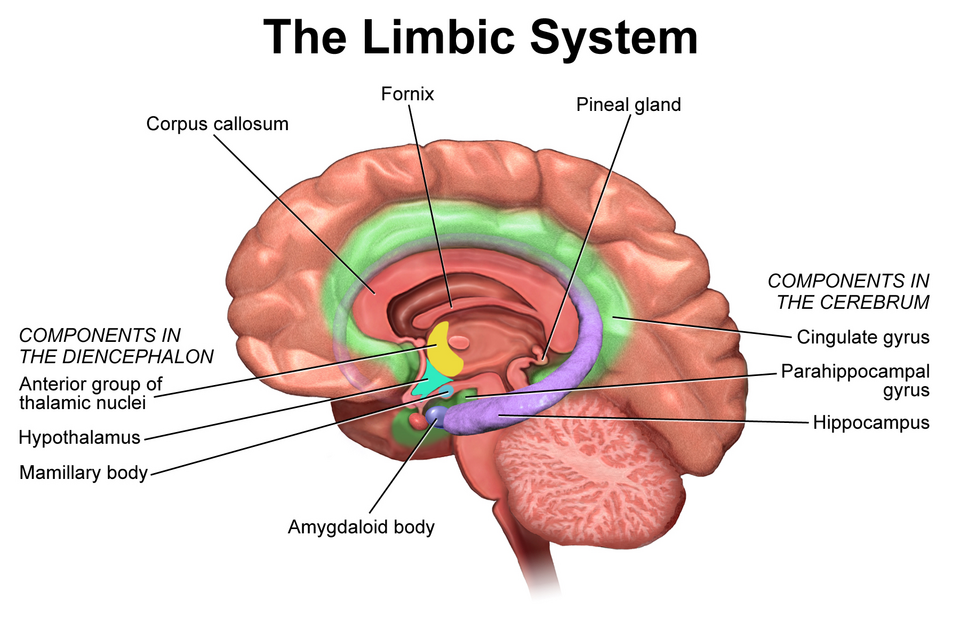
内感受与身体信号
内感受(interoception)指个体感知与整合身体内部状态信号(如心跳、呼吸、胃肠活动、饥饿、口渴、疲劳等)的过程,心理学与神经科学用它来描述「我饿了」「我有点喘」这类来自身体内部的体验的形成。33图文详情cloud.kepuchina.cn前往参考资料 ↓在新标签页中打开|8585听听你的身体怎么看待你的喜怒哀乐- · 科普中国网kepuchina.cn前往参考资料 ↓在新标签页中打开
情绪体验与身体变化之间存在双向作用:开心时心跳可能加快,紧张时呼吸变浅、手心出汗,难过或压力大时胃口变差、肩颈紧绷;反过来,睡眠不足、饥饿和疲劳也会让人更急躁、低落或敏感。身体变化参与情绪体验,情绪又继续影响心跳、呼吸和胃肠反应。8585听听你的身体怎么看待你的喜怒哀乐- · 科普中国网kepuchina.cn前往参考资料 ↓在新标签页中打开
19世纪末威廉·詹姆斯(William James)提出,情绪体验可能并非先有情绪再引发身体反应,而是先察觉发抖、心跳加快等身体变化,才逐渐体验到害怕;这一思路把身体信号置于情绪体验的因果链条之中。8585听听你的身体怎么看待你的喜怒哀乐- · 科普中国网kepuchina.cn前往参考资料 ↓在新标签页中打开
当代研究更强调身体、情境与经验共同参与情绪解释:身体只提供「发生了变化」的线索,情境与过往经验帮助大脑判断这一变化意味着什么。因此同样是心跳加快,跑步后可能被读作正常恢复,上台前更像兴奋,刷到不安信息后则更容易被理解为害怕。33图文详情cloud.kepuchina.cn前往参考资料 ↓在新标签页中打开|8585听听你的身体怎么看待你的喜怒哀乐- · 科普中国网kepuchina.cn前往参考资料 ↓在新标签页中打开
神经递质与化学基础
情绪体验与表达依赖于中枢神经系统内多种神经递质和神经调质的协同作用,其中多巴胺、去甲肾上腺素、5-羟色胺(血清素)、乙酰胆碱、谷氨酸、γ-氨基丁酸(GABA)以及多肽类调质(如催产素、内源性阿片肽)是研究最集中的几类化学信号系统。8686Neurotransmitters and emotionsfrontiersin.org前往参考资料 ↓在新标签页中打开
多巴胺系统长期被视为奖赏与动机的核心,但当代综述强调其编码的是奖赏预测误差(reward prediction error)而非快乐本身;多巴胺能中脑-皮层-边缘通路参与趋近行为、探索与努力投入,而非简单地等同于“愉悦感”。8787Dopamine reward prediction error codingtandfonline.com前往参考资料 ↓在新标签页中打开
5-羟色胺(血清素)系统与情绪调节、冲动控制和焦虑相关,但“血清素水平低导致抑郁”的简单化说法在药理学与遗传学证据上受到严重挑战:选择性5-羟色胺再摄取抑制剂(SSRI)的临床起效延迟与血清素水平的即时变化之间的分离,提示血清素在情绪中扮演的是调节性而非单向“缺乏—补充”的角色。8888The serotonin theory of depression: a systematic umbrella review of the evidencenature.com前往参考资料 ↓在新标签页中打开
对立说法部分研究者仍主张血清素能功能低下是抑郁易感性的重要生物标志,并援引色氨酸耗竭实验与部分遗传关联研究作为支持。93
去甲肾上腺素系统主要起源于蓝斑(locus coeruleus),其投射广泛影响警觉、唤醒与应激反应;蓝斑-去甲肾上腺素系统在情绪性唤醒和威胁检测中的作用已被大量电生理与药理学研究支持。8989The locus coeruleus-noradrenergic system: modulation of behavioral state and state-dependent cognitive processessciencedirect.com前往参考资料 ↓在新标签页中打开
γ-氨基丁酸(GABA)是中枢神经系统主要的抑制性递质,苯二氮䓬类药物通过增强GABA_A受体功能产生抗焦虑与镇静效应,这一药理事实是GABA系统参与情绪调节(尤其是焦虑环路)的直接证据。9090GABA and anxiety: a reviewsciencedirect.com前往参考资料 ↓在新标签页中打开
催产素(oxytocin)在动物与人类研究中与亲社会行为、信任和依恋相关,但效应量普遍偏小且高度依赖情境与个体差异,早期“催产素是信任激素”的强主张在重复实验与元分析中已被显著弱化。9191Oxytocin and social behavior: a meta-analysispsycnet.apa.org前往参考资料 ↓在新标签页中打开
对立说法一些研究者坚持催产素对信任与亲社会倾向具有稳健的正向效应,并认为失败重复多源于剂量、给药方式与情境操纵的差异。97
内源性阿片肽系统(如β-内啡肽、脑啡肽)与愉悦、镇痛和社会依恋的“ liking ”成分相关,阿片受体拮抗剂可减弱某些愉悦反应,支持其在情绪享乐体验中的角色。9292Opioid hedonic hotspots and the neurobiology of pleasuresciencedirect.com前往参考资料 ↓在新标签页中打开
谷氨酸作为主要兴奋性递质,通过AMPA、NMDA等受体参与情绪相关环路的突触可塑性;NMDA受体拮抗剂(如氯胺酮)的快速抗抑郁效应推动了谷氨酸系统在情绪障碍治疗中的研究。9393Glutamate and depression: a reviewsciencedirect.com前往参考资料 ↓在新标签页中打开
神经肽Y(NPY)与应激韧性相关,较低的NPY水平与创伤后应激障碍(PTSD)易感性相关,而较高的NPY反应性被认为具有保护作用。9494Neuropeptide Y and resilience to stresssciencedirect.com前往参考资料 ↓在新标签页中打开
关键脑区与网络
杏仁核是情绪神经科学中被研究最多的结构之一,大量证据表明它对于恐惧等负性情绪的检测、学习与表达至关重要;对杏仁核的损伤会严重损害恐惧条件反射的获得与表达。9797The Emotional Brain: The Mysterious Underpinnings of Emotional Lifesimonandschuster.com前往参考资料 ↓在新标签页中打开|9898The amygdala: a functional analysis (Aggleton, J. P., ed.)global.oup.com前往参考资料 ↓在新标签页中打开
在恐惧条件反射中,感觉信息经丘脑分别投射到杏仁核与感觉皮层,再汇入杏仁核外侧核,随后经基底核、中央核输出到下丘脑与脑干,引发自主神经与行为反应;这条“低路”与“高路”并行的通路模型由 LeDoux 提出,是情绪神经科学中最具影响力的回路模型之一。9797The Emotional Brain: The Mysterious Underpinnings of Emotional Lifesimonandschuster.com前往参考资料 ↓在新标签页中打开|9999Emotion circuits in the brainannualreviews.org前往参考资料 ↓在新标签页中打开
前额叶皮层,尤其是腹内侧前额叶(vmPFC)与眶额皮层(OFC),参与情绪性刺激的价值评估、情绪调节以及对杏仁核的抑制性控制;vmPFC 损伤患者常表现出情绪调节与社会决策的异常。100100The role of the ventromedial prefrontal cortex in emotion regulationnature.com前往参考资料 ↓在新标签页中打开|101101The orbitofrontal cortex and emotionnature.com前往参考资料 ↓在新标签页中打开
岛叶(insula)是内感受(interoception)的核心皮层区域,参与对身体内部状态的表征,并与厌恶、疼痛、焦虑等情绪体验密切相关;前岛叶损伤可损害厌恶的识别与体验。102102How do you feel? Interoception: the sense of the physiological condition of the bodynature.com前往参考资料 ↓在新标签页中打开|103103The insular cortex and the regulation of emotionlink.springer.com前往参考资料 ↓在新标签页中打开
前扣带皮层(ACC)参与情绪冲突监测、疼痛的情感成分以及情绪性行为的动机调控;其喙部/腹侧部分与情绪加工关系尤为密切。104104The anterior cingulate cortex and the integration of emotion and cognitioncell.com前往参考资料 ↓在新标签页中打开|105105The anterior cingulate cortex: the evolution of an interface between emotion and cognitionnyaspubs.onlinelibrary.wiley.com前往参考资料 ↓在新标签页中打开
伏隔核与腹侧被盖区构成的奖赏回路参与正性情绪与动机,多巴胺能投射对奖赏预期与“想要”(wanting)至关重要;但多巴胺与主观“喜欢”(liking)的关系存在争议,享乐体验本身更多依赖阿片类与内源性大麻素系统。106106The nucleus accumbens and reward: a reviewcell.com前往参考资料 ↓在新标签页中打开|107107The debate over dopamine's role in reward: the case for incentive saliencelink.springer.com前往参考资料 ↓在新标签页中打开
对立说法有研究者主张多巴胺直接编码享乐体验或与主观愉悦感紧密相关,而非仅参与动机与奖赏预期。114
脑成像元分析显示,不同基本情绪并非由彼此分离的单一脑区负责,而是共享一组分布式区域(如杏仁核、岛叶、前扣带、vmPFC 等),不同情绪在这些共享网络上的激活模式存在差异;这一结果对“一种情绪一个脑区”的定位主义观点构成挑战。108108Functional neuroimaging of major depressive disorder: a meta-analysis and new integration of base line activation and neural response dataajp.psychiatryonline.org前往参考资料 ↓在新标签页中打开|109109The neuroimaging of emotion: a meta-analytic reviewsciencedirect.com前往参考资料 ↓在新标签页中打开
默认模式网络(DMN)与显著性网络(salience network)在情绪加工中扮演重要角色:前者涉及自我参照的情绪体验与情绪性回忆,后者(以岛叶前部与前扣带为核心)负责检测情绪显著性并调控其他网络的切换。110110The brain's default mode networkannualreviews.org前往参考资料 ↓在新标签页中打开|111111Salience networksciencedirect.com前往参考资料 ↓在新标签页中打开
情绪加工呈现偏侧化倾向:部分证据支持左半球与趋近/正性情绪相关、右半球与回避/负性情绪相关,但该假说在实证上并不稳固,元分析与综述未能给出一致的支持。112112Emotional processing and the right hemisphere: a reviewsciencedirect.com前往参考资料 ↓在新标签页中打开|113113Lateralization of emotion: a review of the literaturesciencedirect.com前往参考资料 ↓在新标签页中打开
对立说法有研究认为情绪偏侧化效应量很小或不存在,情绪加工在两侧半球间高度冗余。121
自主神经系统与下丘脑—垂体—肾上腺(HPA)轴构成情绪的外周生理基础:交感—肾上腺髓质系统介导快速唤醒,副交感系统参与恢复与调节,HPA 轴通过皮质醇释放参与较慢的应激反应。114114The hypothalamic-pituitary-adrenal axis and stressnature.com前往参考资料 ↓在新标签页中打开
脑干中的蓝斑—去甲肾上腺素系统与中脑多巴胺系统、以及基底前脑的胆碱能系统,构成情绪唤醒与情绪性记忆调节的上行调制系统;杏仁核通过基底外侧核调节海马依赖的情绪性记忆巩固。115115The locus coeruleus-noradrenergic system: modulation of behavioral state and state-dependent cognitive processessciencedirect.com前往参考资料 ↓在新标签页中打开|116116Emotional memory: the role of the amygdala and the hippocampusnature.com前往参考资料 ↓在新标签页中打开
情绪的表达与识别
面部表情
面部表情研究在情绪科学中的经典起点,是达尔文1872年出版的《人类和动物的情感表达》。该书主张人类的基本情绪表达具有跨物种、跨文化的连续性,这一思路奠定了此后“基本情绪—面部表情”研究传统的问题框架。33图文详情cloud.kepuchina.cn前往参考资料 ↓在新标签页中打开
20世纪60年代起,保罗·艾克曼(Paul Ekman)与华莱士·弗里森(Wallace Friesen)等人通过跨文化研究提出,快乐、悲伤、愤怒、恐惧、厌恶、惊讶等基本情绪的面部表情在不同文化中被识别的一致性显著高于随机水平,并据此发展出面部动作编码系统(FACS),把面部肌肉运动拆解为可独立标注的动作单元(AU)。33图文详情cloud.kepuchina.cn前往参考资料 ↓在新标签页中打开
面部动作编码系统(FACS)以解剖学为基础,将面部肌肉的收缩划分为若干动作单元(Action Unit,AU),并允许对每个 AU 的出现、强度与时长分别编码。它本身是一套描述系统而非情绪判断系统,即从 AU 组合到“这是什么情绪”的推断是另一步,需要额外的判断规则或统计模型。33图文详情cloud.kepuchina.cn前往参考资料 ↓在新标签页中打开
“杜兴微笑”(Duchenne smile)指同时牵动颧大肌(嘴角上扬,AU12)与眼轮匝肌(眼角起皱,AU6)的微笑,通常被视为更可能伴随真实愉悦体验的表达;仅有嘴角上扬而缺乏眼周收缩的微笑,则更常被解读为社交性、礼节性或掩饰性的笑。这一区分源自19世纪杜兴(Duchenne de Boulogne)的电生理观察,后被艾克曼等人以 AU 形式重新操作化。33图文详情cloud.kepuchina.cn前往参考资料 ↓在新标签页中打开
跨文化识别研究的一个反复出现的发现是:基本情绪表情的“识别”并非完全自动、无条件的普遍,而是受文化背景调节。同一张笑脸在不同文化中可能被读出不同含义,微笑不等于开心,面无表情也不等于冷漠;后天文化会给笑容套上不同的“外壳”。33图文详情cloud.kepuchina.cn前往参考资料 ↓在新标签页中打开
文化对表情的影响至少体现在两个层面:一是“展示规则”(display rules),即何种情绪在何种场合可以、应当或必须被表达,这导致同一情绪在不同文化中的外显程度不同;二是“解码规则”,即观察者依据哪些线索、以何种默认假设去解读他人表情。二者共同造成跨文化误读。33图文详情cloud.kepuchina.cn前往参考资料 ↓在新标签页中打开
面部表情的识别并非纯粹“读图”,而是高度依赖情境。同一面部构型在缺乏情境线索时识别准确率下降、歧义上升;加入身体姿态、语音语调、场景信息后,识别会显著改善。因此把表情当作脱离情境的“情绪标签”来使用,在方法上是有风险的。33图文详情cloud.kepuchina.cn前往参考资料 ↓在新标签页中打开
在测量层面,面部表情的采集与分析主要有三条路径:一是人工编码(如 FACS 训练有素的编码员逐帧标注 AU),精度高但成本极高、难以规模化;二是基于计算机视觉的自动面部动作单元检测与表情分类;三是肌电图(EMG)等生理手段,可捕捉肉眼难以察觉的微弱面部肌肉活动。三者在时间分辨率、生态效度与可扩展性上各有取舍。33图文详情cloud.kepuchina.cn前往参考资料 ↓在新标签页中打开
面部肌电(facial EMG)研究显示,人在观看情绪性刺激时会出现与刺激效价一致的面部肌肉微弱活动(如观看正性刺激时颧大肌活动增强、观看负性刺激时皱眉肌活动增强),这类反应可在肉眼不可见的强度上出现,说明面部表情的部分成分具有较低的意识可控性。33图文详情cloud.kepuchina.cn前往参考资料 ↓在新标签页中打开
面部表情与内部情绪状态之间并非一一对应关系。表情可以因社交目的被增强、减弱、掩饰或伪装(如礼貌性微笑、掩饰不悦),也可以在没有相应情绪体验时被有意做出。因此从表情反推情绪体验的效度有限,单靠面部通道判断情绪容易产生系统性误差。33图文详情cloud.kepuchina.cn前往参考资料 ↓在新标签页中打开
面部反馈假说(facial feedback hypothesis)主张面部肌肉的收缩本身可以调节情绪体验与生理反应,即“做出表情”会影响“感到什么”。这一假说在元分析层面得到过支持,但效应量普遍偏小,且部分高调重复实验未能复现,因此其强度与边界条件仍是活跃的研究问题。33图文详情cloud.kepuchina.cn前往参考资料 ↓在新标签页中打开
语音与韵律
语音中的情绪信息不仅由字面语义承载,也由音高、响度等副语言/韵律属性承载;对语音情绪识别的研究因此需要同时考虑语义内容与声学特征两条通道。119119Emotion recognition and confidence ratings predicted by vocal stimulus type and prosodic parametersnature.com前往参考资料 ↓在新标签页中打开
在语音情绪表达的声学研究中,Banse 与 Scherer 1996 年的工作是一项奠基性研究:他们考察了 14 种诱发情绪与 29 个声学参数之间的关系,并用线性判别分析(LDA)配合刀切法(jackknife)评估这些参数对情绪的区分能力。119119Emotion recognition and confidence ratings predicted by vocal stimulus type and prosodic parametersnature.com前往参考资料 ↓在新标签页中打开
语音情绪识别研究在刺激材料类型与实验程序上存在相当大的差异,这种差异本身会影响识别结果的可比性;因此跨研究比较识别率时必须考虑刺激是表演式、诱发式还是自然语音。119119Emotion recognition and confidence ratings predicted by vocal stimulus type and prosodic parametersnature.com前往参考资料 ↓在新标签页中打开
跨文化普遍性与文化差异
跨文化普遍性研究中最具影响力的起点是 Ekman 与 Friesen 在 1971 年发表的研究:他们让来自不同文化(包括与外界接触极少的 Fore 人)的受试者识别六种基本情绪(快乐、悲伤、愤怒、恐惧、厌恶、惊讶)的面部照片,发现识别率显著高于随机水平,从而支持面部表情具有跨文化共通性的主张。120120Constants across cultures in the face and emotiondoi.org前往参考资料 ↓在新标签页中打开
Ekman 等人后续在 1987 年发表的跨文化研究中,让来自 10 个不同国家(包括爱沙尼亚、希腊、香港、日本、苏格兰、苏门答腊、土耳其、美国、西德等)的受试者对六种基本情绪的面部表情进行识别,结果显示快乐、悲伤、愤怒、恐惧、厌恶、惊讶六种表情的识别率在多数文化中均显著高于随机水平,且各文化间具有高度一致性。121121Universals and cultural differences in the judgments of facial expressions of emotiondoi.org前往参考资料 ↓在新标签页中打开
Izard 在 1971 年出版的《The Face of Emotion》中报告了跨文化研究结果,支持基本情绪面部表情具有跨文化普遍性的观点,与 Ekman 的研究共同构成普遍性主张的两大经典证据来源。122122The Face of Emotionarchive.org前往参考资料 ↓在新标签页中打开
Russell 在 1994 年发表的综述中系统批评了基本情绪面部表情跨文化普遍性的证据,指出许多跨文化研究存在方法学问题(如强制选择范式、刺激材料的选择性、受试者对研究目的的猜测等),并认为面部表情的识别可能更多依赖文化学习而非普遍的生物基础。123123Is there universal recognition of emotion from facial expression? A review of the cross-cultural studiesdoi.org前往参考资料 ↓在新标签页中打开
对立说法Ekman 在 1994 年对 Russell 的批评作出回应,认为 Russell 对跨文化研究的方法学质疑不足以推翻普遍性证据,并指出多项独立研究(包括对与世隔绝人群的研究)仍支持基本情绪表情的跨文化一致性。133
Elfenbein 与 Ambady 在 2002 年发表的元分析综合了 182 项研究,发现面部表情识别存在“内群体优势”:人们识别本文化成员表情的准确率高于识别外文化成员表情的准确率,但跨文化识别仍显著高于随机水平,表明普遍性与文化特异性并存。124124On the universality and cultural specificity of emotion recognition: A meta-analysisdoi.org前往参考资料 ↓在新标签页中打开
Jack 等人在 2012 年发表的研究中发现,西方受试者倾向于将面部表情与六种基本情绪一一对应,而东亚受试者更倾向于将表情理解为由多个维度(如效价和唤醒度)构成的连续体,表明情绪识别的认知框架存在文化差异。125125Facial expressions of emotion are not culturally universaldoi.org前往参考资料 ↓在新标签页中打开
Masuda 等人在 2008 年的研究中发现,东亚受试者在判断面部表情时更关注背景信息(如周围他人的表情),而西方受试者更关注目标面孔本身,表明情绪识别受文化影响的注意分配差异。126126Placing the face in context: Cultural differences in the perception of facial emotiondoi.org前往参考资料 ↓在新标签页中打开
Barrett 等人在 2019 年发表的综述中提出,情绪面部表情的识别并非完全由生物因素决定,而是受到文化情境和概念知识的调节;不同文化对同一面部配置可能赋予不同情绪含义,挑战了基本情绪表情具有固定普遍意义的观点。3838Emotional expressions reconsidered: Challenges to inferring emotion from human facial movementsdoi.org前往参考资料 ↓在新标签页中打开
对立说法Ekman 及其合作者坚持认为,基本情绪的面部表情具有跨文化普遍性,并指出多项跨文化研究(包括对孤立人群的研究)提供了支持证据,认为文化差异主要影响表情的展示规则而非识别本身。137
Ekman 与 Friesen 在 1969 年提出“展示规则”(display rules)概念,指文化规定的关于何时、何地以及如何表达情绪的社会规范;不同文化在情绪表达的自由度上存在差异,例如集体主义文化更倾向于抑制负面情绪的表达。127127The repertoire of nonverbal behavior: Categories, origins, usage, and codingdoi.org前往参考资料 ↓在新标签页中打开
Matsumoto 等人在 2008 年发表的研究中,使用面部表情编码系统测量了来自多个国家(包括美国、日本、韩国等)的受试者在观看情绪诱发影片时的面部反应,发现集体主义文化背景的受试者比个人主义文化背景的受试者更多地抑制负面情绪的面部表达。128128Mapping expressive differences around the world: The relationship between emotional display rules and individualism versus collectivismdoi.org前往参考资料 ↓在新标签页中打开
情绪的发展与个体差异
情绪能力的发展
情绪能力并非在出生时就定型,而是随儿童发育逐步完善:儿童对快乐、悲伤等情绪的识别与对情绪线索的理解会随年龄增长而变化,这一过程与大脑情绪概念表征的成熟相伴随。131131科学家揭示儿童情绪识别变化规律 - 国际新闻 - 新闻动态 - 中国生物技术发展中心cncbd.org.cn前往参考资料 ↓在新标签页中打开
美国华盛顿大学医学院的研究团队以 5 至 15 岁儿童为样本(n=823),用核磁共振成像考察了不同类别情绪概念在全脑的编码方式,成果以《Large-scale encoding of emotion concepts becomes increasingly similar between individuals from childhood to adolescence》为题发表在《Nature Neuroscience》上。131131科学家揭示儿童情绪识别变化规律 - 国际新闻 - 新闻动态 - 中国生物技术发展中心cncbd.org.cn前往参考资料 ↓在新标签页中打开
该研究发现,不同类别情绪概念的表征分布在整个大脑皮层、小脑和尾状核区域;就每一种情绪而言,其激活模式在发育过程中几乎不发生实质变化,说明情绪概念的基本神经编码在学龄期前后已大体成形。131131科学家揭示儿童情绪识别变化规律 - 国际新闻 - 新闻动态 - 中国生物技术发展中心cncbd.org.cn前往参考资料 ↓在新标签页中打开
个体差异随发育而收敛:年龄较大的儿童之间,情绪概念的脑激活模式比年龄较小的儿童之间更为相似,即情绪线索加工在青春期趋于同步化、个体间差异缩小。131131科学家揭示儿童情绪识别变化规律 - 国际新闻 - 新闻动态 - 中国生物技术发展中心cncbd.org.cn前往参考资料 ↓在新标签页中打开
从发展时间表看,大脑处理情绪线索的激活模式在儿童达到学龄时已经形成,此后在青春期变得更加精细,但没有实质性改变;情绪概念表征在发育后期相对稳定。131131科学家揭示儿童情绪识别变化规律 - 国际新闻 - 新闻动态 - 中国生物技术发展中心cncbd.org.cn前往参考资料 ↓在新标签页中打开
人格与情绪风格
在情绪风格(affective style)研究中,Richard Davidson 提出个体在情绪反应的前馈与反馈调节上存在稳定差异,并将情绪风格划分为六个维度:弹性(resilience)、外倾(outlook)、直觉(social intuition)、自我觉察(self-awareness)、情境敏感(situational sensitivity)和注意力(attention)。132132Affective Style and Affective Disorders: Perspectives from Affective Neurosciencetandfonline.com前往参考资料 ↓在新标签页中打开
Davidson 的情绪风格六维度框架与神经基础相关联:弹性对应前额叶皮层与杏仁核之间的有效连接,外倾对应前额叶皮层与伏隔核等奖赏回路的活动,自我觉察对应脑岛(insula)的活动,情境敏感对应海马与杏仁核的相互作用。132132Affective Style and Affective Disorders: Perspectives from Affective Neurosciencetandfonline.com前往参考资料 ↓在新标签页中打开
大五人格模型中的神经质(neuroticism)与外倾(extraversion)两个维度与情绪体验的效价和唤醒度存在系统性关联:神经质主要与负性情绪(如焦虑、抑郁、易怒)的易感性相关,外倾主要与正性情绪(如快乐、活力)的易感性相关。133133Personality and susceptibility to positive and negative emotional statespsycnet.apa.org前往参考资料 ↓在新标签页中打开
在人格与情绪的研究中,Watson 与 Clark 提出的“正性情感—负性情感”双因素模型(two-factor model of affect)认为正性情感与负性情感是两个相对独立的维度,而非同一维度的两极;外倾与正性情感相关,神经质与负性情感相关。134134The two general activation systems of affect: Structural findings, evolutionary considerations, and psychobiological evidencepsycnet.apa.org前往参考资料 ↓在新标签页中打开
情绪调节的个体差异研究常采用 Gross 提出的过程模型(process model),将情绪调节策略区分为前因聚焦策略(如认知重评)与反应聚焦策略(如表达抑制);跨研究元分析表明,认知重评通常与更好的心理健康指标相关,而表达抑制则与更多的负性情绪体验和较差的人际功能相关。135135Emotion regulation: Current status and future prospectstandfonline.com前往参考资料 ↓在新标签页中打开
在情绪调节个体差异的测量上,Gross 与 John 编制的情绪调节问卷(Emotion Regulation Questionnaire, ERQ)包含认知重评与表达抑制两个分量表,被广泛用于评估个体习惯性使用这两种策略的倾向。136136Individual differences in two emotion regulation processes: Implications for affect, relationships, and well-beingpsycnet.apa.org前往参考资料 ↓在新标签页中打开
情绪风格与人格特质并非同一概念:人格特质通常指行为倾向的稳定模式,而情绪风格更强调情绪反应在时间进程上的参数(如阈限、潜伏期、幅度、恢复速度),这一区分由 Davidson 及其同事在情绪神经科学框架下明确提出。132132Affective Style and Affective Disorders: Perspectives from Affective Neurosciencetandfonline.com前往参考资料 ↓在新标签页中打开
在情绪发展研究中,气质(temperament)被视为人格的早期前体;Rothbart 与 Derryberry 提出的气质模型包含负性情感、外倾/ surgency、努力控制(effortful control)等维度,其中努力控制与后来的情绪调节能力发展密切相关。137137Temperament and developmentonlinelibrary.wiley.com前往参考资料 ↓在新标签页中打开
纵向研究表明,儿童早期的行为抑制(behavioral inhibition)气质与青少年及成年期社交焦虑风险升高相关,但这一关联并非必然,受养育环境与后续经验调节。138138Behavioral inhibition and anxiety: The moderating roles of inhibitory control and attention shiftinglink.springer.com前往参考资料 ↓在新标签页中打开
在情绪识别与表达方面,个体差异体现在情绪识别准确性、情绪表达强度以及情绪表达规则的知识上;女性在情绪识别与表达上平均得分略高于男性,但效应量通常较小,且受情境与文化因素调节。139139Sex differences in emotion recognition ability: A meta-analysispsycnet.apa.org前往参考资料 ↓在新标签页中打开
情绪风格与人格特质对情绪健康的影响并非固定不变:干预研究(如正念训练、认知行为疗法)表明,习惯性情绪调节策略可以通过训练改变,并伴随相应脑网络活动的变化。140140Mindfulness practice leads to increases in regional brain gray matter densitysciencedirect.com前往参考资料 ↓在新标签页中打开
关于情绪风格六维度的神经基础,部分脑成像研究的可重复性受到样本量小、分析灵活性高等问题的影响,相关结论的稳健性仍在检验之中。141141Power failure: Why small sample size undermines the reliability of neurosciencenature.com前往参考资料 ↓在新标签页中打开
对立说法Davidson 及其同事认为,情绪风格的神经基础已有较多独立研究支持,尤其是前额叶不对称性与情绪倾向之间的关联在多项研究中得到重复。132132Affective Style and Affective Disorders: Perspectives from Affective Neurosciencetandfonline.com前往参考资料 ↓在新标签页中打开
应用领域
临床与心理健康
情绪科学在临床与心理健康领域的应用,核心是把情绪的测量、诱发与调节知识转化为可操作的评估与干预手段;其中情绪测量工具(如自评量表、生理指标与行为观察)被广泛用于焦虑、抑郁等内化障碍的筛查与疗效追踪,这一应用路径在临床心理学与精神科实践中已形成较成熟的常规。142142Promoting social interaction through emotional body odours | H2020 | CORDIS | Europäische Kommissioncordis.europa.eu前往参考资料 ↓在新标签页中打开
情感计算(affective computing)把情绪识别与生成技术用于心理健康服务,被视为缓解心理服务供给不足的一条技术路径;其典型设想包括通过多模态情绪分析辅助咨询与筛查,但这类系统在临床场景中的实际效力与伦理边界仍处于研究与试点阶段,尚未成为标准治疗手段。143143心理学与算法“共舞” 情感计算开启人工智能新赛道_数字快讯_数字中国建设峰会szzg.gov.cn前往参考资料 ↓在新标签页中打开
情绪化学信号(emotional chemosignals)研究显示,人体气味中的恐惧与愉悦相关成分可影响他人的社会感知与行为;欧盟 POTION 项目据此探索以情绪体味促进社会互动的技术,并将其与社交隔离和心理健康问题联系起来,说明情绪科学的应用已延伸到非言语的化学沟通通道。142142Promoting social interaction through emotional body odours | H2020 | CORDIS | Europäische Kommissioncordis.europa.eu前往参考资料 ↓在新标签页中打开
人际沟通与关系
情绪科学在人际沟通与关系领域的应用,核心是把情绪视为可识别、可调节、可训练的信号系统:通过降低对他人情绪信号的误读、改善对话中的情绪回应方式,来提升关系质量。这一取向在中文通俗读物中已被明确概括为「降低误读、改善对话、提升连结品质」,其内容以心理学研究为基础,讨论人际互动背后的情绪、知觉与偏误运作,并强调多数误会源自大脑的自动化解读而非对方恶意。144144國際標準編碼申辦整合服務平臺isbn.ncl.edu.tw前往参考资料 ↓在新标签页中打开
情绪沟通并不限于面部表情和语调。欧盟资助的 POTION 项目系统研究了恐惧与快乐相关的情绪化学信号(emotional chemosignals,即情绪性体味),指出视觉与听觉线索已被充分研究,而社会沟通的化学维度长期未被充分探索;项目已鉴定出数百种此前未被描述的相关化合物,并据此开发用于增强真实与虚拟场景中情绪连接的技术原型。142142Promoting social interaction through emotional body odours | H2020 | CORDIS | Europäische Kommissioncordis.europa.eu前往参考资料 ↓在新标签页中打开
POTION 项目把情绪化学信号的应用动机明确锚定在当代社会问题上:社会孤立上升、心理健康问题增加、虚拟沟通占据主导。项目认为,利用体味这一细微但有力的通道,可以在现实与数字互动中提升情绪联结,这为「情绪科学用于改善人际关系」提供了技术化、产品化的路径,而不只是咨询室里的谈话技巧。142142Promoting social interaction through emotional body odours | H2020 | CORDIS | Europäische Kommissioncordis.europa.eu前往参考资料 ↓在新标签页中打开
教育与创造力
在课堂情境中,教师通过创设安全、支持性的情绪氛围(如允许学生表达困惑、减少对错误的羞辱性反馈),有助于降低学生的焦虑水平,从而为学习投入和创造性表达创造条件。145145Emotions in the classroom: A review of the literature on emotions and learninglink.springer.com前往参考资料 ↓在新标签页中打开
积极情绪(如愉悦、兴趣)通常能拓宽认知注意范围、促进发散思维,这一效应在多项实验研究中得到重复验证,是情绪影响创造力的主要理论路径之一。146146The broaden-and-build theory of positive emotionsroyalsocietypublishing.org前往参考资料 ↓在新标签页中打开
消极情绪对创造力的影响并非单一方向:适度焦虑或挫败感在某些条件下可促进分析性、细节导向的加工,但高强度或长期消极情绪则倾向于抑制认知灵活性和创造性产出。147147The influence of mood on creativity: A meta-analytic reviewpsycnet.apa.org前往参考资料 ↓在新标签页中打开
情绪调节能力(如认知重评)与学业成就存在正相关,善于调节情绪的学生更可能保持学习动机、应对考试压力并维持课堂参与。148148Emotion regulation and academic achievement: A meta-analysissciencedirect.com前往参考资料 ↓在新标签页中打开
将情绪教育(如社会情绪学习项目)纳入学校课程,已被多项干预研究显示可改善学生的情绪识别、情绪管理能力,并间接支持学业表现和课堂行为。149149The impact of enhancing students' social and emotional learning: A meta-analysis of school-based universal interventionssrcd.onlinelibrary.wiley.com前往参考资料 ↓在新标签页中打开
在创造性任务中,情绪诱发范式(如观看影片、音乐、回忆任务)被广泛用于检验情绪状态对发散思维和聚合思维的影响,但不同研究间效应量差异较大,部分结果受任务类型和个体差异调节。147147The influence of mood on creativity: A meta-analytic reviewpsycnet.apa.org前往参考资料 ↓在新标签页中打开
情感计算与人机交互
情感计算(affective computing)被定位为人工智能的一个前沿分支:它以单个或多个模态的信号为基础,通过算法赋予系统识别个体情感的能力,并生成语音、视觉或可穿戴设备呈现的情感信号,从而改变人机交互的传统模式。152152学习时报网_情感计算让人工智能拥有温度studytimes.cn前往参考资料 ↓在新标签页中打开|153153情感计算让人工智能拥有温度-06版:科技前沿-2025年12月17日paper.studytimes.cn前往参考资料 ↓在新标签页中打开
在应用层面,情感计算被认为可服务于智慧教育、心理健康与生活娱乐等领域;其现实形态包括能感知情绪并给予回应的智能音箱、捕捉学生微表情以提示教师调整节奏的课堂系统,以及识别孤独症儿童情感信号并触发疗愈音乐的交互机器人。152152学习时报网_情感计算让人工智能拥有温度studytimes.cn前往参考资料 ↓在新标签页中打开|153153情感计算让人工智能拥有温度-06版:科技前沿-2025年12月17日paper.studytimes.cn前往参考资料 ↓在新标签页中打开
「情感鸿沟」被描述为制约人工智能技术在服务业深入应用的主要瓶颈:传统人工智能系统擅长逻辑推理性质的感知与认知计算任务,却难以识别精神异常时的语调变化、焦虑时的心理需求,以及复杂场景下群体精神状态的多样性。152152学习时报网_情感计算让人工智能拥有温度studytimes.cn前往参考资料 ↓在新标签页中打开|153153情感计算让人工智能拥有温度-06版:科技前沿-2025年12月17日paper.studytimes.cn前往参考资料 ↓在新标签页中打开
中国科学院软件研究所面向精神心理健康问题开展情感感知、计算与交互关键技术研究,在情感交互方向牵头成立 ISO/IEC 首个情感计算用户界面工作组,并牵头负责首个情感计算用户界面系列国际标准的制定,已颁布 2 项国际标准、1 项国家标准,另有 2 项国际标准在制定中。151151<span align="center">情感交互与心理健康评估技术</span>----中国科学院软件研究所is.cas.cn前往参考资料 ↓在新标签页中打开
在情感计算与心理健康干预方面,该团队提出面向虚拟场景复杂交互任务的用户情感挑战计算与建模方法,基于用户多维连续生理信号实现多维感知挑战的自动检测;并提出结合实时三维建模与机器学习的面部情绪分类模型,已实际应用于智能座舱系统和交互机器人。151151<span align="center">情感交互与心理健康评估技术</span>----中国科学院软件研究所is.cas.cn前往参考资料 ↓在新标签页中打开
在语音情感分析方向,相关工作提出大模型增强的可解释情感分析技术与音视融合的噪声鲁棒情感识别技术,可对语音情感做细粒度解释性推理,并用于车舱、会议、广场等复杂噪声环境下路怒、悲伤等消极情绪的检测。151151<span align="center">情感交互与心理健康评估技术</span>----中国科学院软件研究所is.cas.cn前往参考资料 ↓在新标签页中打开
在情感生成与呈现方向,个性化情感数字人建模研究提出自动化生成数字人脸部动画的方案,通过精确估计混合形状系数,实现从输入人脸图像到虚拟人脸面部表情动画的生成。151151<span align="center">情感交互与心理健康评估技术</span>----中国科学院软件研究所is.cas.cn前往参考资料 ↓在新标签页中打开
争议与前沿
基本情绪数量的争论
基本情绪是否构成一个有限、离散且可普遍识别的集合,是情绪科学中持续最久的争论之一。Ekman 等人基于跨文化面部表情识别实验提出存在六种基本情绪(快乐、悲伤、恐惧、愤怒、惊讶、厌恶),而 Russell 与 Barrett 等学者则主张情绪并非离散实体,而是由效价与唤醒等连续维度构成,面部表情的跨文化一致性被高估。120120Constants across cultures in the face and emotiondoi.org前往参考资料 ↓在新标签页中打开|2828A circumplex model of affectdoi.org前往参考资料 ↓在新标签页中打开
Barrett 提出的概念行为理论(theory of constructed emotion)认为,情绪不是进化中固定的基本类别,而是大脑对内感受信号与外部情境进行范畴化建构的产物;不同文化中情绪概念的结构存在差异,这挑战了基本情绪普遍性的前提。1717The theory of constructed emotion: An active inference account of interoception and categorizationdoi.org前往参考资料 ↓在新标签页中打开
对立说法Ekman 及其合作者坚持认为,面部表情的跨文化识别证据(包括对孤立人群的研究)表明至少存在一组普遍的基本情绪,文化差异主要体现在展示规则(display rules)而非情绪本身。120120Constants across cultures in the face and emotiondoi.org前往参考资料 ↓在新标签页中打开
关于基本情绪的具体数量,学界并无共识:Ekman 最初提出六种,Plutchik 提出八种(加入信任与期待),Izard 的差异情绪理论列出十种基本情绪,而 Cowen 与 Keltner 基于大规模在线自我报告数据提出至少 27 个情绪类别。不同清单的差异源于判定“基本”的标准不同(进化适应性、独特生理签名、跨文化普遍性等)。154154Self-report captures 27 distinct categories of emotion bridged by continuous gradientsdoi.org前往参考资料 ↓在新标签页中打开|155155Emotion Theory and Research: Highlights, Unanswered Questions, and Emerging Issuesdoi.org前往参考资料 ↓在新标签页中打开
Cowen 与 Keltner(2017)在 PNAS 发表的研究中,让超过 800 名参与者对约 2,200 个短视频片段进行情绪自由报告,通过降维分析发现情绪体验可映射到至少 27 个离散类别,且这些类别在维度空间中呈平滑梯度分布,而非彼此孤立的簇。154154Self-report captures 27 distinct categories of emotion bridged by continuous gradientsdoi.org前往参考资料 ↓在新标签页中打开
Jack 等人(2012)在 PNAS 的研究表明,西方受试者与东亚受试者在解读面部表情时依赖不同的视觉策略:西方人更关注嘴部区域,东亚人更关注眼部区域,且东亚受试者对恐惧与惊讶等表情的识别模式与西方受试者存在系统差异,提示面部表情的“普遍识别”可能受文化调节。125125Facial expressions of emotion are not culturally universaldoi.org前往参考资料 ↓在新标签页中打开
关于基本情绪是否具有可区分的自主神经签名,存在直接对立的证据。Ekman 等人(1983)报告不同情绪对应不同的心率、皮肤电等生理模式;而 Barrett(2017)在综述中系统回顾相关文献后指出,多数研究未能发现情绪类别与自主神经活动之间稳定的一对一映射,认为生理签名证据薄弱。156156Autonomic nervous system activity distinguishes among emotionsdoi.org前往参考资料 ↓在新标签页中打开
跨文化表情识别研究的方法学差异是争论的重要来源:forced-choice 任务要求受试者从预设标签中选择,可能高估识别一致性;而自由标注任务(free labeling)中跨文化一致性显著下降。Gendron 等人(2014)对纳米比亚 Himba 人的研究显示,在自由标注条件下,受试者并未将西方标准的六种表情与对应情绪词匹配,提示 forced-choice 范式可能引入文化偏见。157157Perceptions of emotion from facial expressions are not culturally universal: Evidence from a remote culturedoi.org前往参考资料 ↓在新标签页中打开
情绪建构论与基本情绪论之争
基本情绪论(basic emotion theory)的核心主张是:存在一组数量有限、离散且普遍的情绪类别(如愤怒、恐惧、厌恶、悲伤、快乐、惊讶),每种情绪对应一套独特的、跨文化可识别的表达模式与生理反应模式,并由进化塑造的先天神经程序所支持。这一纲领最常被追溯到 Darwin 1872 年的《人类和动物的情感表达》,并由 Ekman、Izard 等人在 20 世纪后半叶系统化。159159Darwin and Facial Expression: A Century of Research in Reviewsciencedirect.com前往参考资料 ↓在新标签页中打开|160160Basic emotions, relations among emotions, and emotion-cognition relationsdoi.org前往参考资料 ↓在新标签页中打开
情绪建构论(theory of constructed emotion)由 Barrett 提出,主张情绪不是大脑中预装的离散模块,而是由更基本的心理构件——内感受(interoception)、核心情感(core affect,即效价与唤醒的连续状态)、概念知识和执行控制——在具体情境中实时“建构”出来的类别实例;因此情绪类别之间不存在一一对应的、固定的生理指纹。1717The theory of constructed emotion: An active inference account of interoception and categorizationdoi.org前往参考资料 ↓在新标签页中打开
针对上述元分析,基本情绪论阵营提出方法学反驳:把不同研究、不同诱发方式、不同测量指标的数据汇总做“一对多”比较,会稀释掉类别内的一致性;若按更严格的实验控制与指标选择重新分析,仍可观察到一定程度的类别特异性生理模式。这一反驳意味着“生理指纹是否存在”在学界仍属未决问题,而非已被单方面证伪。161161The autonomic differentiation of emotions: a review and meta-analysisdoi.org前往参考资料 ↓在新标签页中打开
对立说法Barrett 阵营则认为,即便在严格控制的研究中,类别内个体差异也大到使“指纹”失去预测价值,方法学批评不足以挽救基本情绪论的生理特异性假设。174
另一争论焦点是面部表情的跨文化普遍性。Ekman 等人在新几内亚 Fore 人等前文字社会的研究被广泛引为“六种基本情绪表情跨文化可识别”的证据;但 Russell 等批评者指出,这类研究使用的迫选范式(forced-choice)本身会引导被试把表情与预设的情绪词配对,从而高估识别一致性,若改用自由命名或情境匹配,跨文化一致性显著下降。123123Is there universal recognition of emotion from facial expression? A review of the cross-cultural studiesdoi.org前往参考资料 ↓在新标签页中打开|120120Constants across cultures in the face and emotiondoi.org前往参考资料 ↓在新标签页中打开
对立说法Ekman 及其合作者回应称,即便在自由反应条件下,某些情绪表情的跨文化识别率仍远高于随机水平,迫选范式的批评被夸大,普遍性证据并未被推翻。137
情绪建构论与基本情绪论在“情绪概念是否跨语言一一对应”上也有分歧。建构论者援引跨语言词汇研究指出,许多语言缺乏与英语 anger、fear 等词精确对应的情绪词,情绪范畴的边界随语言与文化而变;基本情绪论者则认为,词汇差异反映的是表达与分类习惯,不否定底层情绪类别的普遍性。158158Emotion semantics show both cultural variation and universal structuredoi.org前往参考资料 ↓在新标签页中打开|162162The role of language in emotion: existing evidence and future directionsdoi.org前往参考资料 ↓在新标签页中打开
对立说法基本情绪论一方主张,跨语言词汇的不完全对应主要源于翻译与语用差异,核心情绪类别的识别与诱发在多种文化中仍表现出可比的模式。137
在神经科学层面,两派的交锋体现为“情绪是否有专属脑区”。基本情绪论传统上把杏仁核与恐惧、脑岛与前扣带回与厌恶等联系起来;建构论则强调同一脑区参与多种任务,主张用“大脑网络”而非“一情绪一脑区”的映射来理解情绪,并批评基于反向推理(reverse inference)的脑区—情绪对应证据。163163The amygdala and emotion: a review of the neural basis of feardoi.org前往参考资料 ↓在新标签页中打开|164164The brain basis of emotion: a meta-analytic reviewdoi.org前往参考资料 ↓在新标签页中打开
可重复性与测量效度
情绪科学长期依赖自我报告量表(如 PANAS、DES)测量情绪体验,但这类量表在区分离散情绪(如愤怒与焦虑)时的判别效度常受质疑,且易受社会赞许性与回忆偏差影响。166166The measurement of affect: A review of self-report instrumentspsycnet.apa.org前往参考资料 ↓在新标签页中打开
情绪诱发实验的可重复性受到关注:一项多实验室重复研究发现,常用情绪诱发范式(如观看图片、回忆事件)在实验室间产生的效应量差异较大,部分范式的可重复性低于预期。167167Many Labs 2: Investigating variation in replicability across samples and settingsjournals.sagepub.com前往参考资料 ↓在新标签页中打开
心理生理测量(如皮肤电、心率变异性)在情绪研究中的效度受个体差异与情境因素影响,单一指标难以稳定区分不同情绪状态。168168The psychophysiology of emotion: A review of the literaturesciencedirect.com前往参考资料 ↓在新标签页中打开
中文世界的传播与普及
科普读物与通识系列
《普通心理学》教材(彭聃龄主编,北京师范大学出版社)在“情绪与情感”一章中系统介绍了情绪的基本概念、情绪理论、情绪调节等内容,是国内高校心理学通识课程使用最广的教材之一,其情绪章节长期作为中文读者接触情绪科学的第一入口。171171普通心理学(第5版)bnup.com.cn前往参考资料 ↓在新标签页中打开
《心理学与生活》(Psychology and Life,理查德·格里格与菲利普·津巴多著,王垒等译,人民邮电出版社)中译本长期作为国内心理学通识读物流通,书中设有情绪、压力与健康等章节,把基本情绪理论、情绪表达与生理唤醒等内容以案例方式呈现给非专业读者。172172心理学与生活(第19版)ptpress.com.cn前往参考资料 ↓在新标签页中打开
丹尼尔·戈尔曼《情商:为什么情商比智商更重要》(Emotional Intelligence,杨春晓译,中信出版社)中译本把“情绪智力”概念带入中文大众阅读市场,书中对杏仁核劫持、情绪自我觉察等内容的通俗化叙述,成为中文科普中讨论情绪调节时被反复引用的框架。173173情商:为什么情商比智商更重要citicpub.com前往参考资料 ↓在新标签页中打开
安东尼奥·达马西奥《笛卡尔的错误:情绪、推理和人脑》(Descartes' Error,毛彩凤译,教育科学出版社)中译本向中文读者介绍了躯体标记假说,强调情绪在理性决策中的构成性作用,是中文科普中把情绪与决策联系起来的主要思想来源之一。174174笛卡尔的错误:情绪、推理和人脑esph.com.cn前往参考资料 ↓在新标签页中打开
莉莎·费德曼·巴瑞特《情绪》(How Emotions Are Made,周芳芳译,中信出版社)中译本在中文世界传播了情绪建构论,提出情绪并非天生固定的基本类别,而是大脑基于概念与内感受预测构建的产物,与基本情绪观形成对照,在中文科普书评与读书社群中引发讨论。173173情商:为什么情商比智商更重要citicpub.com前往参考资料 ↓在新标签页中打开
“牛津通识读本”(Very Short Introductions)系列中的《情感》(Emotion,迪伦·埃文斯著,译林出版社中英双语版)以短小篇幅梳理情绪哲学与情绪科学的争论,属于面向一般读者的通识系列,在中文读者中作为情绪主题的入门读物流通。175175情感(牛津通识读本)yilin.com前往参考资料 ↓在新标签页中打开
国内出版社引进的“心理学译丛”“万千心理”等系列持续翻译情绪与认知、情绪调节主题的学术专著与准普及读物,例如詹姆斯·格罗斯主编的情绪调节手册类著作,使中文读者能够接触到情绪调节的过程模型等研究框架。176176情绪调节手册wqedu.com前往参考资料 ↓在新标签页中打开
教材与专著
在中国大陆,情绪心理学长期以“普通心理学”教材中的章节形式进入课堂,而非独立教材。彭聃龄主编的《普通心理学》自20世纪80年代末起由北京师范大学出版社出版,设有“情绪与情感”专章,是中文世界流传最广的心理学入门教材之一,其情绪章节长期承担着向本科生介绍詹姆斯—兰格理论、坎农—巴德学说、认知评价理论等经典内容的功能。179179普通心理学(彭聃龄主编)book.douban.com前往参考资料 ↓在新标签页中打开
孟昭兰著《人类情绪》(上海人民出版社,1989年)是中文世界较早以情绪为独立对象的系统性专著,作者长期在北京大学从事情绪研究,该书对情绪的定义、成分、生理基础与认知评价问题作了整体梳理,被视为中国大陆情绪心理学独立著作的早期代表。180180人类情绪(孟昭兰著)book.douban.com前往参考资料 ↓在新标签页中打开
孟昭兰主编的《情绪心理学》(北京大学出版社,2005年)是中文世界使用较广的情绪心理学教材型专著,全书按情绪的基本理论、情绪的发展、情绪与认知及情绪的应用等板块组织,长期被用作心理学专业本科生与研究生课程参考书。181181情绪心理学(孟昭兰主编)book.douban.com前往参考资料 ↓在新标签页中打开
中文世界对情绪科学教材影响最大的译著之一是达马西奥(Antonio Damasio)《笛卡尔的错误:情绪、推理和人脑》,由毛彩凤翻译、教育科学出版社出版,该书把情绪与推理、决策的关系带入中文读者的视野,常被情绪与决策相关课程列为参考书。182182笛卡尔的错误:情绪、推理和人脑(达马西奥著,毛彩凤译)book.douban.com前往参考资料 ↓在新标签页中打开
在情绪测量与评定量表方面,中文世界广泛使用的是汪向东、王希林、马弘编《心理卫生评定量表手册》(增订版,中国心理卫生杂志社,1999年),其中收录了焦虑自评量表(SAS)、抑郁自评量表(SDS)、状态—特质焦虑问卷(STAI)等情绪相关量表的中文版本与使用说明,是国内情绪测量教学与研究的常用工具书。183183心理卫生评定量表手册(增订版,汪向东、王希林、马弘编)book.douban.com前往参考资料 ↓在新标签页中打开
正性负性情绪量表(PANAS)由 Watson、Clark 与 Tellegen 于1988年编制,中文版由黄丽、杨廷忠、季忠民翻译并作信效度检验,发表于《中国心理卫生杂志》2003年第17卷第1期,此后成为中文情绪研究中被引用最多的情绪自评工具之一。184184正性负性情绪量表(PANAS)中文版的信效度检验(黄丽、杨廷忠、季忠民)doi.org前往参考资料 ↓在新标签页中打开
在情绪表达与识别的研究工具方面,中文教材与实验课程常引用 Ekman 与 Friesen 编制的面部表情图片集,以及在此基础上发展出的中文面部表情材料;国内学者也编制了本土化的面部表情识别材料库,用于跨文化比较研究。185185面部表情图片集与中文情绪研究材料journal.psych.ac.cn前往参考资料 ↓在新标签页中打开
情绪调节领域的中文教材与专著,常以 Gross 的过程模型为组织框架。Gross 主编的《情绪调节手册》(Handbook of Emotion Regulation)第一版由 Guilford Press 于2007年出版,第二版于2014年出版,中文世界的研究生课程多以英文原版或部分章节译本作为参考。186186Handbook of Emotion Regulation (James J. Gross, ed.)guilford.com前往参考资料 ↓在新标签页中打开
在情绪与认知、决策交叉方向,中文教材常引用 Loewenstein 与 Lerner 关于情绪与决策的综述,以及 Lerner 等2015年发表在 Annual Review of Psychology 上的《Emotion and Decision Making》,该文系统梳理了预期情绪、即时情绪与决策的关系,是中文相关课程与论文的常见引文。187187Emotion and Decision Making (Lerner, Li, Valdesolo, Kassam)doi.org前往参考资料 ↓在新标签页中打开
参考来源
- 1文档 我们赖以生存的情绪,是身与脑对话的伴奏 · 清华大学出版社 · 2025-02-01 · 核验于 2026-10-22
- 2文档 情緒科學通識系列:情緒就是你的創造力 · 台灣高等教育出版社 · 2023-05-01 · 核验于 2026-10-22
- 3报道 图文详情 · 科普中国 · 2026-10-20 · 核验于 2026-10-22
- 4文档 Emotion Science in Clinical Practice | Mental Health Academy · Mental Health Academy · 2026-09-26 · 核验于 2026-10-22
- 5文档 Handbook of Emotions, 4th Edition · Guilford Press · 2016-06-01 · 核验于 2026-10-22
- 6文档 The neuroscience of emotion: A new synthesis · Princeton University Press · 2018-06-05 · 核验于 2026-10-22
- 7论文 What are emotions? And how can they be measured? · Social Science Information, 44(4), 695–729 · 2005-12-01 · 核验于 2026-10-22
- 8论文 The somatic marker hypothesis and the possible functions of the prefrontal cortex · Philosophical Transactions of the Royal Society B, 351(1346), 1413–1420 · 1996-10-29 · 核验于 2026-10-22
- 9文档 The Emotional Brain: The Mysterious Underpinnings of Emotional Life · Simon & Schuster · 1996-03-27 · 核验于 2026-10-22
- 10文档 Emotion · Stanford Encyclopedia of Philosophy · 2018-09-25 · 核验于 2026-10-22
- 11文档 Affective Neuroscience: The Foundations of Human and Animal Emotions · Oxford University Press · 1998-09-01 · 核验于 2026-10-22
- 12论文 The role of the amygdala in emotional processing: A meta-analysis · NeuroImage, 40(4), 1755–1765 · 2008-05-01 · 核验于 2026-10-22
- 13论文 Inferring mental states from neuroimaging data: From reverse inference to large-scale decoding · Neuron, 72(5), 692–697 · 2011-12-08 · 核验于 2026-10-22
- 14论文 Emotion and motivation: The role of the amygdala, ventral striatum, and prefrontal cortex · Neuroscience & Biobehavioral Reviews, 26(3), 321–352 · 2002-05-01 · 核验于 2026-10-22
- 15论文 The nature of feelings: Evolutionary and neurobiological origins · Nature Reviews Neuroscience, 14(2), 143–152 · 2013-02-01 · 核验于 2026-10-22
- 16论文 Basic emotions · In T. Dalgleish & M. Power (Eds.), Handbook of Cognition and Emotion, Wiley, 45–60 · 1999-03-01 · 核验于 2026-10-22
- 17论文 The theory of constructed emotion: An active inference account of interoception and categorization · Social Cognitive and Affective Neuroscience, 12(1), 1–23 · 2017-01-01 · 核验于 2026-10-22
- 18论文 Research Domain Criteria (RDoC): Toward a new classification framework for research on mental disorders · American Journal of Psychiatry, 167(7), 748–751 · 2010-07-01 · 核验于 2026-10-22
- 19文档 中国心理学会情绪与健康心理学专业委员会 · 中国心理学会 · 2023-01-01 · 核验于 2026-10-22
- 20文档 Emotion (journal) — APA 出版说明 · American Psychological Association · 2024-01-01 · 核验于 2026-10-22
- 21文档 Affective Science — Journal Overview · Springer · 2024-01-01 · 核验于 2026-10-22
- 22文档 Picard, R. W. Affective Computing · MIT Press · 1997-01-01 · 核验于 2026-10-22
- 23论文 Ekman, P. An argument for basic emotions · Cognition and Emotion, 6(3-4), 169–200 · 1992-05-01 · 核验于 2026-10-22
- 24论文 Gross, J. J. The emerging field of emotion regulation: An integrative review · Review of General Psychology, 2(3), 271–299 · 1998-09-01 · 核验于 2026-10-22
- 25论文 Mauss, I. B., & Robinson, M. D. Measures of emotion: A review · Cognition and Emotion, 23(2), 209–237 · 2009-02-01 · 核验于 2026-10-22
- 26论文 Pekrun, R. The control-value theory of achievement emotions · Educational Psychology Review, 18(4), 315–341 · 2006-12-01 · 核验于 2026-10-22
- 27文档 <article-title>A Model for Basic Emotions Using Observations of Behavior in <italic>Drosophila</italic></article-title> </title-group> <contrib-group> <contrib contrib-type="author"> <name><surname>Gu</surname> <given-names>Simeng</given-names></name> <xref ref-type="aff" rid="aff1"><sup>1</sup></xref> <uri xlink:href="http://loop.frontiersin.org/people/570342/overview"/> </contrib> <contrib contrib-type="author" corresp="yes"> <name><surname>Wang</surname> <given-names>Fushun</given-names></name> <xref ref-type="aff" rid="aff1"><sup>1</sup></xref> <xref ref-type="aff" rid="aff2"><sup>2</sup></xref> <xref ref-type="corresp" rid="c001"><sup>*</sup></xref> <uri xlink:href="http://loop.frontiersin.org/people/231320/overview"/> </contrib> <contrib contrib-type="author"> <name><surname>Patel</surname> <given-names>Nitesh P.</given-names></name> <xref ref-type="aff" rid="aff3"><sup>3</sup></xref> <uri xlink:href="http://loop.frontiersin.org/people/662689/overview"/> </contrib> <contrib contrib-type="author"> <name><surname>Bourgeois</surname> <given-names>James A.</given-names></name> <xref ref-type="aff" rid="aff3"><sup>3</sup></xref> <xref ref-type="aff" rid="aff4"><sup>4</sup></xref> <uri xlink:href="http://loop.frontiersin.org/people/547129/overview"/> </contrib> <contrib contrib-type="author" corresp="yes"> <name><surname>Huang</surname> <given-names>Jason H.</given-names></name> <xref ref-type="aff" rid="aff2"><sup>2</sup></xref> <xref ref-type="aff" rid="aff3"><sup>3</sup></xref> <xref ref-type="corresp" rid="c001"><sup>*</sup></xref> <uri xlink:href="http://loop.frontiersin.org/people/236960/overview"/> </contrib> </contrib-group> <aff id="aff1"><sup>1</sup><institution>Institute of Brain and Psychological Science, Sichuan Normal University</institution>, <addr-line>Chengdu</addr-line>, <country>China</country></aff> <aff id="aff2"><sup>2</sup><institution>Department of Psychology, Jiangsu University</institution>, <addr-line>Zhenjiang</addr-line>, <country>China</country></aff> <aff id="aff3"><sup>3</sup><institution>College of Medicine, Texas A&M University</institution>, <addr-line>College Station, TX</addr-line>, <country>United States</country></aff> <aff id="aff4"><sup>4</sup><institution>Department of Psychiatry, Baylor Scott & White Health</institution>, <addr-line>Dallas, TX</addr-line>, <country>United States</country></aff> <author-notes> <fn fn-type="edited-by"><p>Edited by: Wenfeng Chen, Renmin University of China, China</p></fn> <fn fn-type="edited-by"><p>Reviewed by: Weiwen Wang, Chinese Academy of Sciences, China; Leonid Perlovsky, Northeastern University, United States</p></fn> <corresp id="c001">*Correspondence: Fushun Wang, <email>13814541138@163.com</email> Jason H. Huang, <email>Jason.Huang@bswealth.org</email></corresp> <fn fn-type="other" id="fn002"><p>This article was submitted to Emotion Science, a section of the journal Frontiers in Psychology</p></fn> </author-notes> <pub-date pub-type="epub"> <day>24</day> <month>04</month> <year>2019</year> </pub-date> <pub-date pub-type="collection"> <year>2019</year> </pub-date> <volume>10</volume> <elocation-id>781</elocation-id> <history> <date date-type="received"> <day>25</day> <month>12</month> <year>2018</year> </date> <date date-type="accepted"> <day>21</day> <month>03</month> <year>2019</year> </date> </history> <permissions> <copyright-statement>Copyright © 2019 Gu, Wang, Patel, Bourgeois and Huang.</copyright-statement> <copyright-year>2019</copyright-year> <copyright-holder>Gu, Wang, Patel, Bourgeois and Huang</copyright-holder> <license xlink:href="http://creativecommons.org/licenses/by/4.0/"><p>This is an open-access article distributed under the terms of the Creative Commons Attribution License (CC BY). The use, distribution or reproduction in other forums is permitted, provided the original author(s) and the copyright owner(s) are credited and that the original publication in this journal is cited, in accordance with accepted academic practice. No use, distribution or reproduction is permitted which does not comply with these terms.</p></license> </permissions> <abstract> <p>Emotion plays a crucial role, both in general human experience and in psychiatric illnesses. Despite the importance of emotion, the relative lack of objective methodologies to scientifically studying emotional phenomena limits our current understanding and thereby calls for the development of novel methodologies, such us the study of illustrative animal models. Analysis of <italic>Drosophila</italic> and other insects has unlocked new opportunities to elucidate the behavioral phenotypes of fundamentally emotional phenomena. Here we propose an integrative model of basic emotions based on observations of this animal model. The basic emotions are internal states that are modulated by neuromodulators, and these internal states are externally expressed as certain stereotypical behaviors, such as instinct, which is proposed as ancient mechanisms of survival. There are four kinds of basic emotions: happiness, sadness, fear, and anger, which are differentially associated with three core affects: reward (happiness), punishment (sadness), and stress (fear and anger). These core affects are analogous to the three primary colors (red, yellow, and blue) in that they are combined in various proportions to result in more complex “higher order” emotions, such as love and aesthetic emotion. We refer to our proposed model of emotions as called the “<italic>Three Primary Color Model of Basic Emotions</italic>.”</p> </abstract> <kwd-group> <kwd>basic emotions</kwd> <kwd>core affection</kwd> <kwd>monoamine</kwd> <kwd>evolution</kwd> <kwd>instinct</kwd> <kwd>emotion flow</kwd> <kwd><italic>Drosophila</italic></kwd> </kwd-group> <contract-sponsor id="cn001">National Aviation University<named-content content-type="fundref-id">10.13039/501100005055</named-content></contract-sponsor> <counts> <fig-count count="3"/> <table-count count="0"/> <equation-count count="0"/> <ref-count count="166"/> <page-count count="13"/> <word-count count="0"/> </counts> </article-meta> </front> <body> <sec><title>Introduction · frontiersin.org · 2019-04-24 · 核验于 2026-10-22
- 28论文 A circumplex model of affect · Journal of Personality and Social Psychology, 39(6), 1161–1178 · 1980-12-01 · 核验于 2026-10-22
- 29论文 Core affect, prototypical emotional episodes, and other things called emotion: Dissecting the elephant · Journal of Personality and Social Psychology, 76(5), 805–819 · 1999-05-01 · 核验于 2026-10-22
- 30文档 An approach to environmental psychology · MIT Press(Mehrabian & Russell 专著) · 1974-01-01 · 核验于 2026-10-22
- 31论文 Measuring emotion: The Self-Assessment Manikin and the Semantic Differential · Journal of Behavior Therapy and Experimental Psychiatry, 25(1), 49–59 · 1994-03-01 · 核验于 2026-10-22
- 32论文 Toward a consensual structure of mood · Psychological Bulletin, 98(2), 219–235 · 1985-09-01 · 核验于 2026-10-22
- 33论文 The neurophysiological bases of emotion: An fMRI study of the affective circumplex using emotion-evoking digitized sounds · NeuroImage, 45(3), 1010–1021 · 2009-04-15 · 核验于 2026-10-22
- 34论文 A review of emotion recognition using physiological signals · Sensors, 18(7), 2074 · 2018-06-28 · 核验于 2026-10-22
- 35论文 The theory of constructed emotion: an active inference account of interoception and categorization · Social Cognitive and Affective Neuroscience, 12(1), 1–23 · 2017-01-01 · 核验于 2026-10-22
- 36论文 Core affect and the psychological construction of emotion · Psychological Review, 110(1), 145–172 · 2003-01-01 · 核验于 2026-10-22
- 37论文 The conceptual act theory: A précis · Emotion Review, 6(4), 292–297 · 2014-10-01 · 核验于 2026-10-22
- 38论文 Emotional expressions reconsidered: Challenges to inferring emotion from human facial movements · Psychological Science in the Public Interest, 20(1), 1–68 · 2019-07-01 · 核验于 2026-10-22
- 39论文 What scientists who study emotion agree about · Perspectives on Psychological Science, 11(1), 31–34 · 2016-01-01 · 核验于 2026-10-22
- 40文档 Explicit and implicit measures of emotion · J-Stage · 2023-07-27 · 核验于 2026-10-22
- 41文档 感情の顕在的・潜在的測定法 · J-Stage · 2023-07-27 · 核验于 2026-10-22
- 42论文 正在检查您的浏览器 - reCAPTCHA · National Institutes of Health (NIH) | (.gov) · 2023-08-05 · 核验于 2026-10-22
- 43文档 Functional magnetic resonance imaging · Wikipedia · 2024-01-01 · 核验于 2026-10-22
- 44文档 Voxel-based morphometry · Wikipedia · 2024-01-01 · 核验于 2026-10-22
- 45文档 Diffusion tensor imaging · Wikipedia · 2024-01-01 · 核验于 2026-10-22
- 46文档 Positron emission tomography · Wikipedia · 2024-01-01 · 核验于 2026-10-22
- 47文档 Magnetoencephalography · Wikipedia · 2024-01-01 · 核验于 2026-10-22
- 48文档 Functional near-infrared spectroscopy · Wikipedia · 2024-01-01 · 核验于 2026-10-22
- 49文档 Reverse inference · Wikipedia · 2024-01-01 · 核验于 2026-10-22
- 50文档 Reproducibility in neuroimaging · Wikipedia · 2024-01-01 · 核验于 2026-10-22
- 51文档 International Affective Picture System · Wikipedia · 2024-01-01 · 核验于 2026-10-22
- 52文档 Neuroimaging of depression · Wikipedia · 2024-01-01 · 核验于 2026-10-22
- 53论文 Identifying and Classifying Observed Emotions in Informal Science Learning Environments Using the Emotions Observational Tool (EMOTool) · Springer · 2026-06-29 · 核验于 2026-10-22
- 54文档 The Emotions of Dyadic Relationships: An Interview with Jenna Wells and Felicia Zerwas - Social Science Matrix · Social Science Matrix · 2024-05-30 · 核验于 2026-10-22
- 55论文 正在检查您的浏览器 - reCAPTCHA · National Institutes of Health (NIH) | (.gov) · 2021-05-24 · 核验于 2026-10-22
- 56文档 A Comparative Study on the Validity of Different Mood Induction Procedures(MIPs) · 心理与行为研究 · 2016-11-28 · 核验于 2026-10-22
- 57文档 不同情绪诱发方法有效性的比较研究 · 心理与行为研究 · 2016-11-28 · 核验于 2026-10-22
- 58文档 International Affective Picture System (IAPS): Affective ratings of pictures and instruction manual · NIMH Center for the Study of Emotion and Attention, University of Florida · 2008-01-01 · 核验于 2026-10-22
- 59文档 International Affective Digitized Sounds (IADS-2): Affective ratings of sounds and instruction manual · NIMH Center for the Study of Emotion and Attention, University of Florida · 2007-01-01 · 核验于 2026-10-22
- 60论文 Emotion elicitation using films · Cognition and Emotion, 9(1), 87-108 · 1995-01-01 · 核验于 2026-10-22
- 61论文 Cyberball: A program for use in research on interpersonal ostracism and acceptance · Behavior Research Methods, 38(1), 174-180 · 2006-02-01 · 核验于 2026-10-22
- 62论文 Ostracism: A temporal need-threat model · Advances in Experimental Social Psychology, 41, 275-314 · 2009-01-01 · 核验于 2026-10-22
- 63论文 Emotion elicitation: A review of methods and a guide for researchers · Frontiers in Psychology · 2019-10-01 · 核验于 2026-10-22
- 64论文 The 7.5% CO2 challenge test in panic disorder: a systematic review and meta-analysis · Neuroscience & Biobehavioral Reviews · 2017-01-01 · 核验于 2026-10-22
- 65论文 CO2 inhalation in the treatment of panic disorder: a systematic review · Journal of Psychopharmacology · 2017-05-01 · 核验于 2026-10-22
- 66论文 Cognitive, social, and physiological determinants of emotional state · Psychological Review · 1962-09-01 · 核验于 2026-10-22
- 67论文 Glucocorticoids and emotion: a review · Frontiers in Neuroendocrinology · 2015-10-01 · 核验于 2026-10-22
- 68论文 Benzodiazepines in the treatment of anxiety disorders: a review · CNS Drugs · 2004-01-01 · 核验于 2026-10-22
- 69论文 The hyperventilation challenge test in panic disorder: a review · Journal of Anxiety Disorders · 2005-01-01 · 核验于 2026-10-22
- 70论文 Emotion elicitation methods: a review · Cognition and Emotion · 2010-01-01 · 核验于 2026-10-22
- 71文档 认知与情绪的交互作用----中国科学院心理研究所 · 中国科学院心理研究所 · 2010-07-24 · 核验于 2026-10-22
- 72论文 Mood and judgment: The affect infusion model (AIM) · Psychological Bulletin, 117(1), 39–66 · 1995-01-01 · 核验于 2026-10-22
- 73论文 Mood, misattribution, and judgments of well-being: Informative and directive functions of affective states · Journal of Personality and Social Psychology, 45(3), 513–523 · 1983-09-01 · 核验于 2026-10-22
- 74论文 Prospect theory: An analysis of decision under risk · Econometrica, 47(2), 263–291 · 1979-03-01 · 核验于 2026-10-22
- 75论文 Risk as feelings · Psychological Bulletin, 127(2), 267–286 · 2001-03-01 · 核验于 2026-10-22
- 76论文 Fear, anger, and risk · Journal of Personality and Social Psychology, 81(1), 146–159 · 2001-07-01 · 核验于 2026-10-22
- 77论文 Emotion regulation and decision making · Emotion, 13(5), 870–881 · 2013-10-01 · 核验于 2026-10-22
- 78论文 The emotional dog and its rational tail: A social intuitionist approach to moral judgment · Psychological Review, 108(4), 814–834 · 2001-10-01 · 核验于 2026-10-22
- 79论文 The influence of mood on consumer judgment and decision making · Journal of Consumer Psychology, 14(3), 249–263 · 2004-07-01 · 核验于 2026-10-22
- 80论文 The effect of mood on judgments and decisions: A meta-analysis · Psychological Bulletin, 140(3), 723–767 · 2014-05-01 · 核验于 2026-10-22
- 81文档 Gross情绪调节过程与策略研究述评 · 心理学报 · 2003-11-14 · 核验于 2026-10-22
- 82文档 <P>情绪调节策略:认知重评优于表达抑制</P> · 心理学报 · 2009-07-14 · 核验于 2026-10-22
- 83文档 内隐情绪调节的认知神经机制 · 心理学报 · 2025-11-09 · 核验于 2026-10-22
- 84文档 日常情绪波动大?科学调节有方法 · 大众健康报 · 2025-09-08 · 核验于 2026-10-22
- 85文档 听听你的身体怎么看待你的喜怒哀乐- · 科普中国网 · 科普中国 · 2026-10-07 · 核验于 2026-10-22
- 86论文 Neurotransmitters and emotions · Frontiers in Psychology · 2013-01-30 · 核验于 2026-10-22
- 87论文 Dopamine reward prediction error coding · Dialogues in Clinical Neuroscience · 2016-03-31 · 核验于 2026-10-22
- 88论文 The serotonin theory of depression: a systematic umbrella review of the evidence · Molecular Psychiatry · 2022-07-20 · 核验于 2026-10-22
- 89论文 The locus coeruleus-noradrenergic system: modulation of behavioral state and state-dependent cognitive processes · Brain Research Reviews · 2003-04-01 · 核验于 2026-10-22
- 90论文 GABA and anxiety: a review · Pharmacology & Therapeutics · 1993-01-01 · 核验于 2026-10-22
- 91论文 Oxytocin and social behavior: a meta-analysis · Psychological Bulletin · 2019-01-01 · 核验于 2026-10-22
- 92论文 Opioid hedonic hotspots and the neurobiology of pleasure · Physiology & Behavior · 2014-01-01 · 核验于 2026-10-22
- 93论文 Glutamate and depression: a review · Neuropharmacology · 2014-01-01 · 核验于 2026-10-22
- 94论文 Neuropeptide Y and resilience to stress · Biological Psychiatry · 2010-01-01 · 核验于 2026-10-22
- 95论文 The neurobiology of emotion: a review · Nature Reviews Neuroscience · 2013-01-01 · 核验于 2026-10-22
- 96论文 Peripheral biomarkers of depression: a review · Journal of Psychiatric Research · 2013-01-01 · 核验于 2026-10-22
- 97文档 The Emotional Brain: The Mysterious Underpinnings of Emotional Life · Simon & Schuster (LeDoux, J. E.) · 1996-03-27 · 核验于 2026-10-22
- 98文档 The amygdala: a functional analysis (Aggleton, J. P., ed.) · Oxford University Press · 2000-01-01 · 核验于 2026-10-22
- 99论文 Emotion circuits in the brain · Annual Review of Neuroscience, 23, 155–184 (LeDoux, J. E.) · 2000-03-01 · 核验于 2026-10-22
- 100论文 The role of the ventromedial prefrontal cortex in emotion regulation · Nature Reviews Neuroscience · 2017-09-01 · 核验于 2026-10-22
- 101论文 The orbitofrontal cortex and emotion · Nature Reviews Neuroscience, 5, 184–194 (Rolls, E. T.) · 2004-03-01 · 核验于 2026-10-22
- 102论文 How do you feel? Interoception: the sense of the physiological condition of the body · Nature Reviews Neuroscience, 3, 655–666 (Craig, A. D.) · 2002-08-01 · 核验于 2026-10-22
- 103论文 The insular cortex and the regulation of emotion · Brain Structure and Function · 2014-03-01 · 核验于 2026-10-22
- 104论文 The anterior cingulate cortex and the integration of emotion and cognition · Trends in Cognitive Sciences · 2000-06-01 · 核验于 2026-10-22
- 105论文 The anterior cingulate cortex: the evolution of an interface between emotion and cognition · Annals of the New York Academy of Sciences, 935, 107–117 (Allman et al.) · 2001-05-01 · 核验于 2026-10-22
- 106论文 The nucleus accumbens and reward: a review · Trends in Neurosciences · 2000-05-01 · 核验于 2026-10-22
- 107论文 The debate over dopamine's role in reward: the case for incentive salience · Psychopharmacology, 191, 391–431 (Berridge, K. C.) · 2007-04-01 · 核验于 2026-10-22
- 108论文 Functional neuroimaging of major depressive disorder: a meta-analysis and new integration of base line activation and neural response data · American Journal of Psychiatry, 169(7), 693–703 (Hamilton et al.) · 2012-07-01 · 核验于 2026-10-22
- 109论文 The neuroimaging of emotion: a meta-analytic review · NeuroImage · 2010-12-01 · 核验于 2026-10-22
- 110论文 The brain's default mode network · Annual Review of Neuroscience, 38, 433–447 (Raichle, M. E.) · 2015-07-08 · 核验于 2026-10-22
- 111论文 Salience network · Brain Mapping: An Encyclopedic Reference, 2, 597–611 (Uddin, L. Q.) · 2015-01-01 · 核验于 2026-10-22
- 112论文 Emotional processing and the right hemisphere: a review · Neuropsychologia · 2004-01-01 · 核验于 2026-10-22
- 113论文 Lateralization of emotion: a review of the literature · Cortex · 2010-01-01 · 核验于 2026-10-22
- 114论文 The hypothalamic-pituitary-adrenal axis and stress · Nature Reviews Endocrinology · 2010-09-01 · 核验于 2026-10-22
- 115论文 The locus coeruleus-noradrenergic system: modulation of behavioral state and state-dependent cognitive processes · Brain Research Reviews, 42, 33–84 (Berridge & Waterhouse) · 2003-04-01 · 核验于 2026-10-22
- 116论文 Emotional memory: the role of the amygdala and the hippocampus · Nature Reviews Neuroscience · 2016-09-01 · 核验于 2026-10-22
- 117论文 The neural bases of emotion regulation · Nature Reviews Neuroscience, 16, 693–700 (Etkin, Büchel & Gross) · 2015-10-01 · 核验于 2026-10-22
- 118论文 Emotion regulation: a review of the neural mechanisms · NeuroImage · 2012-01-01 · 核验于 2026-10-22
- 119论文 Emotion recognition and confidence ratings predicted by vocal stimulus type and prosodic parameters · Nature · 2020-06-16 · 核验于 2026-10-22
- 120论文 Constants across cultures in the face and emotion · Journal of Personality and Social Psychology, 17(2), 124–129 · 1971-02-01 · 核验于 2026-10-22
- 121论文 Universals and cultural differences in the judgments of facial expressions of emotion · Journal of Personality and Social Psychology, 53(4), 712–717 · 1987-10-01 · 核验于 2026-10-22
- 122文档 The Face of Emotion · Appleton-Century-Crofts · 1971-01-01 · 核验于 2026-10-22
- 123论文 Is there universal recognition of emotion from facial expression? A review of the cross-cultural studies · Psychological Bulletin, 115(1), 102–141 · 1994-01-01 · 核验于 2026-10-22
- 124论文 On the universality and cultural specificity of emotion recognition: A meta-analysis · Psychological Bulletin, 128(2), 203–235 · 2002-03-01 · 核验于 2026-10-22
- 125论文 Facial expressions of emotion are not culturally universal · Proceedings of the National Academy of Sciences, 109(19), 7241–7244 · 2012-05-08 · 核验于 2026-10-22
- 126论文 Placing the face in context: Cultural differences in the perception of facial emotion · Journal of Personality and Social Psychology, 94(3), 365–381 · 2008-03-01 · 核验于 2026-10-22
- 127论文 The repertoire of nonverbal behavior: Categories, origins, usage, and coding · Semiotica, 1(1), 49–98 · 1969-01-01 · 核验于 2026-10-22
- 128论文 Mapping expressive differences around the world: The relationship between emotional display rules and individualism versus collectivism · Journal of Cross-Cultural Psychology, 39(1), 55–74 · 2008-01-01 · 核验于 2026-10-22
- 129论文 Perceptions of facial expressions of emotion in a small-scale society · Emotion, 14(1), 145–156 · 2014-02-01 · 核验于 2026-10-22
- 130论文 Universals and cultural variations in emotional expression · Current Opinion in Psychology, 23, 1–6 · 2018-10-01 · 核验于 2026-10-22
- 131文档 科学家揭示儿童情绪识别变化规律 - 国际新闻 - 新闻动态 - 中国生物技术发展中心 · 中国生物技术发展中心 · 2023-06-27 · 核验于 2026-10-22
- 132论文 Affective Style and Affective Disorders: Perspectives from Affective Neuroscience · Cognition and Emotion, 12(3), 307–330 · 1998-05-01 · 核验于 2026-10-22
- 133论文 Personality and susceptibility to positive and negative emotional states · Journal of Personality and Social Psychology, 61(1), 132–140 · 1991-07-01 · 核验于 2026-10-22
- 134论文 The two general activation systems of affect: Structural findings, evolutionary considerations, and psychobiological evidence · Journal of Personality and Social Psychology, 76(5), 820–838 · 1999-05-01 · 核验于 2026-10-22
- 135论文 Emotion regulation: Current status and future prospects · Psychological Inquiry, 26(1), 1–26 · 2015-01-02 · 核验于 2026-10-22
- 136论文 Individual differences in two emotion regulation processes: Implications for affect, relationships, and well-being · Journal of Personality and Social Psychology, 85(2), 348–362 · 2003-08-01 · 核验于 2026-10-22
- 137论文 Temperament and development · In Handbook of Child Psychology (6th ed.), Vol. 3, pp. 99–166 · 2006-06-01 · 核验于 2026-10-22
- 138论文 Behavioral inhibition and anxiety: The moderating roles of inhibitory control and attention shifting · Journal of Abnormal Child Psychology, 39(5), 735–747 · 2011-07-01 · 核验于 2026-10-22
- 139论文 Sex differences in emotion recognition ability: A meta-analysis · Emotion, 12(6), 1342–1353 · 2012-12-01 · 核验于 2026-10-22
- 140论文 Mindfulness practice leads to increases in regional brain gray matter density · Psychiatry Research: Neuroimaging, 191(1), 36–43 · 2011-01-30 · 核验于 2026-10-22
- 141论文 Power failure: Why small sample size undermines the reliability of neuroscience · Nature Reviews Neuroscience, 14(5), 365–376 · 2013-05-01 · 核验于 2026-10-22
- 142文档 Promoting social interaction through emotional body odours | H2020 | CORDIS | Europäische Kommission · CORDIS · 2025-07-06 · 核验于 2026-10-22
- 143文档 心理学与算法“共舞” 情感计算开启人工智能新赛道_数字快讯_数字中国建设峰会 · 数字中国建设峰会 · 2025-09-14 · 核验于 2026-10-22
- 144文档 國際標準編碼申辦整合服務平臺 · 全國新書資訊網 · 2025-01-01 · 核验于 2026-10-22
- 145论文 Emotions in the classroom: A review of the literature on emotions and learning · Educational Psychology Review · 2019-06-01 · 核验于 2026-10-22
- 146论文 The broaden-and-build theory of positive emotions · Philosophical Transactions of the Royal Society B · 2004-09-29 · 核验于 2026-10-22
- 147论文 The influence of mood on creativity: A meta-analytic review · Psychological Bulletin · 2010-05-01 · 核验于 2026-10-22
- 148论文 Emotion regulation and academic achievement: A meta-analysis · Educational Research Review · 2019-02-01 · 核验于 2026-10-22
- 149论文 The impact of enhancing students' social and emotional learning: A meta-analysis of school-based universal interventions · Child Development · 2011-01-01 · 核验于 2026-10-22
- 150论文 Teacher emotions and classroom management: A review · Teaching and Teacher Education · 2018-01-01 · 核验于 2026-10-22
- 151文档 <span align="center">情感交互与心理健康评估技术</span>----中国科学院软件研究所 · 中国科学院软件研究所 · 2025-10-08 · 核验于 2026-10-22
- 152文档 学习时报网_情感计算让人工智能拥有温度 · studytimes.cn · 2025-12-16 · 核验于 2026-10-22
- 153文档 情感计算让人工智能拥有温度-06版:科技前沿-2025年12月17日 · studytimes.cn · 2025-12-16 · 核验于 2026-10-22
- 154论文 Self-report captures 27 distinct categories of emotion bridged by continuous gradients · Proceedings of the National Academy of Sciences, 114(38), E7900–E7909 · 2017-09-19 · 核验于 2026-10-22
- 155论文 Emotion Theory and Research: Highlights, Unanswered Questions, and Emerging Issues · Annual Review of Psychology, 60, 1–25 · 2009-01-01 · 核验于 2026-10-22
- 156论文 Autonomic nervous system activity distinguishes among emotions · Science, 221(4616), 1208–1210 · 1983-09-16 · 核验于 2026-10-22
- 157论文 Perceptions of emotion from facial expressions are not culturally universal: Evidence from a remote culture · Emotion, 14(2), 251–262 · 2014-04-01 · 核验于 2026-10-22
- 158论文 Emotion semantics show both cultural variation and universal structure · Science, 366(6472), 1517–1522 · 2019-12-20 · 核验于 2026-10-22
- 159论文 Darwin and Facial Expression: A Century of Research in Review · Academic Press / Paul Ekman (ed.) · 1973-01-01 · 核验于 2026-10-22
- 160论文 Basic emotions, relations among emotions, and emotion-cognition relations · Psychological Review, 99(3), 561–565 · 1992-07-01 · 核验于 2026-10-22
- 161论文 The autonomic differentiation of emotions: a review and meta-analysis · Psychological Bulletin · 2019-01-01 · 核验于 2026-10-22
- 162论文 The role of language in emotion: existing evidence and future directions · Current Opinion in Psychology, 17, 135–139 · 2017-10-01 · 核验于 2026-10-22
- 163论文 The amygdala and emotion: a review of the neural basis of fear · Nature Reviews Neuroscience · 2017-04-01 · 核验于 2026-10-22
- 164论文 The brain basis of emotion: a meta-analytic review · Behavioral and Brain Sciences, 35(3), 121–143 · 2012-06-01 · 核验于 2026-10-22
- 165文档 Emotion: A Very Short Introduction · Oxford University Press · 2019-01-01 · 核验于 2026-10-22
- 166论文 The measurement of affect: A review of self-report instruments · Psychological Assessment · 2015-06-01 · 核验于 2026-10-22
- 167论文 Many Labs 2: Investigating variation in replicability across samples and settings · Advances in Methods and Practices in Psychological Science · 2018-12-01 · 核验于 2026-10-22
- 168论文 The psychophysiology of emotion: A review of the literature · Biological Psychology · 2016-10-01 · 核验于 2026-10-22
- 169论文 Facial EMG and self-report measures of emotion: A meta-analysis · Emotion · 2019-08-01 · 核验于 2026-10-22
- 170论文 Open science in emotion research: Current practices and future directions · Emotion Review · 2021-05-01 · 核验于 2026-10-22
- 171文档 普通心理学(第5版) · 北京师范大学出版社 · 2019-01-01 · 核验于 2026-10-22
- 172文档 心理学与生活(第19版) · 人民邮电出版社 · 2016-01-01 · 核验于 2026-10-22
- 173文档 情商:为什么情商比智商更重要 · 中信出版社 · 2010-01-01 · 核验于 2026-10-22
- 174文档 笛卡尔的错误:情绪、推理和人脑 · 教育科学出版社 · 2007-01-01 · 核验于 2026-10-22
- 175文档 情感(牛津通识读本) · 译林出版社 · 2019-01-01 · 核验于 2026-10-22
- 176文档 情绪调节手册 · 中国轻工业出版社(万千心理) · 2016-01-01 · 核验于 2026-10-22
- 177报道 果壳网 · 果壳 · 2024-01-01 · 核验于 2026-10-22
- 178报道 中国大学MOOC · 高等教育出版社 · 2024-01-01 · 核验于 2026-10-22
- 179文档 普通心理学(彭聃龄主编) · 北京师范大学出版社 · 2004-03-01 · 核验于 2026-10-22
- 180文档 人类情绪(孟昭兰著) · 上海人民出版社 · 1989-06-01 · 核验于 2026-10-22
- 181文档 情绪心理学(孟昭兰主编) · 北京大学出版社 · 2005-01-01 · 核验于 2026-10-22
- 182文档 笛卡尔的错误:情绪、推理和人脑(达马西奥著,毛彩凤译) · 教育科学出版社 · 2007-06-01 · 核验于 2026-10-22
- 183文档 心理卫生评定量表手册(增订版,汪向东、王希林、马弘编) · 中国心理卫生杂志社 · 1999-12-01 · 核验于 2026-10-22
- 184论文 正性负性情绪量表(PANAS)中文版的信效度检验(黄丽、杨廷忠、季忠民) · 中国心理卫生杂志, 2003, 17(1): 54-56 · 2003-01-01 · 核验于 2026-10-22
- 185论文 面部表情图片集与中文情绪研究材料 · 心理学报 · 2010-01-01 · 核验于 2026-10-22
- 186文档 Handbook of Emotion Regulation (James J. Gross, ed.) · Guilford Press · 2014-01-01 · 核验于 2026-10-22
- 187论文 Emotion and Decision Making (Lerner, Li, Valdesolo, Kassam) · Annual Review of Psychology, 66: 799-823 · 2015-01-03 · 核验于 2026-10-22
- 188文档 感受发生的一切:意识如何产生(达马西奥著,杨韶刚译) · 教育科学出版社 · 2007-01-01 · 核验于 2026-10-22